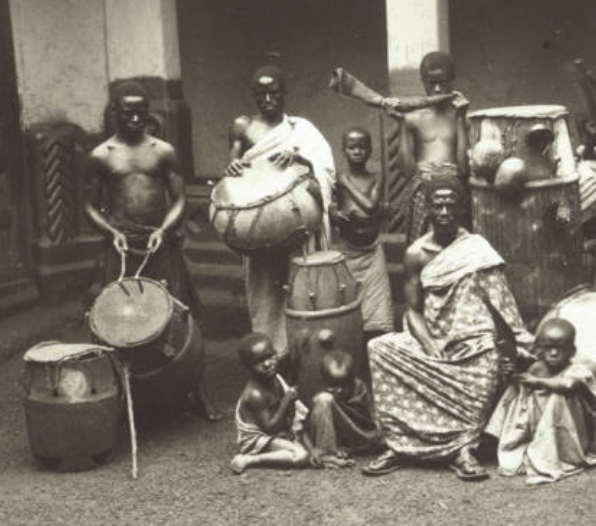
Breasted Mother Drum (Asante, Ghana)
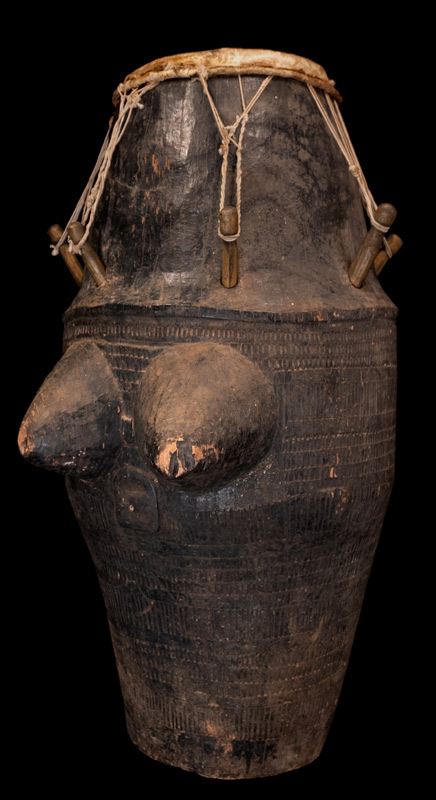
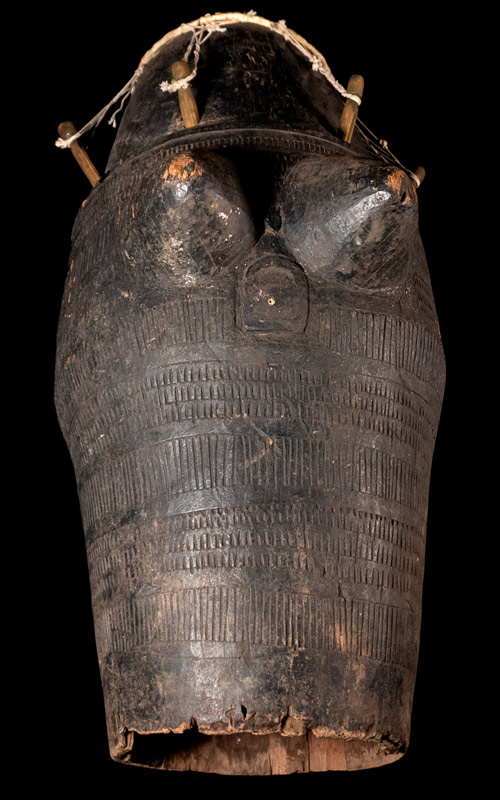
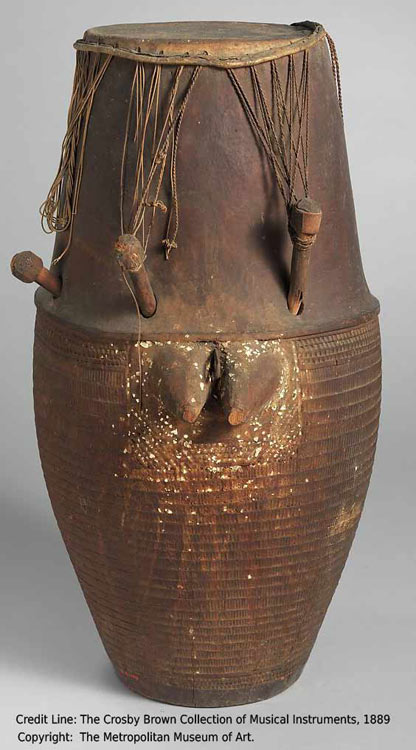
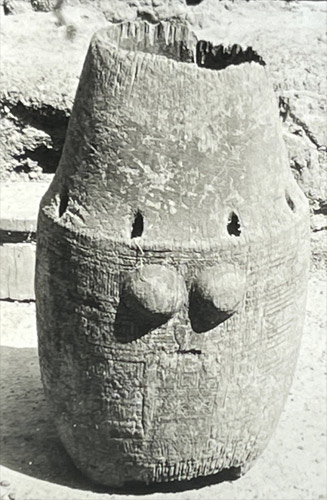
The present example is known as a "mother" drum. The sculpted breasts, first documented in the nineteenth century, identify the instrument as the leading drum of the ensemble. Such visual symbolism reflects the importance of motherhood within Akan society and emphasizes the drum's role as the central and coordinating instrument during musical performance.
The characteristic vessel-shaped body is decorated with finely incised geometric patterns, while the projecting breasts transform the drum into an anthropomorphic representation. Similar examples are preserved in several museum collections, including the Metropolitan Museum of Art.
Asante drumming is based on complex rhythmic structures in which each instrument fulfills a specific musical function. Rather than serving as a simple accompaniment, drums participate in a highly organized musical language that communicates social relationships, ceremonial order, and collective identity.
Source
"The breasts, first documented in the nineteenth century, indicate the drum's role as 'mother' of the ensemble."
Rattray, Robert Sutherland: Religion and Art in Ashanti. Oxford University Press, 1927.
Anku, William:
Drumming among the Akan and Anlo Ewe of Ghana: An Introduction. African Music 8(3), 2009.
Chernoff, John Miller:
African Rhythm and African Sensibility: Aesthetics and Social Action in African Musical Idioms. Chicago University Press, 1979.
Koetting, James:
An Analytical Study of Ashanti Kete Drumming. 1970.
Locke, David:
Drum Gahu: An Introduction to African Rhythm. 1998.
Nketia, J. H. Kwabena:
Drumming in Akan Communities of Ghana. 1963.
Rattray, Robert Sutherland:
Religion and Art in Ashanti. Oxford University Press, 1927.