agba ogboni drum yoruba nigeria
Àgbá Ogboni Drum (Yoruba, Nigeria)
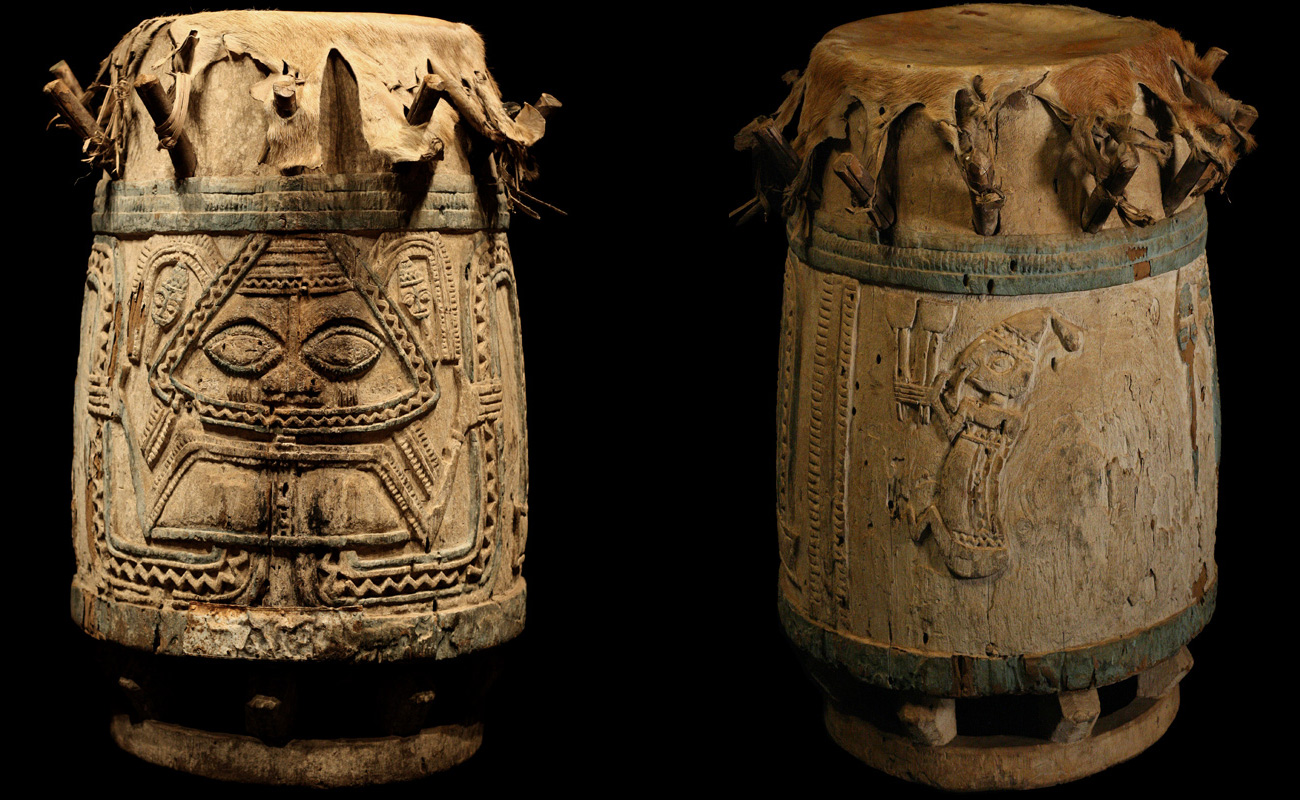
The Àgbá drum ensemble is the principal ceremonial drum of the Ògbóni (Ogboni), one of the oldest and most influential religious institutions of the Yoruba. Throughout precolonial Yorubaland, the Ògbóni exercised important judicial, political, and spiritual authority while serving as custodians of customary law, ancestral traditions, and the veneration of the earth deity. Within this context, the Àgbá drum was far more than a musical instrument; it functioned as a sacred emblem of ritual authority and an audible expression of the society's religious identity.
Like many Yoruba ritual instruments, the Àgbá drum occupies a highly specialized ceremonial role. Unlike drums intended for public entertainment or secular festivities, it is performed exclusively within the religious sphere of the Ògbóni. Historical accounts describe the drums being sounded in the early morning to announce meetings of the society, traditionally convened every seventeenth day. Their rhythms marked the beginning of sacred assemblies, while the instruments themselves were regarded as ritual objects possessing profound spiritual significance.
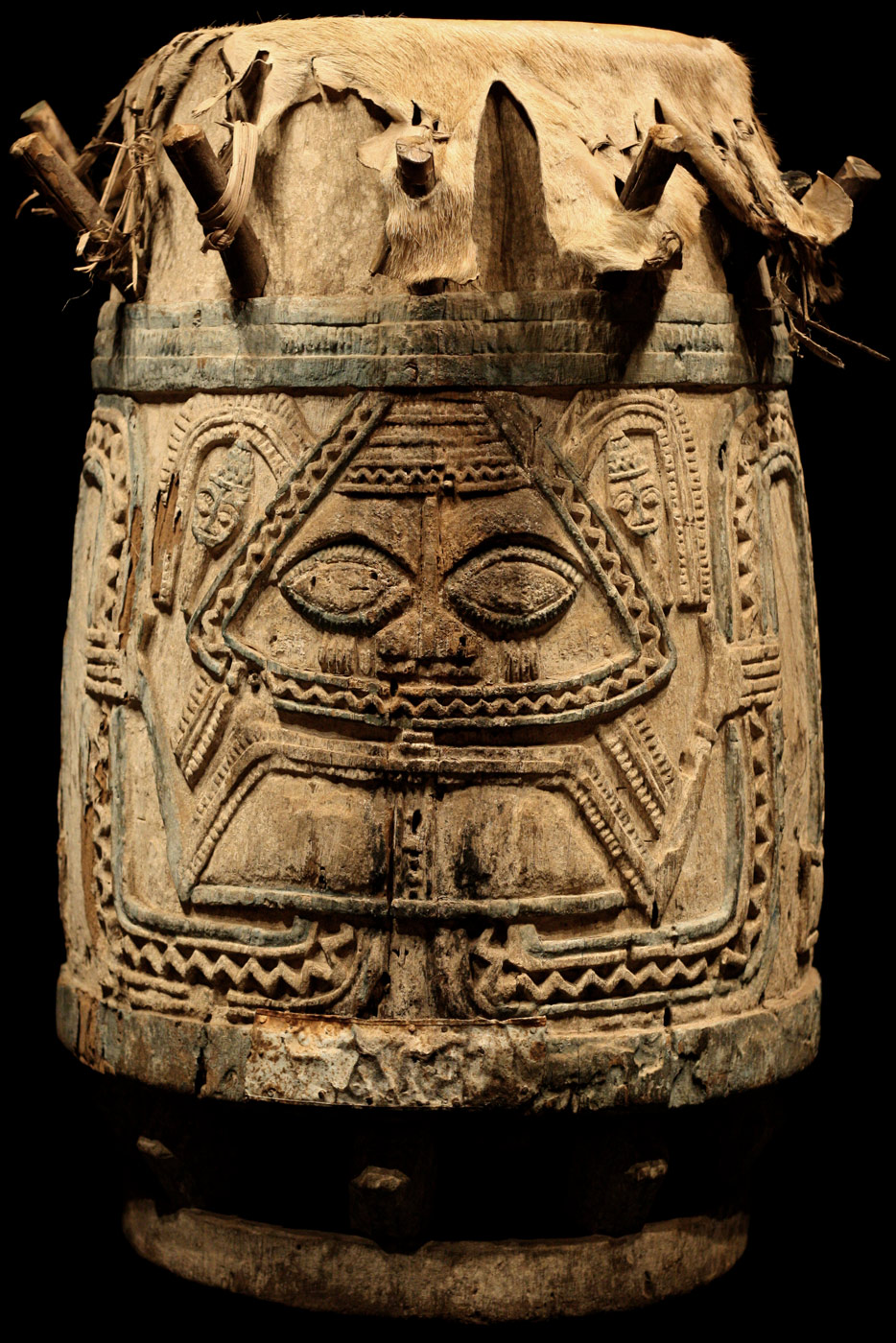
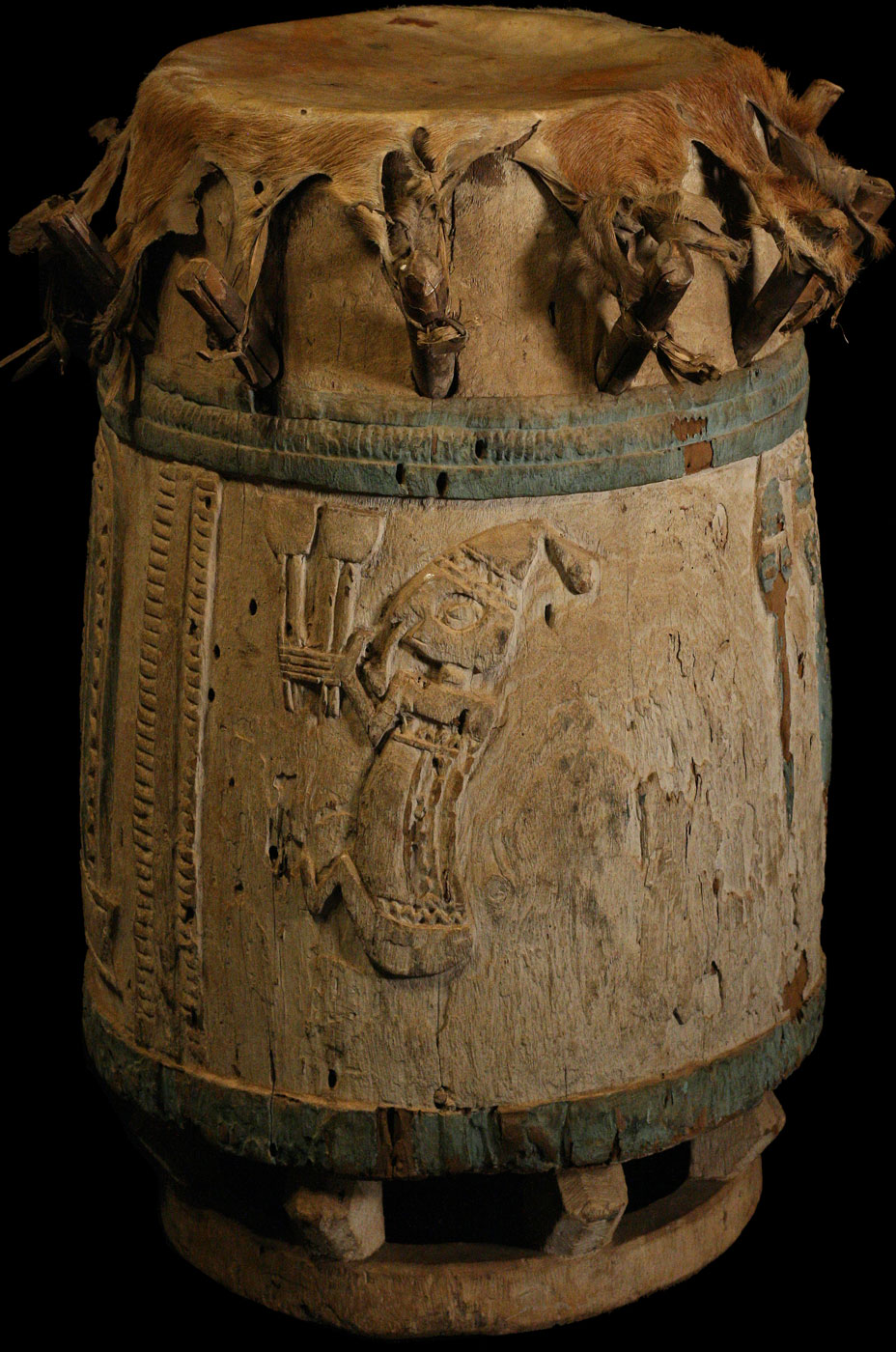
The Àgbá ensemble normally consists of three large upright single-headed membranophones carved from hollowed tree trunks and covered with goatskin. Organologically they belong to the same family as the Ìgbìn and Ìpèsè drums, yet they are distinguished by their considerably larger dimensions, heavier construction, and powerful resonance. Their deep, sonorous sound was particularly suited to ceremonial performances conducted in open spaces and before large gatherings, reinforcing both the prestige of the Ògbóni and the solemnity of its rituals.
Beyond their musical function, Àgbá drums embody important aspects of Yoruba religious thought. Within Yoruba cosmology, sound serves as a medium through which communication is established between the visible world, the ancestors, and the oriṣa. Consequently, the performance of the Àgbá ensemble formed an essential component of ritual practice, expressing communal cohesion, spiritual authority, and continuity with ancestral tradition. As with other sacred Yoruba drum traditions, the instrument itself was regarded as a living repository of religious knowledge rather than merely an object used to produce rhythm.
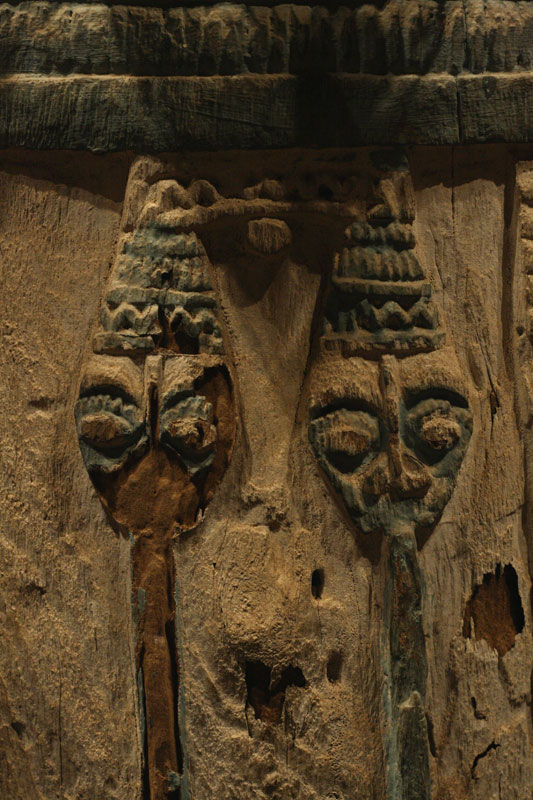
The ceremonial importance of Ògbóni drums is further reflected in their sculptural decoration. Several historic examples, particularly those associated with Ilé-Ifẹ̀, display elaborate anthropomorphic carvings depicting a human head with outstretched arms supporting a loop emerging from the drum body. According to Yoruba iconographic interpretation, this imagery represents the earth deity, whose central role within Ògbóni belief underscores the close relationship between ritual authority, ancestral veneration, and the sacred symbolism embodied by the drum. These sculptural elements demonstrate the intimate union of music, religion, and visual art that characterizes Yoruba ceremonial culture.
"Àgbá is the drum ensemble used in the cult of Ògbóni, a secret society that wielded strong political, judicial, and religious powers among the Yorùbá in the precolonial era, but now functions as a social and religious group. Like the ìgbìn and ìpèsè, each of the three-drum ensemble of àgbá is upright open-ended log drum with single goatskin/leather head. But unlike the ìgbìn and/or ìpèsè that are usually of moderate size, àgbá drums are generally large and heavy."
Oláwọlé Fámúlẹ̀, Èdè Àyàn: The Language of Àyàn in Yorùbá Art and Ritual of Egúngún. University of Wisconsin–Superior / University of Florida.
"Much Yoruba drumming is associated with the worship of deities, and certain types of drums are found only in ritual contexts. (...) To the Ogboni, their drums are musical instruments to be beaten in the early morning to announce cult meetings which take place every seventeenth day. At the same time they are sacred objects."
J. R. O. Ojo, Ogboni Drums. African Arts, Vol. 6, No. 3, 1973.
"The principal decoration on the largest of the Ife drums consists of a head and arms holding both ends of a loop which originates where the body would normally be, which curves towards the head. The head and its associated motifs apparently represent the earth deity..."
J. R. O. Ojo, Ogboni Drums. African Arts, Vol. 6, No. 3, 1973.
Bibliography:
Biobaku, Saburi. Ogboni, the Egba Senate, in Proceedings of the 3rd International West African Conference, 1956.
Dennett, R. E. Nigerian Studies, or the religious and political system of the Yorubas, 1910.
Ogboni and other secret societies in Nigeria, African Society, 16, 1916.
Egharevba, J. Benin Law and Custom, Port 1946.
Eliade, M. Patterns in Comparative Religion, 1958.
Ellis, Alfred Burdon, The Yoruba Speaking Peoples, 1894.
Farrow, S. S. Faith, Fancies and Fetish, or Yoruba Paganism, 1926.
Harrison, J. E. Ancient Art and Ritual, 1913.
Meek, C. K. Tribal Studies in Northern Nigeria, 1931.
Morton-Williams, P. An outline of the cosmology and cult organisation of the Oyo Yoruba, Africa, 34, 1964.
Nadel, S. F. Witchcraft and Anti-witchcraft in Nupe so- Ogunbowale, P. O. Awon irunmole ile Yoruba, 1962.
Ojo JRO 1973. Ogboni Drums: African Arts, 6(3): 50-. 53. Prince R 1969.
Parrinder, G. African Mythology, 1967.
Talbot, P. A. The peoples of Southern Nigeria, 4 vols. 1926.
Williams, D. The iconology of the Yoruba edan Oghoni, Africa, 34, 1964.
Beier, Ulli : Three Igbin drums from Igbomina. 1963
Beier, Ulli : Obatala Festival. In: Nigeria Bd.52 1956
Dagan , Esther A. : Drums - The Heartbeat of Africa edited by Galerie Amrad 1993
De Silva,Tamara : Symbols and Ritual: The socio-religous role of the igbin drum family.
King, Anthony : Yoruba Sacred Music from Ekiti. Ibadan 1961
Kubik, Gerhard : Musikgeschichte in Bildern - Westafrika. Leipzig 1989
Laoye I. Timi von Ede : Yoruba Drums. 1959
Meyer, Andreas : Afrikanische Trommeln – West- und Zentralafrika. Staatliche Museen Preußischer Kulturbesitz, Berlin 1997
Meyer, Andreas : African Drums in the Berliner Museum für Völkerkunde. In: Dagen, Esther A.(Hrsg.): Drums. The Heartbeat of Africa. Galerie Amrad 1993
Ortiz, Fernando: Los instrumentos de la musica afrocubana. Habana 1952 V. Volumes.
Thieme, Darius : A Descriptive Catalogue of Yoruba Musical Instruments. Diss. Washington D.C. 1969
Wieschhoff, Heinz : Die afrikanischen Trommeln und ihre außerafrikanischen Beziehungen. Stuttgart 1933
Willet, Frank : A Contribution to the History of Musical Instruments among the Yoruba. 1977