Bakongo Drum / Democratic Republic of the Congo
Bakongo Drum / Democratic Republic of the Congo
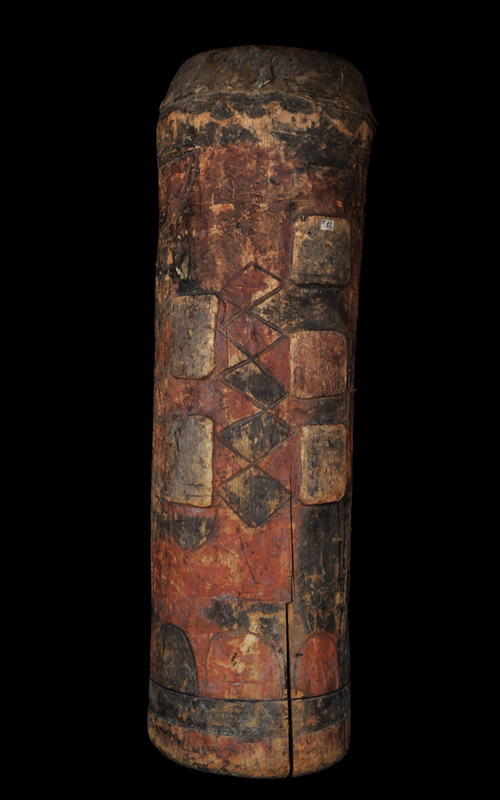
Large cylindrical drums occupied an important position within the political and ceremonial life of the former Kingdom of Kongo. Their function extended beyond musical performance and included the communication of social status, the accompaniment of public ceremonies, and the reinforcement of political authority. Historical sources indicate that such instruments were particularly associated with royalty and funerary rituals.
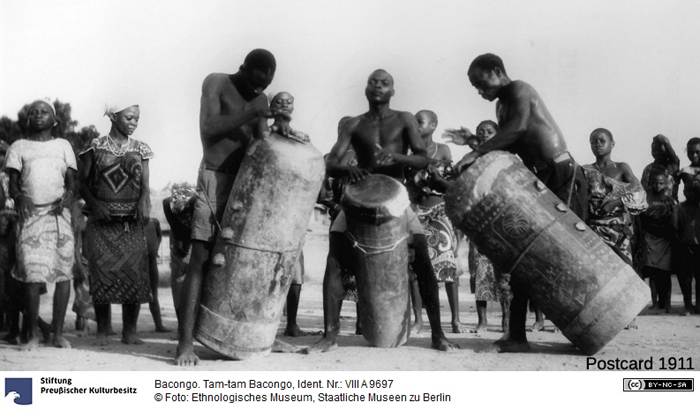
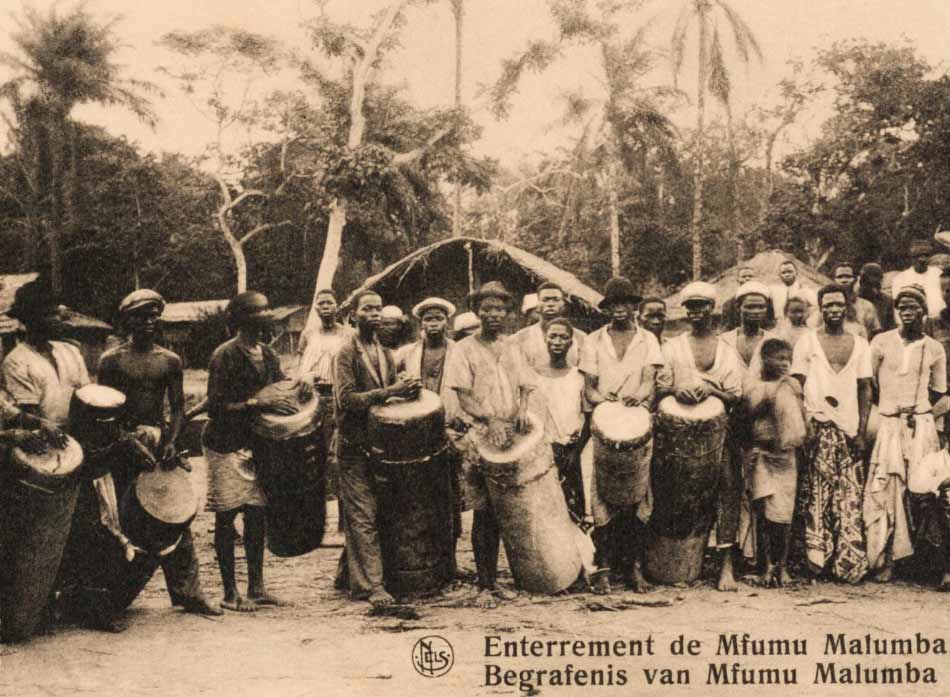
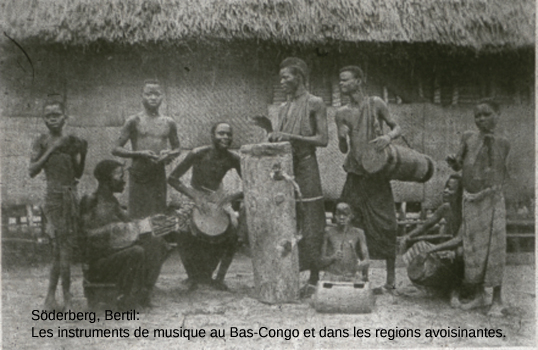
The present example belongs to this tradition. Comparable drums documented in historical photographs were performed during public gatherings, funeral ceremonies, and official occasions. Ethnographic studies from the Congo emphasize that these instruments served both ceremonial and representative purposes and were used to honor rulers, important individuals, and the deceased.
From an organological perspective, the instrument is a large cylindrical membranophone carved from a hollowed tree trunk and covered with a single animal-skin membrane. The painted geometric decoration is relatively simple and consists primarily of diamond-shaped and rectangular motifs arranged along the vertical axis of the drum. Such ornamentation is characteristic of many Central African instruments and should be understood primarily as a functional decorative element rather than as an elaborate sculptural program.
The importance of the Bakongo drum therefore lies less in its artistic refinement than in its historical and cultural context. It represents a musical tradition in which rhythm accompanied political authority, social ceremony, and ancestor veneration. Within museum collections, such instruments provide valuable evidence of the close relationship between music, ritual, and social organization in Central Africa.
"The drum was played to honor royalty and the dead. Nowadays it can be heard on other occasions, mainly during festivals or the visit of a notable person."
Söderberg, Bertil: Les instruments de musique au Bas-Congo et dans les régions avoisinantes. Stockholm, 1956.
Boone, Olga: Les tambours du Congo Belge et du Ruanda-Urundi. 2 Vol. 1951.
Chauvet, Stephen: Musique Nègre. 1929.
Gansemans, Jos: Les instruments de musique Luba. 1980.
Laurenty, J. S.: Les membranophones des Luba-Shankadi. 1972.
Maes, Joseph: Sculpture décorative ou symbolique des instruments de musique du Congo Belge. 1937.
Söderberg, Bertil: Les instruments de musique au Bas-Congo et dans les régions avoisinantes. Stockholm, 1956.
Thompson, Robert Farris: The Four Moments of the Sun: Kongo Art in Two Worlds. 1981.
Wieschhoff, Heinz: Die afrikanischen Trommeln und ihre außerafrikanischen Beziehungen. Stuttgart, 1933.