Luba-Balunda-Kuba Area Drum Congo
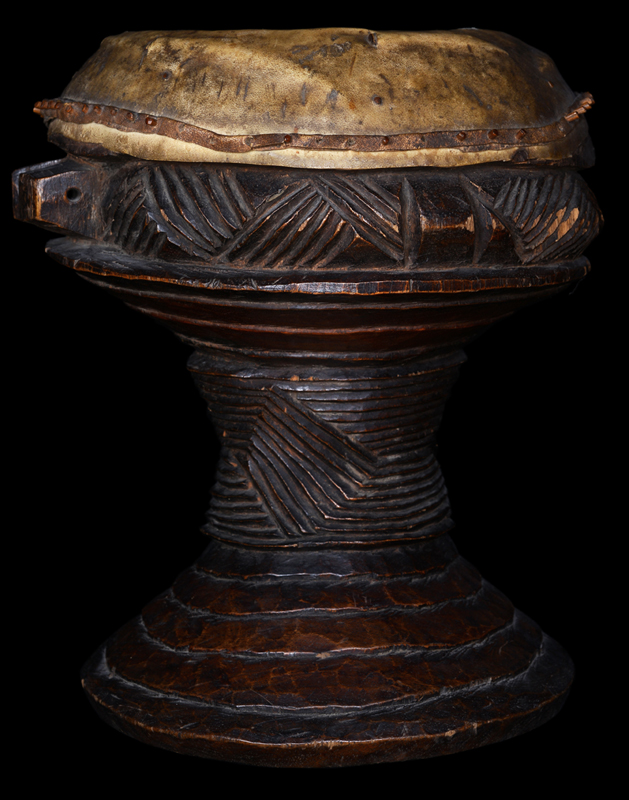
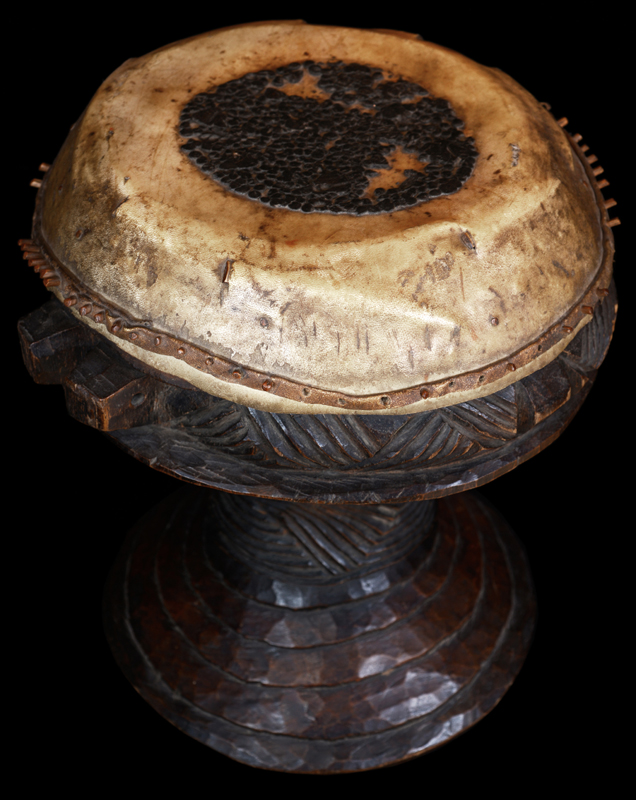
Luba-Balunda-Kuba Area Drum (Democratic Republic of the Congo)
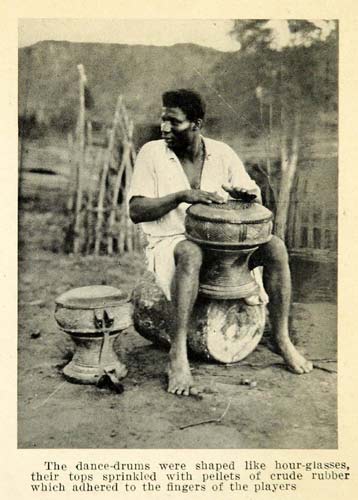
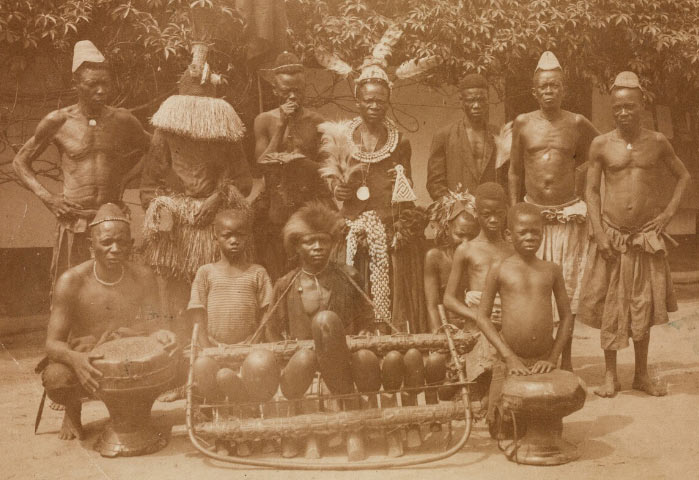
The present example originates from the cultural sphere of the Baluba and Balunda peoples of the southern Congo region. Historical sources indicate that similar drums were performed during investiture ceremonies and funerals of rulers and members of the court. In this context, music fulfilled both a ceremonial and a representative function.
From an organological perspective, the instrument is a single-headed membranophone carved from a solid piece of wood. The drum body is characterized by its distinctive pedestal-shaped form and by the geometric carving that decorates both the resonator and the supporting base. Such decorative patterns are frequently encountered in the artistic traditions of the Congo region and demonstrate the close relationship between musical instruments and woodcarving.
Ethnomusicological research has repeatedly emphasized the importance of artistic production among the Baluba. Wood served as the primary material for sculpture, masks, furniture, ceremonial objects, and musical instruments. Drums, xylophones, and slit gongs formed part of a broader artistic tradition in which music, craftsmanship, and social life were closely interconnected.
"From the artistic point of view the Baluba, especially those from Kabongo, have developed artistic skills to a high degree. Their artists excel in the practice of the plastic arts. Wood and clay are the basic material. They fashion statuettes (Nkinsi) and big masks (Kifwebe), headrests (Musamo) and arrow holders. They use different musical instruments that are made from wood: drums (Ngoma), xylophones (Mandimba), wood gongs (Kyondo). These instruments harmonise the melodies for social entertainment."
Gansemans, Jos - Bantje, Han: La musique et son rôle dans la vie sociale et rituelle Luba. Tervuren, Musée royal de l'Afrique centrale, 1978, pp. 59–68.
Boone, Olga: Les tambours du Congo Belge et du Ruanda-Urundi. 2 Vol. 1951.
Brincard, M. T.: Sounding Forms – African Musical Instruments. 1989.
Chauvet, Stephen: Musique Nègre. 1929.
Dagan, Esther A.: Drums: The Heartbeat of Africa. Galerie Amrad, 1993.
Gansemans, Jos: Muziek van de Lunda uit Zaire. 1974.
Gansemans, Jos - Bantje, Han: La musique et son rôle dans la vie sociale et rituelle Luba. Tervuren, 1978.
Gansemans, Jos: Les instruments de musique Luba. 1980.
Laurenty, J. S.: Les membranophones des Luba-Shankadi. 1972.
Maes, Joseph: Sculpture décorative ou symbolique des instruments de musique du Congo Belge. 1937.
Meyer, Andreas: Afrikanische Trommeln – West- und Zentralafrika. Berlin, 1997.
Söderberg, Bertil: Les instruments de musique au Bas-Congo et dans les régions avoisinantes. Stockholm, 1956.
Thompson, Robert Farris: The Four Moments of the Sun: Kongo Art in Two Worlds. 1981.
Wieschhoff, Heinz: Die afrikanischen Trommeln und ihre außerafrikanischen Beziehungen. Stuttgart, 1933.