Africa
bamum drum cameroon
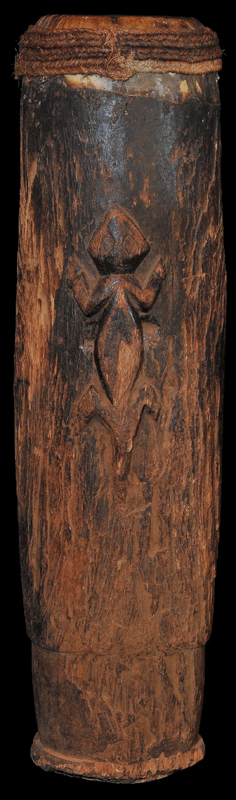
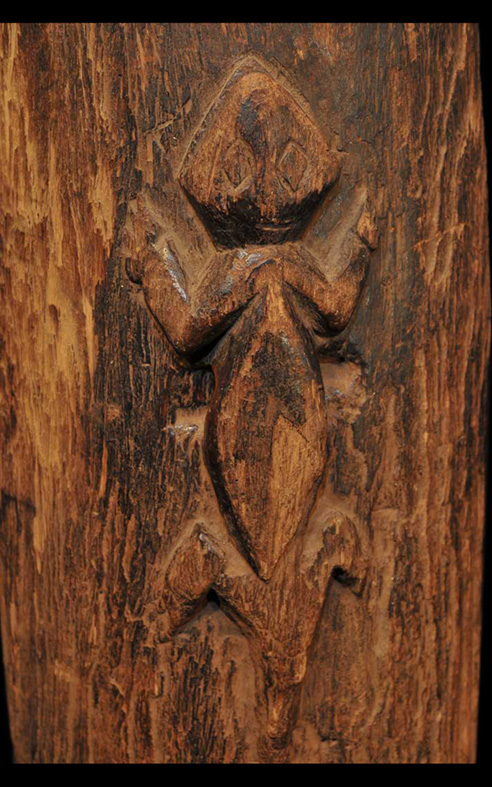
Bamum Drum (Cameroon)
The Bamum Kingdom of western Cameroon developed one of the most influential royal courts in the Grassfields region, where music, political authority, and ceremonial life formed an inseparable cultural tradition. Among the most important instruments of this court culture were the richly carved ceremonial drums, whose impressive forms and elaborate ornamentation reflected both artistic excellence and social prestige.
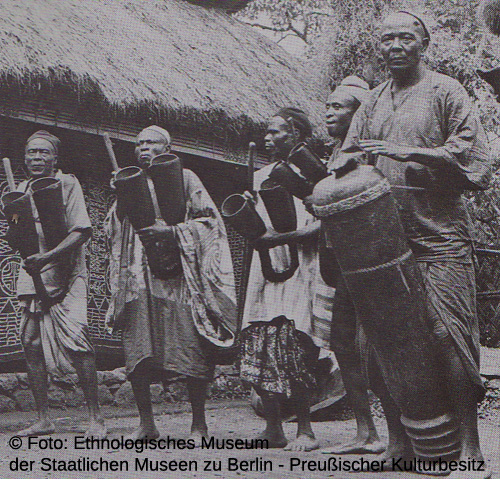
Bamum ceremonial drums were primarily performed during funerary rites, memorial ceremonies, and rituals associated with ancestor veneration. Their powerful sound accompanied important public events and reinforced the authority of the palace and traditional institutions. Historically, some of these drums were also played during annual ceremonial festivals, although many of these celebrations have disappeared or survive today only among a limited number of communities.
The carved drum bodies were produced in goblet, barrel, or cylindrical forms and were covered with animal hide secured by rows of wooden pegs. Like many tension-laced drums found elsewhere in Africa, Bamum ceremonial drums were traditionally played with the hands. Their sculptural quality demonstrates the exceptional woodworking traditions of the Grassfields, where musical instruments were often regarded as important works of art as well as functional ceremonial objects.
Particularly significant are drums decorated with anthropomorphic or zoomorphic carvings. Such instruments were not regarded as private possessions but belonged collectively to the royal palace, the community, or important secret societies. Their ownership reflected social and political structures rather than individual status, emphasizing their role as ceremonial objects representing collective identity, ancestral authority, and royal power.
"The ornamented ceremonial drums of the grassland area have bodies in the shape of goblets, barrels or cylinders. The skins are secured to the shells with nails. (...) The carved drums are always played with the hands. They are used at ritual ceremonies, chiefly at burials and memorial celebrations. Drums carved with anthropomorphic or zoomorphic figures always belong to the whole community; they are never the property of individuals."
Andreas Meyer, Afrikanische Trommeln – West- und Zentralafrika. Berlin, 1997, p. 242.
"Mit Tierfiguren beschnitzte Trommeln befanden sich nicht im Besitz von Privatpersonen. Sie gehörten zum Inventar des Palastes oder waren im Besitz von Geheimgesellschaften. Sie werden hauptsächlich bei Begräbnissen und im Ahnenkult verwendet. Allerdings wurden sie früher auch bei verschiedenen Jahresfesten benutzt, die heute jedoch nur noch bei sehr wenigen Bevölkerungsgruppen gefeiert werden."
After Andreas Meyer, Afrikanische Trommeln – West- und Zentralafrika. Berlin, 1997.
Literature
Ankermann, B. Die afrikanischen Musikinstrumente.
Bebey, Francis. African Music: A People's Art. New York: Lawrence Hill, 1975.
Brincard, M.T. Sounding Forms – African Musical Instruments. 1989.
Dagan, Esther A. Drums: The Heartbeat of Africa. Galerie Amrad, 1993.
Kubik, Gerhard. Musikgeschichte in Bildern: Westafrika. Leipzig, 1989.
Meyer, Andreas. Afrikanische Trommeln – West- und Zentralafrika. Berlin, 1997.
Wieschhoff, Heinz. Die afrikanischen Trommeln und ihre außerafrikanischen Beziehungen. Stuttgart, 1933.