DRUMS OF THE WORLD

bashilele drum congo
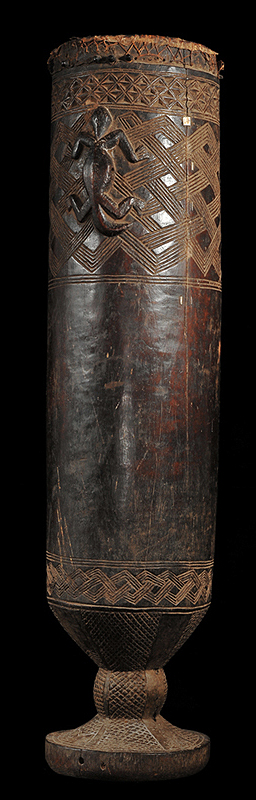


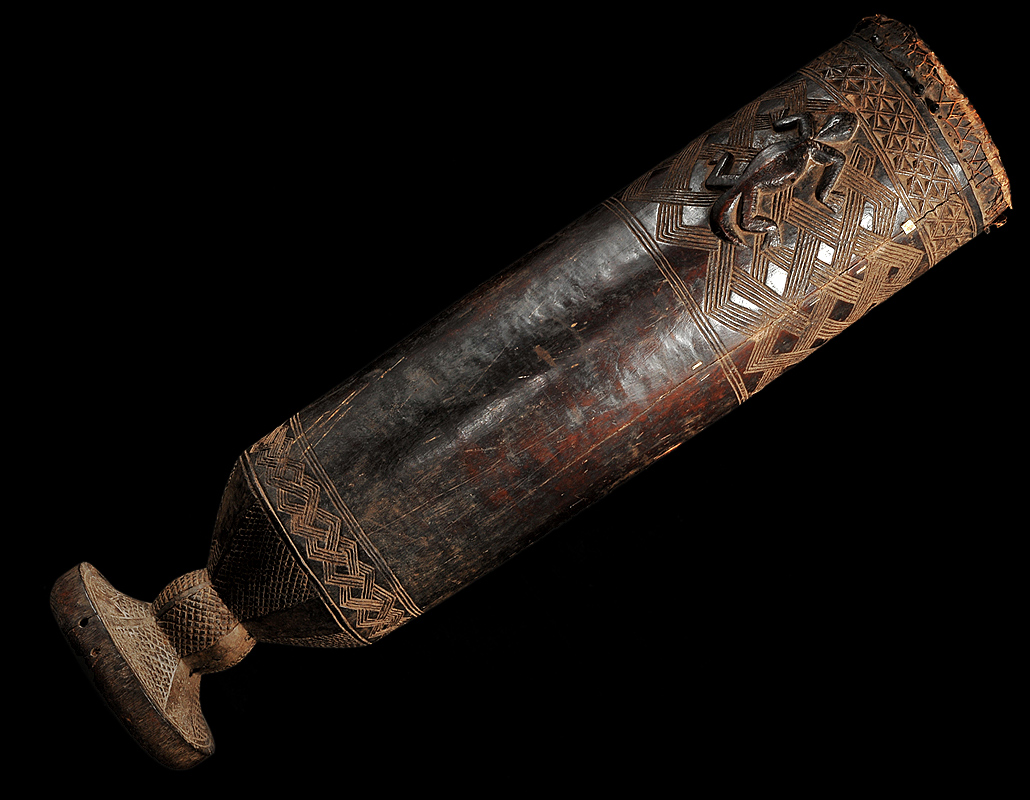
Bashilele (Lele) drum / Ngoma / Tambour
Democratic Republic of the Congo


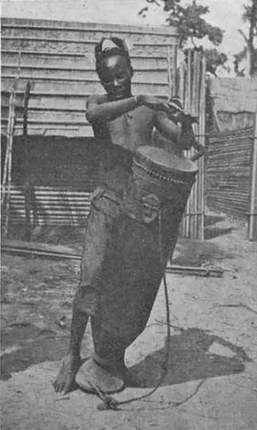
The Bashilele (Lele) are part of the Kuba cultural region of the Kasai Basin in the central Democratic Republic of the Congo. Their drums are among the finest examples of Central African woodcarving, combining refined craftsmanship with sophisticated geometric decoration. Although intended primarily as musical instruments, they also demonstrate the high artistic standards that characterize the sculptural traditions of the Kasai region.

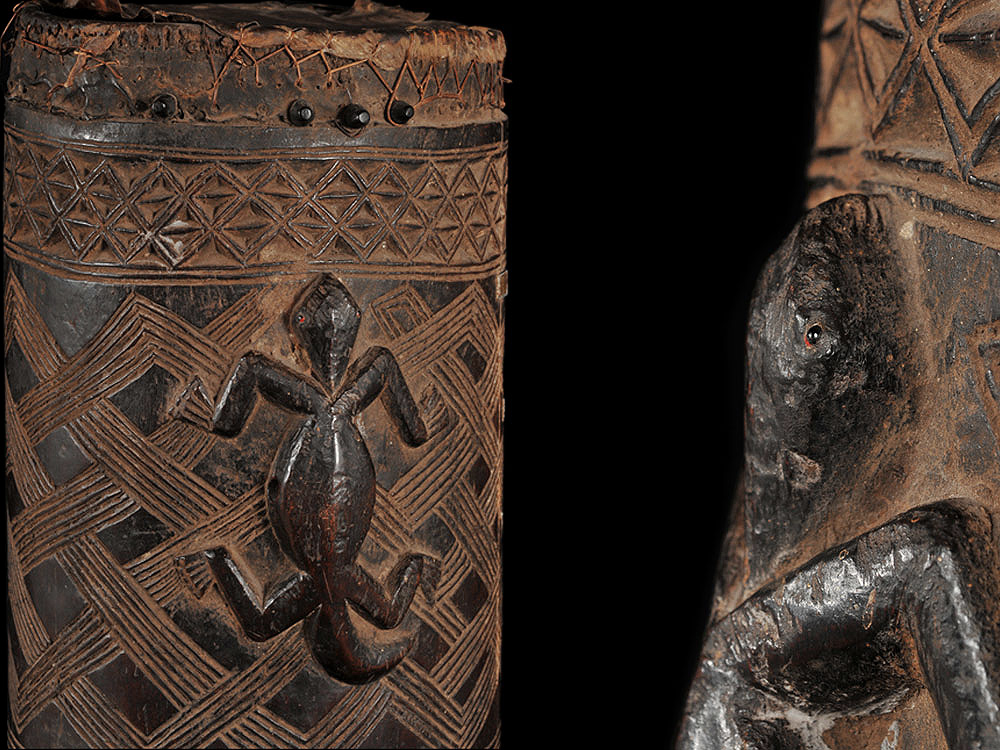
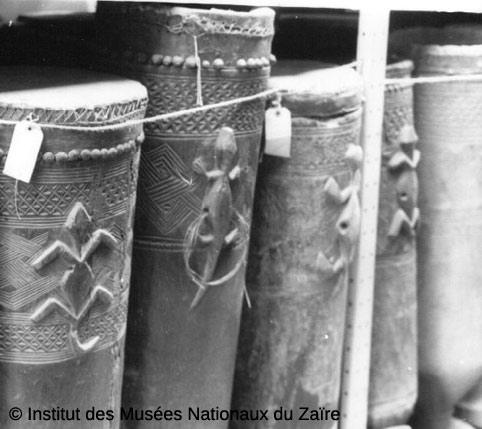
This cylindrical drum is carved from a single piece of wood and stands on a circular pedestal base. The upper body is covered with finely executed geometric ornamentation, while the front is decorated with a sculptural representation of a lizard, a recurring motif found on several Bashilele drums preserved in museum collections. Historical photographs from the Institut des Musées Nationaux du Zaïre document comparable examples, confirming that this decorative feature belongs to an established regional drum type rather than an individual variation.

As described by Andreas Meyer, the drumhead is attached by means of a characteristic construction in which a leather strip is fixed around the rim of the wooden body and the skin is subsequently stitched to this supporting band. This method distinguishes many drums from the Kuba cultural area and represents one of their most recognizable technical features.

A closely related Bashilele drum collected by Leo Frobenius during his expedition of 1905 is preserved in the Museum am Rothenbaum – Kulturen und Künste der Welt (MARKK), Hamburg (formerly Museum für Völkerkunde Hamburg), inventory no. 4721:06.
Source
"The cultures of south Zaire, east Angola and the north-west province of Zambia are mostly characterized by various influential royal dynasties. The best-known drums of the region come from the Kuba kingdom, situated between Kasai and Sankuru. Their skins are attached using a characteristic technique. A strip of leather is placed around the top of the body and nailed to it; the skin is then stitched to the leather strip."

Andreas Meyer, Afrikanische Trommeln – West- und Zentralafrika. Staatliche Museen zu Berlin, 1997, p. 243.

Literature

Boone, Olga (1951). Les tambours du Congo Belge et du Ruanda-Urundi. 2 vols. Tervuren: Annales du Musée du Congo Belge, Ethnographie 1.

Brincard, Marie-Thérèse (1989). Sounding Forms – African Musical Instruments. New York: The American Federation of Arts.

Chauvet, Stephen (1929). Musique Nègre. Paris.

Cornet, Joseph (1975). Art from Zaire. New York.

Dagan, Esther A. (1993). Drums: The Heartbeat of Africa. Galerie Amrad.

Meyer, Andreas (1997). Afrikanische Trommeln – West- und Zentralafrika. Staatliche Museen zu Berlin.

Wieschhoff, Heinz (1933). Die afrikanischen Trommeln und ihre außerafrikanischen Beziehungen. Stuttgart.

zurück