Basongye Drum (Songye, Songe) – DRC
Basongye Drum – Sculpture and Sound
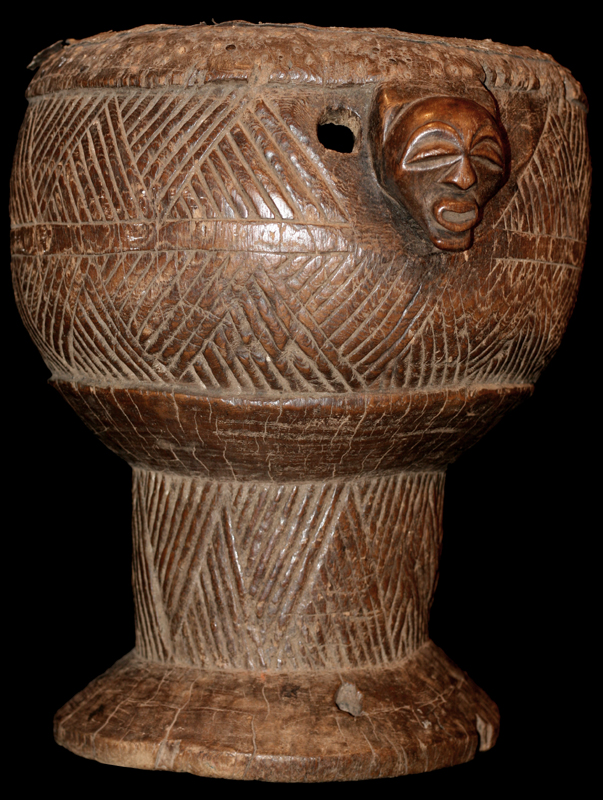
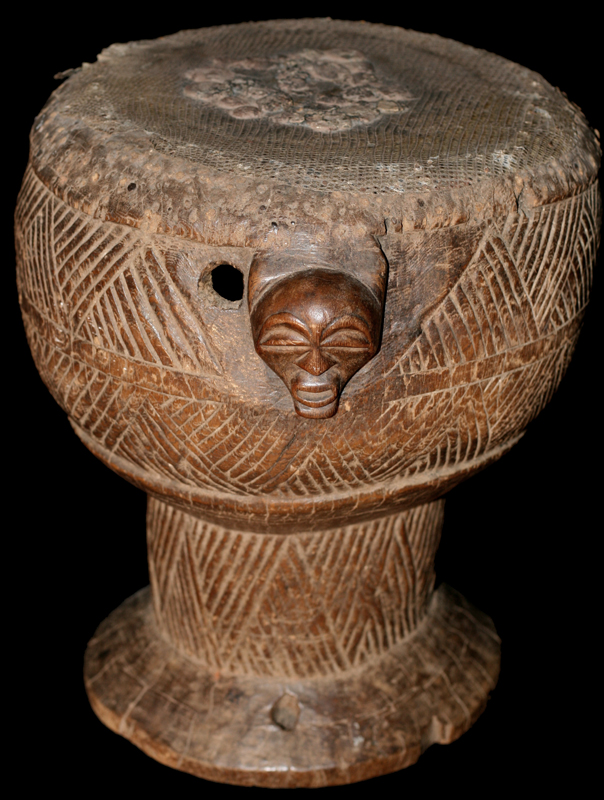
Among the artistic traditions of the Democratic Republic of the Congo, the Songye are particularly known for the powerful relationship between figural sculpture, ritual objects and the visual expression of social and spiritual power. This drum represents a remarkable intersection of these traditions. Unlike Songye drums associated with the characteristic kifwebe mask tradition, the present instrument carries a fully modelled human head whose formal language is much closer to Songye figure sculpture.
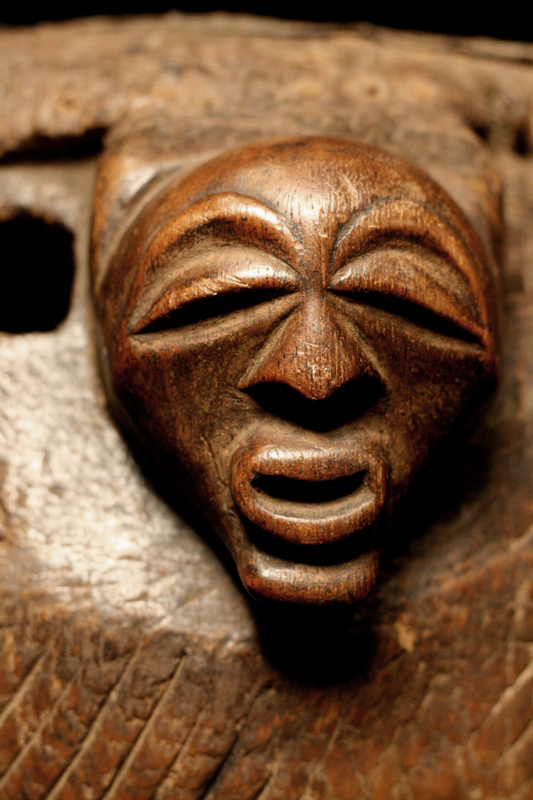
The face is not applied as an independent mask but carved directly into the wooden body of the drum. Its arched brows, lowered eyes, pronounced nose, open mouth and compact chin create a concentrated and highly expressive physiognomy. These features recall the strongly structured heads of Songye anthropomorphic sculptures, in which the human face is reduced to a powerful arrangement of clearly defined forms.
The Carved Head and Songye Sculpture
Songye sculptors frequently transformed the human figure into a system of enlarged volumes and sharply articulated facial features. Heads can dominate the body, while eyes, brows, nose and mouth are reduced to essential sculptural elements. The head on this drum follows the same principle of formal concentration.
It should not, however, automatically be identified as an nkishi or interpreted as the representation of a particular spirit or ancestor. There is no sufficient evidence for such an attribution. What can be established is a strong stylistic relationship with Songye figural sculpture. The sculptor has transferred a vocabulary normally encountered in three-dimensional sculpture onto a functional musical instrument.
Music and Social Life
The drum nevertheless remains first and foremost a musical instrument. Alan P. Merriam's study of Basongye musical life demonstrates the importance of musicians within the social organisation of the village. Professional musicians and drummers participated in funerals, celebrations, ceremonies and other major collective events. Music was therefore not an ornamental addition to social life but an essential component of it.
Merriam observed that a village without musicians was regarded as incomplete. His research is particularly important for understanding the cultural position of instruments such as this one: the artistic elaboration of the drum did not separate it from everyday musical practice, but existed within a society in which music fulfilled important social functions.
Historical Documentation
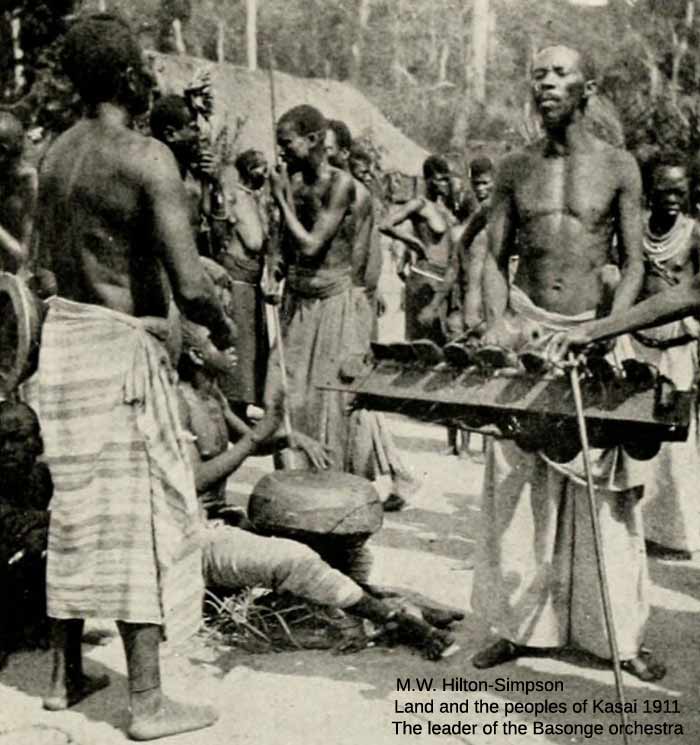
An early twentieth-century account by M. W. Hilton-Simpson provides valuable historical evidence for Basongye instrumental ensembles. During his journey through the Kasai region in 1911, he described an orchestra consisting of drums, wooden gongs, flutes and a xylophone. His observations demonstrate that organised instrumental music was already an established element of Basongye public life at the beginning of the twentieth century.
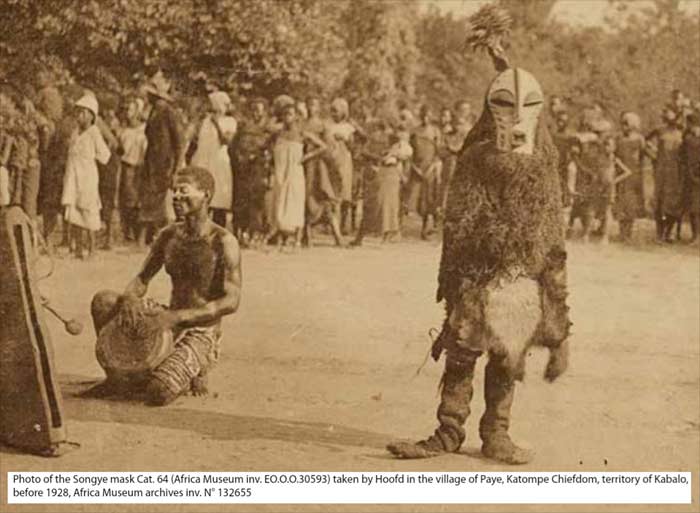
The historical photograph associated with Hilton-Simpson's work is particularly significant in this context. It shows Basongye musicians performing together with drums and other instruments, providing an early visual record of the musical environment in which objects of this type were used.
Art-Historical Significance
The importance of this drum lies in the close relationship between its function as a musical instrument and its sculptural conception. The carved head transforms the resonating body into an anthropomorphic presence without ceasing to be a functional object.
The drum therefore challenges the conventional distinction between sculpture and musical instrument. Its artistic language belongs to the same broader visual world as Songye figural sculpture, while its sound-producing function places it within the specialised musical traditions of Basongye society. The object demonstrates how sculptural ideas could be transferred across different categories of material culture and incorporated into an instrument intended for performance.
Rather than functioning merely as decoration, the carved head gives the drum an individual visual identity. It is an example of how Songye artistic practice could unite utility, sculptural invention and expressive human imagery within a single object.
"Society needs the services of musicians, for without music, normal life patterns simply cannot continue, at least as that society is currently construed by its members."
Alan P. Merriam: Basongye Musicians and Institutionalized Social Deviance. Yearbook of the International Folk Music Council, Vol. 11, 1979, pp. 1–26.
"Without musicians a village is incomplete. People want to be happy, and music-making is associated closely with happiness."
Alan P. Merriam: Basongye Musicians and Institutionalized Social Deviance. Yearbook of the International Folk Music Council, Vol. 11, 1979, pp. 1–26.
"The orchestra was composed of a number of drums, wooden gongs, flutes, and a xylophone."
M. W. Hilton-Simpson: Land and Peoples of the Kasai; Being a Narrative of a Two Years' Journey among the Cannibals of the Equatorial Forest and Other Savage Tribes of the South-Western Congo. London: Constable and Company, 1911.
Bibliography:
Alan P. Merriam: Basongye Musicians and Institutionalized Social Deviance. Yearbook of the International Folk Music Council, Vol. 11, 1979, pp. 1–26.
M. W. Hilton-Simpson: Land and Peoples of the Kasai; Being a Narrative of a Two Years' Journey among the Cannibals of the Equatorial Forest and Other Savage Tribes of the South-Western Congo. London: Constable and Company, 1911.
François Neyt: Songye – The Formidable Statuary of Central Africa.
Dunja Hersak: Songye – Masks and Figure Sculpture.
Jean Willy Mestach: Etudes Songye – Songye Studies: Form and Symbolism, an Analytical Essay, 1985.
Marc Leo Felix: Beauty and the Beasts – Kifwebe and Animal Masks of the Songye, Luba and Related Peoples. Tribal Arts S.P.R.I., 2003.
Julien Volper: Under the Influence of the Songye, 2012.
François Neyt: Kifwebe: A Century of Songye and Luba Masks, 2019.