Africa
Ganga Drum Hausa Nigeria
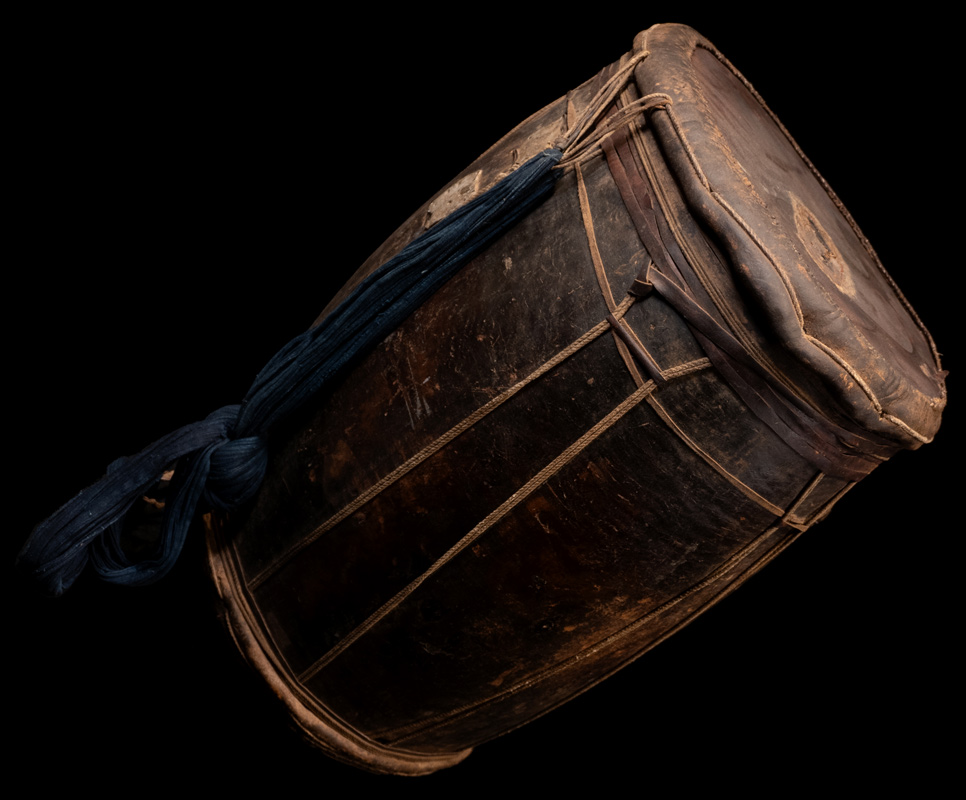
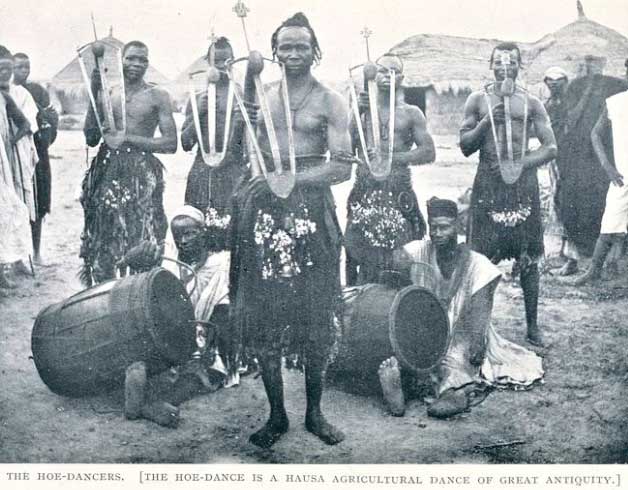
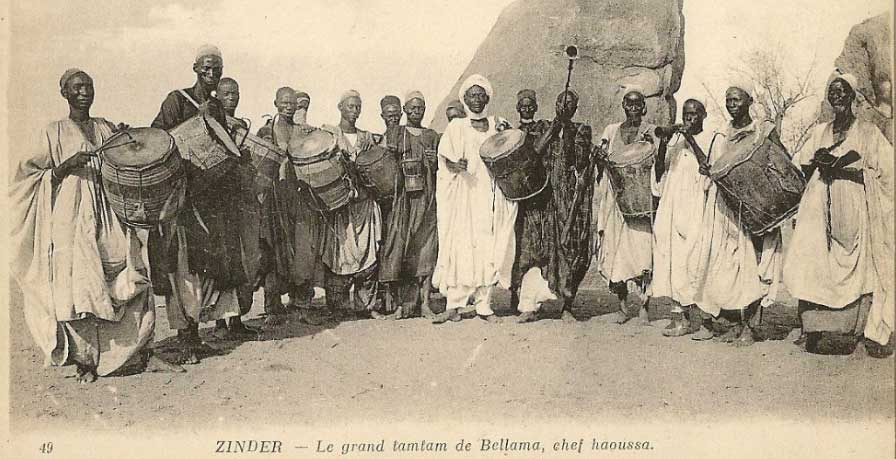
Ganga Drum (Hausa, Nigeria)
The Ganga is a large double-headed cylindrical drum associated with the musical traditions of the Hausa people of northern Nigeria and the wider Hausa-speaking region of West Africa. In Hausa terminology, ganga is a general term for a large drum, while the instrument itself belongs to an important family of double-membrane drums whose forms and functions occur across the northern Nigerian and Sahelian cultural zone. The present example, measuring 71 cm in height, is a substantial cylindrical membranophone designed to produce a powerful and penetrating sound.
Unlike the hourglass-shaped kalangu, whose tension can be manipulated during performance to produce changing pitches, the Hausa Ganga is essentially a fixed-pitch drum. Its two membranes are stretched over the opposite ends of a hollow wooden body and are connected and tensioned by cords running along the sides of the resonator. This construction gives the instrument considerable acoustic volume and makes it particularly suitable for outdoor performance and large ceremonial ensembles.
The Ganga occupies an important position in Hausa ceremonial and court music. In traditional Hausa ensembles it can be combined with the algaita, a powerful double-reed instrument, and the long metal kakaki trumpet. Such ensembles were closely associated with rulers and aristocratic courts, where music accompanied public appearances, ceremonies and praise performances.
The relationship between the Ganga and Hausa praise music is particularly significant. Court musicians and praise singers used instrumental sound to accompany performances in honour of rulers and patrons. In ensembles containing ganga, algaita and kakaki, the instruments contribute to a strongly declamatory musical style in which rhythmic and melodic gestures are closely connected with verbal expression. The Ganga provides a powerful rhythmic foundation against which the voices and wind instruments can articulate their musical statements.
The instrument also belongs to a broader sphere of Hausa popular and occupational music. The Ganga is listed among the principal traditional Hausa drums together with instruments such as the jauje, dundufa, tambari and kalangu. Its use was not therefore restricted to the royal court. Different forms of Hausa music employed drums according to the social occasion, including ceremonial events, public entertainment, praise singing and other communal activities. The historical photographs associated with this instrument illustrate the importance of large double-headed drums in northern Nigerian and Sahelian dance and ceremonial contexts.
The playing technique of the Ganga is distinctive. The instrument may be struck with a curved wooden stick, while in some performance practices the two membranes are approached differently, with the upper head struck by the stick and the lower head by the hand. This produces a contrast between the sharper attack of the stick and the deeper, more flexible sound of the hand. Regional traditions also demonstrate that Ganga-type drums can be incorporated into rhythmic structures in which repeated strokes establish a steady pulse while variations and accents interact with dance movements, vocal lines or other instruments.
Ames, David W. (1971): Glossary of Hausa Music and Its Social Contexts. Northwestern University Press, Evanston.Ames, David W. & Anthony King (1989): Glossary of Hausa Music and Its Social Contexts. Northwestern University Press.
Brandel, Rose (1960): “Africa.” In: Harvard Dictionary of Music. 2nd edition. Harvard University Press.
Dauer, Alfons Michael (1985): Tradition afrikanischer Blasorchester und Entstehung des Jazz. Beiträge zur Jazzforschung, Band 7. Akademische Verlagsanstalt, Graz.
King, Anthony (1980): “Nigerian Music.” In: The New Grove Dictionary of Music and Musicians. London.
King, Anthony & K. A. Gourlay (1984): “Algaita.” In: The New Grove Dictionary of Musical Instruments. Macmillan Press, London.
Kubik, Gerhard (1989): Musikgeschichte in Bildern – Westafrika. Leipzig.
Meyer, Andreas (1997): Afrikanische Trommeln – West- und Zentralafrika. Staatliche Museen zu Berlin – Preußischer Kulturbesitz, Berlin.
Miller, Lloyd (1990): “Music and the Muslim World.” Journal of the American Musical Instrument Society, Vol. 16.
Thieme, Darius (1969): A Descriptive Catalogue of Yoruba Musical Instruments. Dissertation, Washington D.C.
Wieschhoff, Heinz (1933): Die afrikanischen Trommeln und ihre außerafrikanischen Beziehungen. Stuttgart.