Chokwe hourglass drum (Mukupela) / Angola
Chokwe hourglass drum (Mukupela) / Angola – Democratic Republic of the Congo
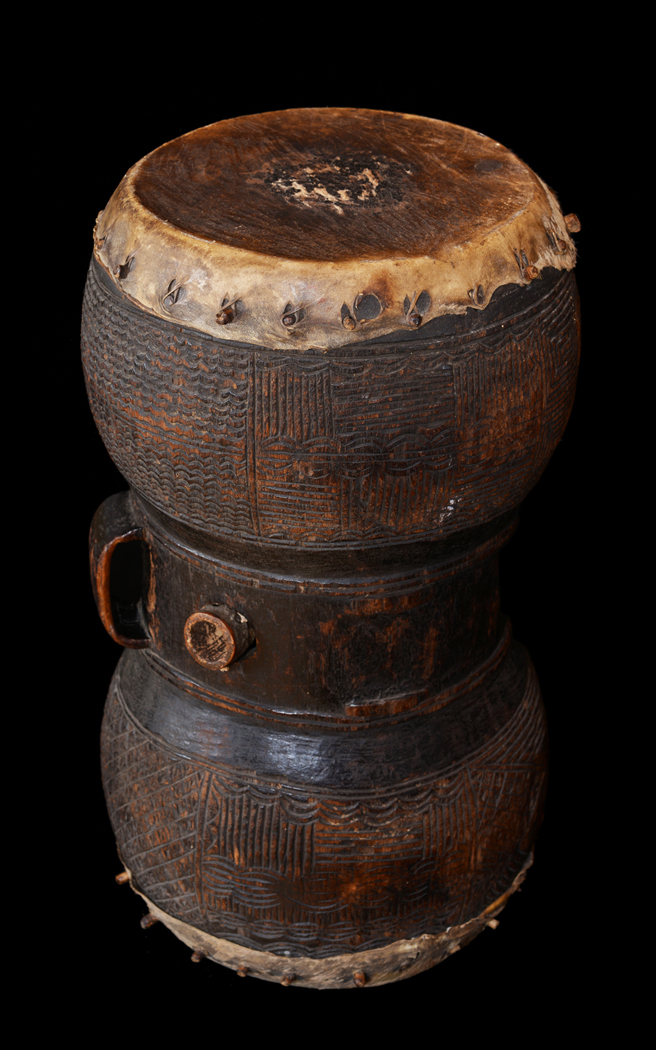
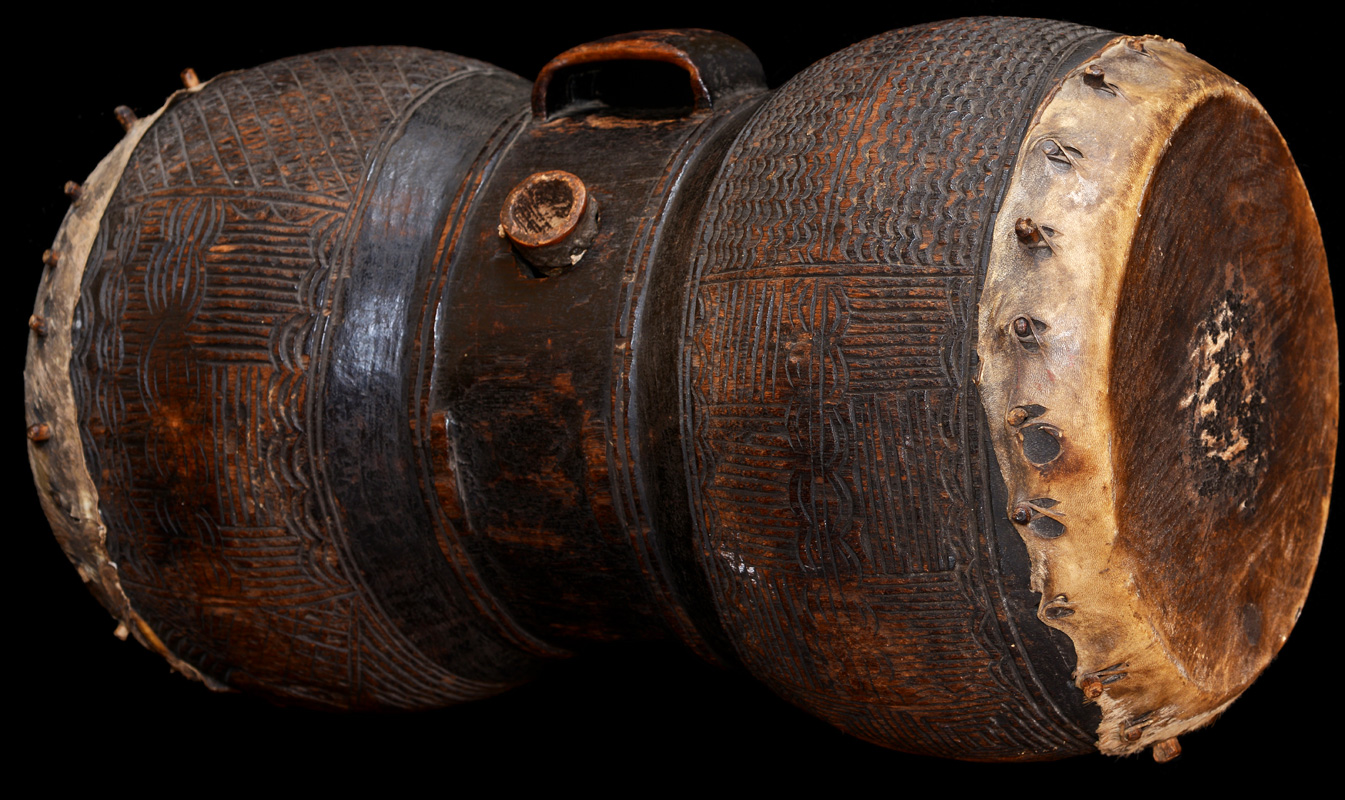
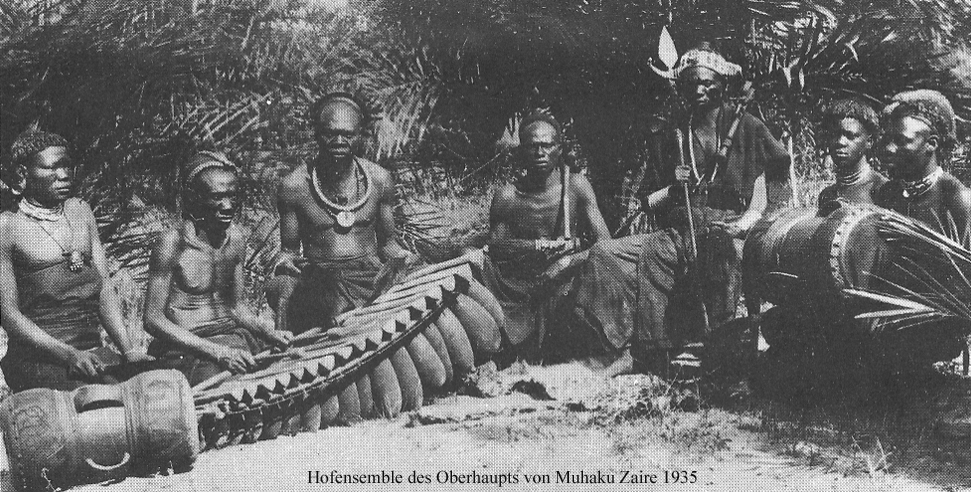
The Mukupela (plural Mikupela) is a finely carved hourglass drum of the Chokwe, whose traditional homeland extends across northeastern Angola and the adjacent regions of the Democratic Republic of the Congo. Distinguished by its elegant proportions and elaborate incised decoration, the Mukupela occupies an important place within Chokwe musical and court traditions. Historical photographs document its use in the ceremonial drum ensemble of Chokwe chiefs, where it was performed together with other drums and the double bell (Lupembe).
According to Marie-Louise Bastin, the Mukupela originally served as one of the insignia of powerful chiefs and was sounded on important occasions, including the announcement of war. In more recent times it has continued as a dance drum performed while seated. The drum is carved from a single piece of resonant hardwood and is richly ornamented with geometric engraving, while many examples display carved human faces closely related to the distinctive sculptural style of Chokwe masks and other court art.
One of the most remarkable features of the Mukupela is the resonating device inserted into the opening at the narrow waist of the drum. A slightly conical tube made from the neck of a calabash is fitted into this aperture and covered internally with the membrane of a spider's egg sac (lundandji). This membrane vibrates sympathetically when the drumheads are struck, producing a characteristic buzzing resonance that enriches the instrument's tone. Bastin describes this construction as a distinctive feature of Chokwe drum making.
The historical photograph of the court ensemble of Chief Muhaku (1935) illustrates the Mukupela in its ceremonial context, confirming its importance within Chokwe court music as both a musical instrument and an emblem of chiefly authority.
Source
"In addition to the upright drums, the Chokwe orchestra normally includes two hourglass drums called mikupela (sing. mukupela). In former times the mikupela, always well decorated with incised motifs, were the insignia of great chiefs, and were sounded in various circumstances, for example for announcing war. Nowadays it is a dance drum which is played sitting down."
Marie-Louise Bastin, Musical Instruments, Songs and Dances of the Chokwe.
"The drum has (...) a hole in the neck. The cihondo, cut from a calabash neck, is pushed into this hole. Slightly conical in shape, it goes in narrow end first, taking with it into the interior a lundandji membrane which closes the airway and vibrates in sympathy when the skins are beaten."
Marie-Louise Bastin, Musical Instruments, Songs and Dances of the Chokwe.
Literature
Bastin, Marie-Louise. Musical Instruments, Songs and Dances of the Chokwe.
Bastin, Marie-Louise. The Mwanangana Chokwe Chief and Art.
Boone, Olga (1951). Les Tambours du Congo Belge et du Ruanda-Urundi. 2 vols. Tervuren: Annales du Musée du Congo Belge, Ethnographie 1.
Kubik, Gerhard (1989). Musikgeschichte in Bildern. Leipzig.
Meyer, Andreas (1997). Afrikanische Trommeln – West- und Zentralafrika. Staatliche Museen zu Berlin.
Schmidt-Wrenger, Barbara (1975). Muziek van de Tshokwe uit Zaire.
Wieschhoff, Heinz (1933). Die afrikanischen Trommeln und ihre außerafrikanischen Beziehungen. Stuttgart.