Bukita Drum (Kuba Kingdom, Democratic Republic of the Congo)
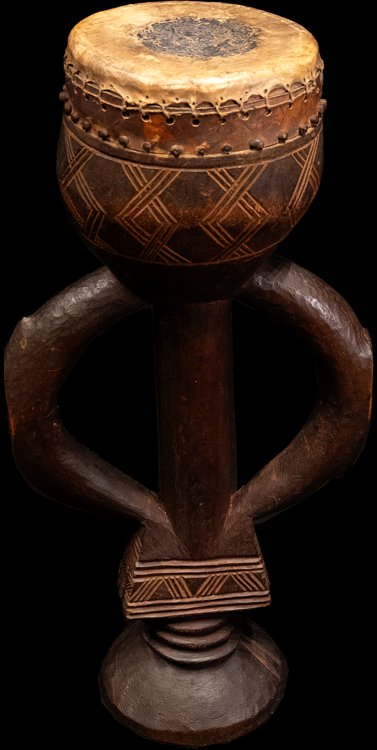
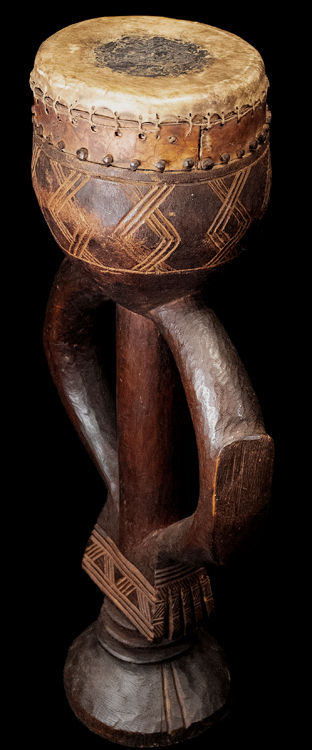
Bukita Drum (Kuba, Democratic Republic of the Congo)
The Kuba kingdom, situated in the central region of the Democratic Republic of the Congo between the Kasai and Sankuru rivers, developed one of the most sophisticated courtly artistic traditions of Central Africa. Its visual culture is characterized by highly refined woodcarving, geometric surface decoration, textiles, regalia, prestige objects, and ceremonial musical instruments. Within this cultural environment, drums could acquire meanings that extended far beyond their purely musical function and became closely associated with political authority, social rank, and ceremonial life.
The present instrument is a remarkable example of the Kuba Bukita, a highly distinctive sculptural drum whose unusual construction separates it from the more common cylindrical and hourglass-shaped drums of the region. The instrument consists of an upper resonating body carrying the membrane, a narrow central support, and a lower body forming the base. Two large, stylized human arms extend from the central section and curve outward before terminating in carefully carved hands. These anthropomorphic elements appear to support and embrace the drum body, giving the instrument an exceptionally expressive sculptural character. The complete structure has been carved from wood and combines the practical requirements of a membranophone with the highly developed visual language of Kuba prestige art.
The elaborate decoration of the drum is characteristic of the importance attached to geometric design in Kuba artistic traditions. The upper resonating body is covered with carefully incised linear patterns arranged in symmetrical bands. Intersecting diagonal lines create repeating geometric motifs that recall the visual vocabulary also found in Kuba textiles, mats, baskets, boxes, cups, and other objects of prestige. The decoration therefore does not function merely as ornament but places the instrument within a broader system of Kuba artistic expression in which pattern, symmetry, craftsmanship, and social identity are closely interconnected.
The construction of the membrane is particularly characteristic. As described by Andreas Meyer in his study of African drums, a leather strip is placed around the upper part of the wooden body and attached with nails. The animal skin is then stitched to this leather strip. This method produces a clearly visible transition between the wooden resonator and the membrane and represents a distinctive technique documented among drums of the Kuba cultural region.
The Bukita belongs to a category of drums whose function was closely connected with exceptional ceremonial occasions. According to the available documentation, drums of this type were used only rarely, including occasions such as the investiture of nobles. Their restricted use distinguishes them from drums intended for regular dance performances. In such circumstances, the instrument participated in the ceremonial representation of political and social status rather than serving simply as a rhythmic accompaniment.
The relationship between drumming and political authority was particularly important within the Kuba kingdom. Musical instruments formed part of a larger ceremonial system in which the presence of rulers and nobles was expressed through carefully regulated performances, objects, costumes, and visual symbols. A drum used during an investiture therefore contributed to the public transformation and recognition of an individual entering a position of authority. Sound, movement, craftsmanship, and political symbolism were brought together within a single ceremonial context.
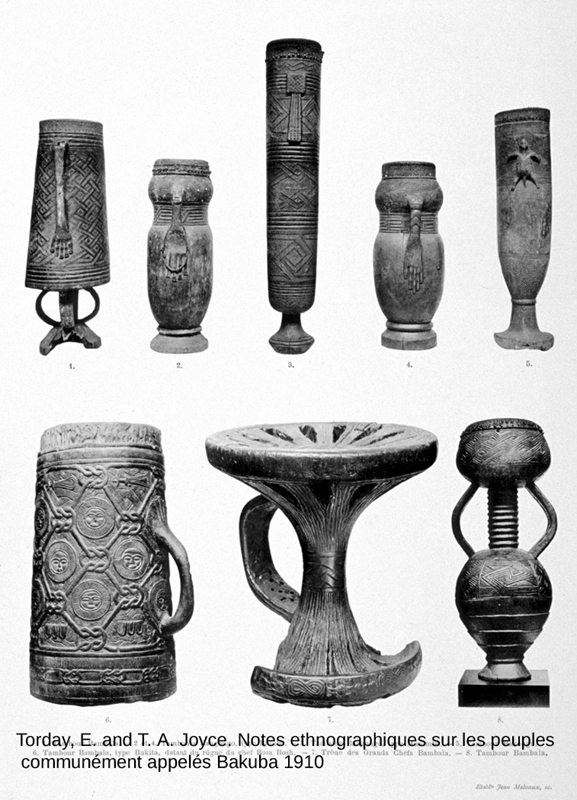
The historical documentation of Kuba drums is of particular importance for understanding the development of this tradition. Early twentieth-century publications, including the ethnographic work of Emil Torday and T. A. Joyce, recorded a remarkable variety of Kuba drums and other musical instruments. Their illustrations demonstrate that drums within the Kuba sphere could assume highly differentiated forms and could incorporate handles, sculptural elements, geometric carving, and elaborate decorative systems. Such documentation confirms the longstanding importance of drums as both musical instruments and prestige objects.
The Bukita also illustrates the close relationship between music and sculpture in Kuba culture. The instrument is not simply a container for a vibrating membrane but a carefully conceived three-dimensional work of art. Its symmetrical construction, geometric ornamentation, and monumental appearance transform it into an object capable of communicating status even when it is not being played. In this respect, the Bukita belongs to the same broader cultural environment in which stools, vessels, boxes, figures, textiles, and other objects were designed to express rank, identity, and participation in the royal and aristocratic order.
As a museum object, the Bukita therefore provides evidence of several interconnected aspects of Kuba cultural history. It documents traditional woodworking and drum-making techniques, the organization of ceremonial music, the visual language of Kuba design, and the close relationship between musical instruments and political authority. Its exceptional form demonstrates how, within the Kuba kingdom, an instrument could become simultaneously a musical object, a ceremonial object, and a work of sculpture.
“The cultures of south Zaire, east Angola and the north-west province of Zambia are mostly characterized by various influential royal dynasties. The best-known drums of the region come from the Kuba kingdom, situated between Kasai and Sankuru. Their skins are attached using a characteristic technique. A strip of leather is placed around the top of the body and nailed to it; the skin is then stitched to the leather strip.”
Excerpt from: Meyer, Andreas (1997): Afrikanische Trommeln – West- und Zentralafrika. Staatliche Museen Preußischer Kulturbesitz, Berlin, p. 243.
“Such drums were employed only in rare circumstances, such as the investiture of nobles.”
Meyer, Andreas (1997): Afrikanische Trommeln – West- und Zentralafrika. Staatliche Museen Preußischer Kulturbesitz, Berlin.
Boone, Olga (1951): Les tambours du Congo Belge et du Ruanda-Urundi. 2 vols. Tervuren: Annales du Musée du Congo Belge, Ethnographie 1.
Brincard, Marie-Thérèse (ed.) (1989): Sounding Forms – African Musical Instruments. New York.
Chauvet, Stephen (1929): Musique Nègre. Paris.
Cornet, Joseph (1975): Art from Zaire. Kinshasa.
Dagan, Esther A. (ed.) (1993): Drums: The Heartbeat of Africa. Galerie Amrad.
Meyer, Andreas (1997): Afrikanische Trommeln – West- und Zentralafrika. Staatliche Museen Preußischer Kulturbesitz, Berlin.
Torday, Emil & Joyce, T. A. (1910): Notes ethnographiques sur les peuples communément appelés Bakuba, ainsi que sur les peuplades apparentées. Brussels.
Wieschhoff, Heinz (1933): Die afrikanischen Trommeln und ihre außerafrikanischen Beziehungen. Stuttgart.