Africa
Luba Drum with Mirliton
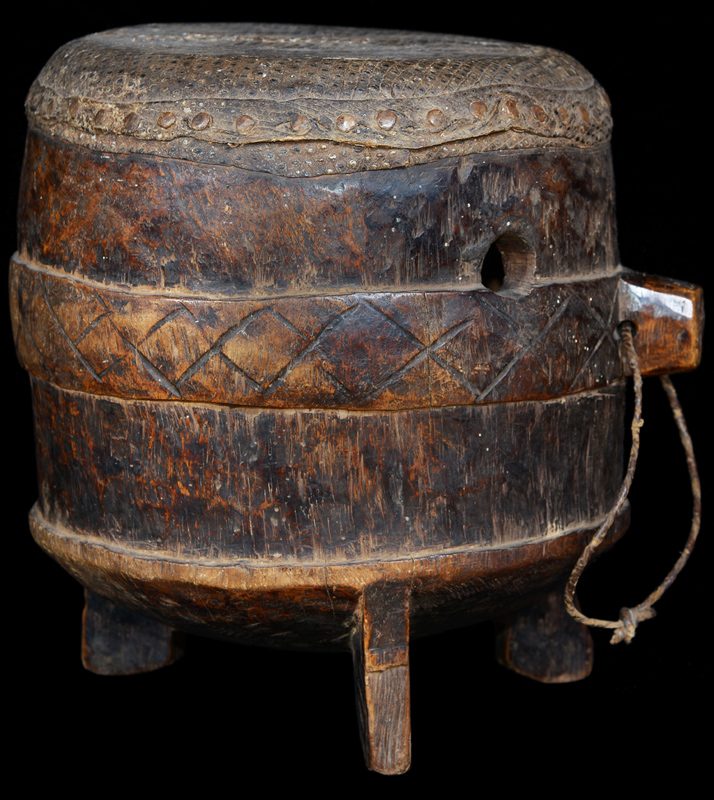
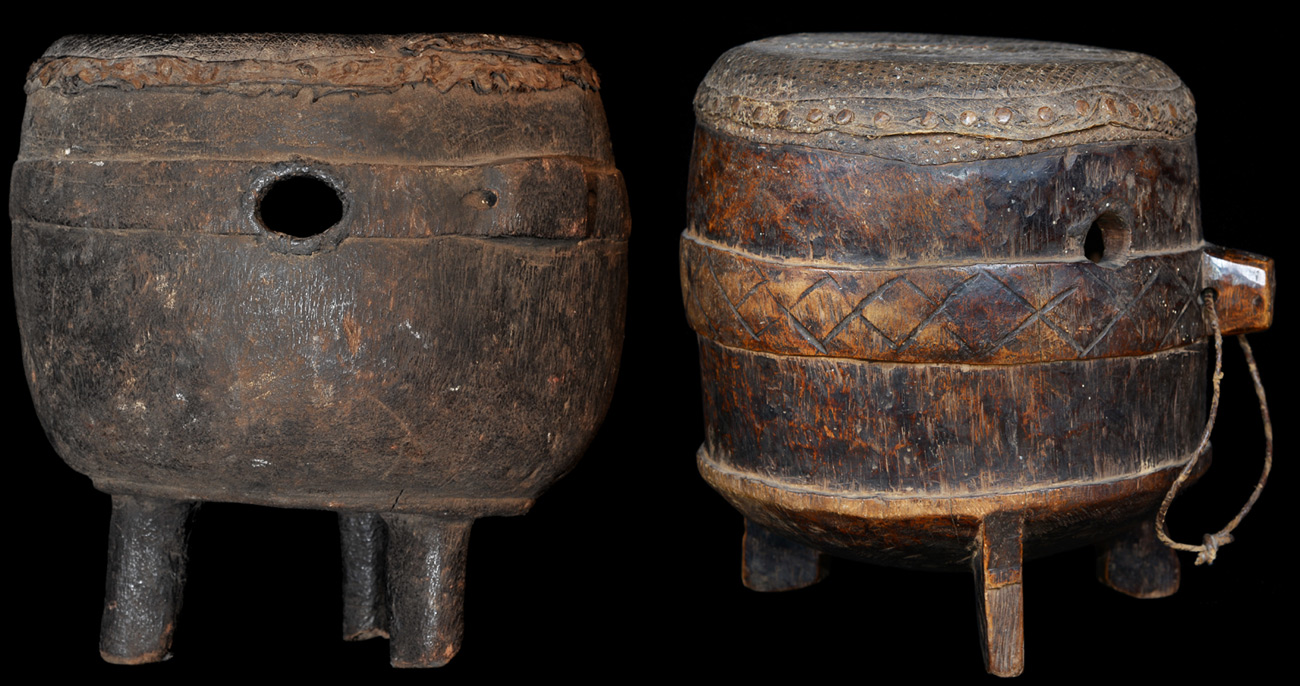
Luba Drum with Mirliton (Katanga, Democratic Republic of the Congo)
This Luba drum from the Katanga region is distinguished by the combination of a single drumhead, monitor lizard skin and a lateral mirliton hole. The approximately 40 cm high instrument rests on four short legs and has a compact, rounded body. A closely related drum shown alongside it has three legs, demonstrating that variations in the construction of this type existed within the Luba tradition.One of the most distinctive acoustic features of many Luba and Songye drums is the mirliton, a secondary vibrating membrane that transforms the sound of the instrument. Rather than producing a pure drum tone, the mirliton adds a characteristic buzzing resonance that is highly valued throughout Central Africa.
A small opening is carved into the side of the wooden drum body and fitted with a short tube, often made from the neck of a calabash. ( The calabash tube is missing ).This opening is covered with an extremely thin membrane traditionally made from the parchment-like cocoon of a spider or from another delicate natural membrane, which is sealed in place with beeswax. The membrane does not produce sound on its own but vibrates sympathetically with the air pressure created inside the drum when the main drumhead is struck.
The result is a rich, textured timbre rather than a dry percussive tone. The buzzing overtone increases the projection of the instrument and allows its sound to remain clearly audible during outdoor ceremonies, dances and large ensemble performances. In Luba musical aesthetics, this resonant quality is not regarded as an imperfection but as an essential part of the drum's voice.
"The Itumba drum was a closed drum with a mirliton fixed into its side, 20" high and with 12 1/2" membrane. The Mutumbwe drums were both weighted with paste to lower their pitch, and had similar mirlitons."
Hugh Tracey, field recording documentation, Kinkondje, 1952, International Library of African Music.
Bibliography:
Boone, Olga: Les tambours du Congo Belge et du Ruanda-Urundi. 2 vols. Tervuren: Annales du Musée du Congo Belge, Ethnographie 1, 1951.
Brincard, Marie-Thérèse (ed.): Sounding Forms – African Musical Instruments. New York, 1989.
Dagan, Esther A.: Drums: The Heartbeat of Africa. Galerie Amrad, 1993.
Meyer, Andreas: Afrikanische Trommeln – West- und Zentralafrika. Staatliche Museen Preußischer Kulturbesitz, Berlin, 1997.
Tracey, Hugh: International Library of African Music – Luba Field Recordings. Kinkondje, 1952.
Wieschhoff, Heinz: Die afrikanischen Trommeln und ihre außerafrikanischen Beziehungen. Stuttgart, 1933.
Royal Museum for Central Africa, Tervuren: Luba drums from Katanga.