Africa
dan slit drum ivory coast
Dan Slit Drum (Dan, Ivory Coast)
Among the numerous percussion instruments of the Dan of western Ivory Coast and eastern Liberia, the slit drum occupies a particularly important position. Unlike many African membranophones, the Dan slit drum is an idiophone whose sound is produced by the vibration of the wooden body itself rather than by an animal skin. In Dan society, these instruments traditionally fulfilled both practical and ceremonial functions and formed an integral part of everyday social life, agricultural activities, ritual performances, and masked entertainment.
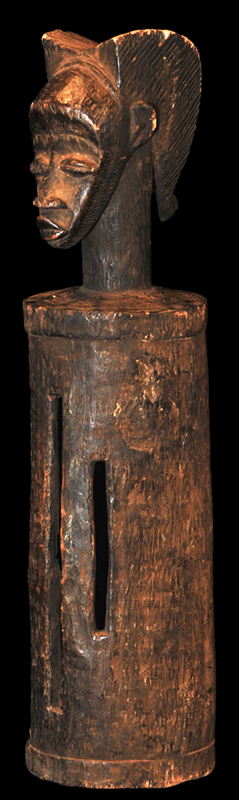
The present example belongs to a rare anthropomorphic type of Dan slit drum. Carved from a hollowed tree trunk, the instrument consists of a cylindrical resonating chamber with narrow vertical slits cut into the body. Above the resonator rises a finely carved human head with an elaborate hairstyle, transforming the instrument into both a musical device and a sculptural object. This combination of sound production and figurative carving reflects a characteristic feature of Dan material culture, in which artistic expression and practical function are closely interconnected.
According to the ethnomusicological investigations of Hugo Zemp, the Dan distinguish their slit drums by the term gò or gòn, a name derived from the tree species traditionally used for their construction (Cordia platythyrsa). Unlike many other West African slit drums with broad openings, Dan instruments are characterized by exceptionally narrow slits measuring only a few millimeters in width. The interior of the trunk is carefully hollowed to create a resonating channel, while the remaining wooden sections function as vibrating tongues that produce different pitches when struck.
Slit drums formerly served as important communication instruments throughout the Dan region. Their powerful sound could carry over considerable distances and was used to alert villagers in times of danger or to summon members of the community. Over time, their role expanded beyond communication, and they became closely associated with social gatherings, agricultural labor, ceremonial events, and the performance traditions of Dan mask societies.
The relationship between the slit drum and masked performance is particularly significant. Dan masks are among the most celebrated artistic traditions of West Africa and play an essential role in public ceremonies, initiation rituals, entertainment, and social regulation. During these performances, slit drums provide rhythmic accompaniment for masked dancers and contribute to the complex interaction between movement, music, and visual representation. Instruments used in this context often receive ritual offerings and acquire a sacred status that distinguishes them from ordinary musical objects.
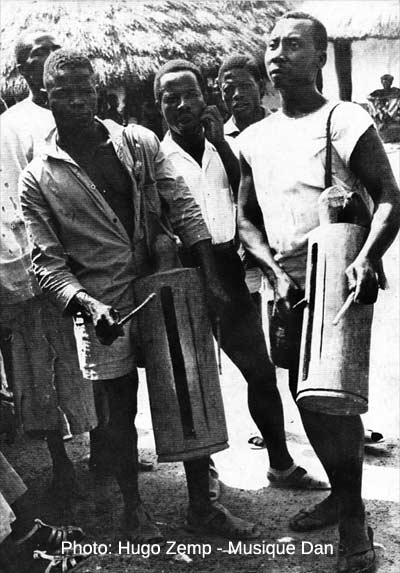
Dan musicians frequently perform with two slit drums of different sizes. Ethnographic studies describe the larger instrument as the "mother" and the smaller one as the "child." While one musician maintains a repeating rhythmic pattern, the other introduces rhythmic variations and improvisations. This musical dialogue creates a dynamic texture that accompanies both dance and collective activities.
The anthropomorphic decoration of the present instrument also reflects an important symbolic dimension. Among the Dan, musical instruments are often described using terms derived from the human body. The slit itself may be identified metaphorically as a mouth, while other structural elements receive names associated with human anatomy. Such terminology demonstrates that instruments are understood not merely as sound-producing devices but as living cultural objects that participate in social and ritual life.
Within museum collections, anthropomorphic Dan slit drums occupy a special position because they unite several artistic traditions in a single object. They simultaneously represent sculpture, musical technology, ceremonial practice, oral tradition, and performance culture and therefore provide valuable insight into the artistic and intellectual world of the Dan people.
"The slit-drum was formerly used throughout the Dan country to call the inhabitants together in the event of danger. Today it is played during certain festivals, at the return of circumcision initiates, during masquerades, while working in the fields, and to accompany jugglers."
Zemp, Hugo: Musique Dan. La musique dans la pensée et la vie sociale d'une société africaine.
Zemp, Hugo: Musique Dan. La musique dans la pensée et la vie sociale d'une société africaine.
Fischer, Eberhard; Himmelheber, Hans: Die Kunst der Dan. Museum Rietberg, Zürich.
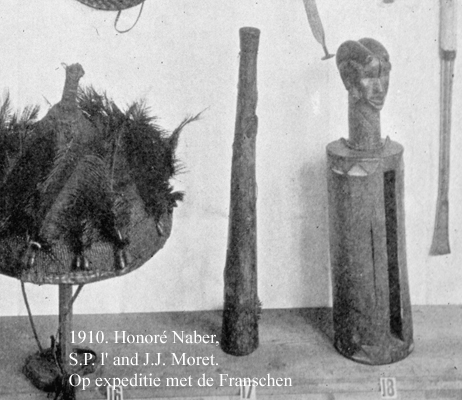
Naber, Honoré; Moret, J.: Op expeditie met de Franschen. Reisherinneringen aan die Fransch-Liberiaansche Grensregelings-Expeditie in de jaren 1908 und 1909.
Kubik, Gerhard: Musikgeschichte in Bildern – Westafrika. Leipzig 1989.
Meyer, Andreas: Afrikanische Trommeln – West- und Zentralafrika. Staatliche Museen Preußischer Kulturbesitz, Berlin 1997.
Wieschhoff, Heinz: Die afrikanischen Trommeln und ihre außerafrikanischen Beziehungen. Stuttgart 1933.