Hemba Ceremonial Drum (Democratic Republic of the Congo)
Hemba Ceremonial Drum (Hemba, Democratic Republic of the Congo)
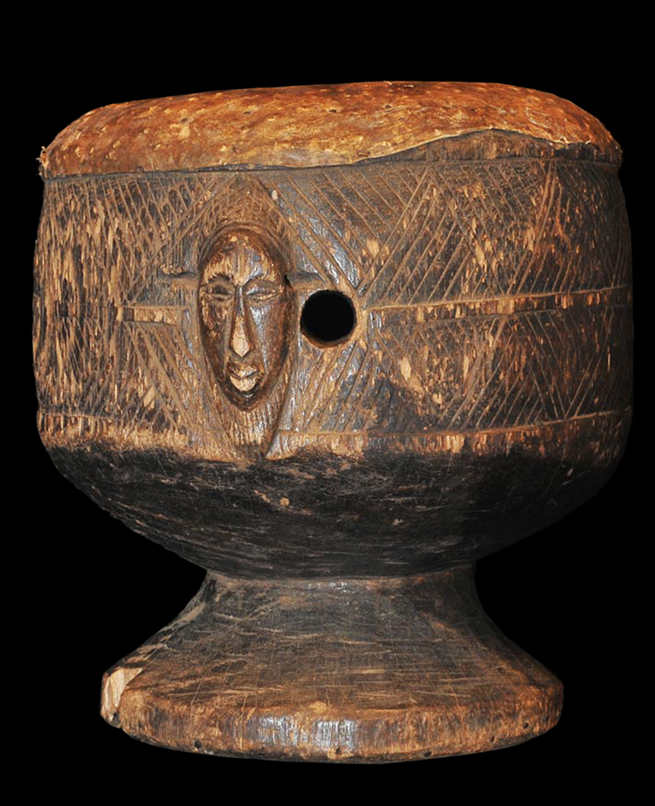
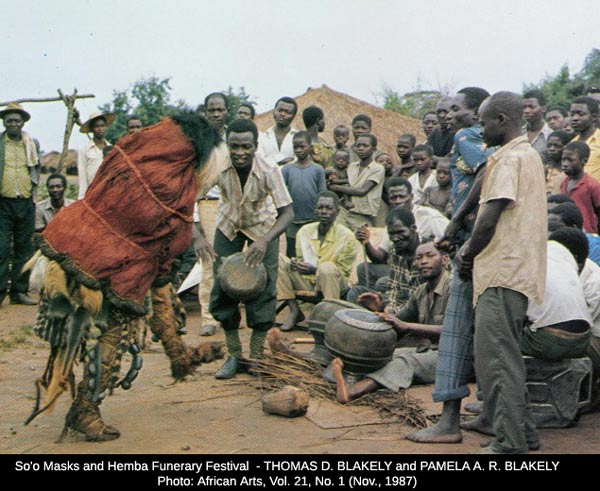
The ceremonial drums of the Hemba belong to one of the most remarkable sculptural traditions of Central Africa. The Hemba inhabit the southeastern part of the Democratic Republic of the Congo, where they developed a rich artistic culture that combines ancestor veneration, political symbolism, and exceptional woodcarving. Musical instruments occupied an important position within this cultural landscape and frequently transcended their purely acoustic function to become highly symbolic ceremonial objects.
The Hemba and the neighboring Luba share a close historical and cultural relationship. Both peoples originated from a common cultural background, and periods of political and economic interaction contributed to the development of closely related artistic traditions. Because of these similarities, early European collectors and museum curators frequently attributed Hemba sculptures to the Luba. This overlap is particularly evident in the treatment of human figures, facial features, proportions, and ornamental designs found in many works of art from both cultures.
The artistic composition of the drum reflects a characteristic feature of Hemba sculpture: the central importance of the human figure. Throughout Hemba art, the human body serves as a visual expression of ancestry, lineage, authority, and spiritual continuity. Ancestor figures are among the most celebrated achievements of Hemba sculpture, and many of the stylistic principles found in these figures also appear in ceremonial objects and musical instruments. The carved face incorporated into the drum therefore functions not merely as decoration but as an essential symbolic element that establishes a connection between sound, memory, and ancestral presence.
"The Hemba and Luba peoples of the Democratic Republic of the Congo share a deep historical, cultural, and artistic connection. Having split from a common root and experienced periods of Luba political dominance over the Hemba, their sculptural traditions overlap so closely that early Western collectors frequently misattributed Hemba ancestor figures to the Luba."
Based on comparative studies of Hemba and Luba art history.
Boone, Olga: Les tambours du Congo Belge et du Ruanda-Urundi. 2 vols. Tervuren: Annales du Musée du Congo Belge, Ethnographie 1, 1951.
Brincard, Marie-Thérèse: Sounding Forms – African Musical Instruments. 1989.
Chauvet, Stephen: Musique Nègre. 1929.
Dagan, Esther A.: Drums – The Heartbeat of Africa. Galerie Amrad, 1993.
Gansemans, Jos: Les instruments de musique Luba. 1980.
Laurenty, Jean-Sébastien: Les membranophones des Luba-Shankadi. 1972.
Maes, Joseph: Sculpture décorative ou symbolique des instruments de musique du Congo Belge. 1937.
Meyer, Andreas: Afrikanische Trommeln – West- und Zentralafrika. Staatliche Museen Preußischer Kulturbesitz, Berlin, 1997.
Roberts, Allen F.; Roberts, Mary Nooter: Memory: Luba Art and the Making of History. New York: Museum for African Art / Prestel, 1996.
Reefe, Thomas Q.: The Rainbow and the Kings: A History of the Luba Empire to 1891. Berkeley: University of California Press, 1981.
Thompson, Robert Farris: The Four Moments of the Sun: Kongo Art in Two Worlds. 1981.
Wieschhoff, Heinz: Die afrikanischen Trommeln und ihre außerafrikanischen Beziehungen. Stuttgart, 1933.