Africa
Kamba Drum Kenia
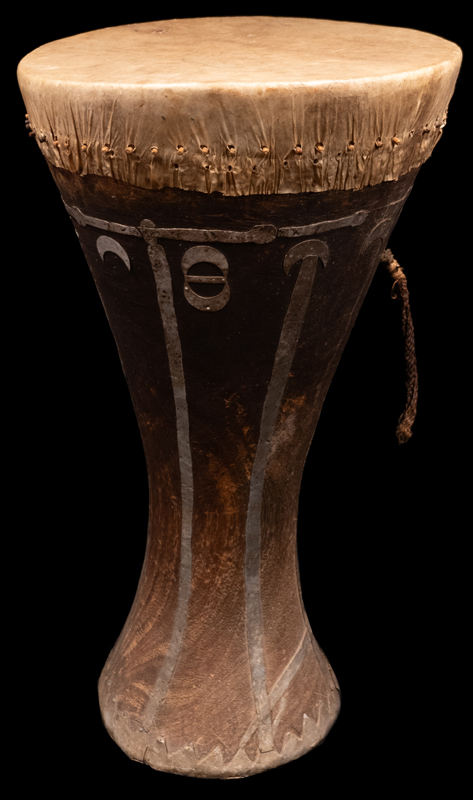
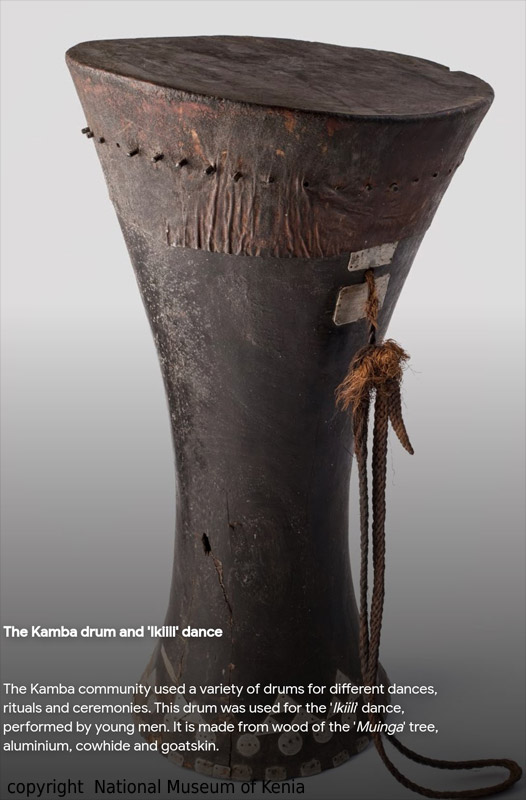
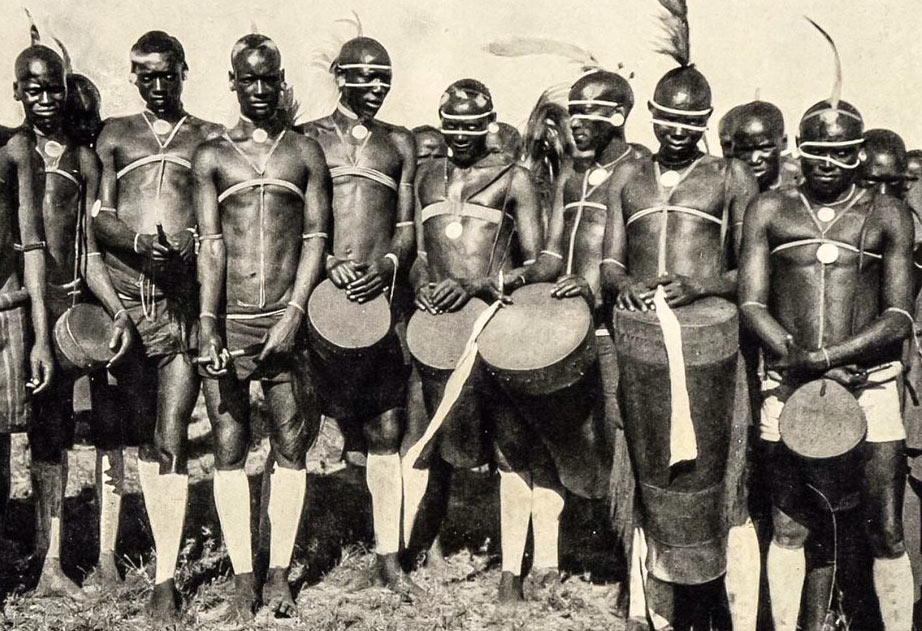
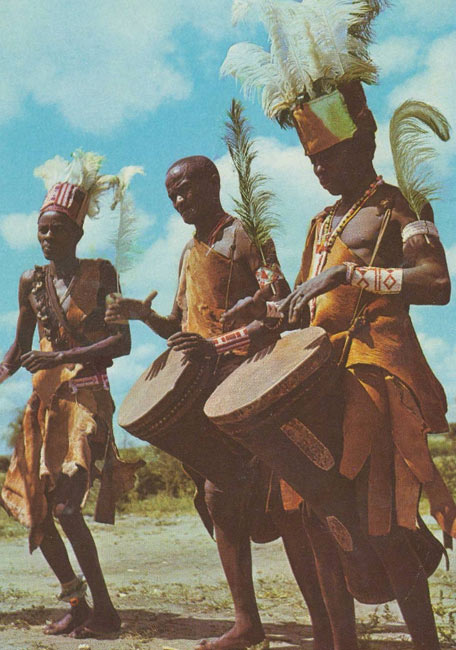
Kamba Drum (Akamba, Kenya)
The Kamba people of eastern Kenya have developed a rich and differentiated tradition of drum music in which particular drums are associated with specific dances, ceremonies, age groups, and ritual situations. The present drum, measuring 81 cm in height, belongs to this musical tradition. Its tall, waisted wooden body and single membrane give it a characteristic profile among Kamba membranophones, while its substantial size enables it to produce a powerful sound suitable for outdoor dance and ceremonial performance.
Among the Akamba, drums are not simply general-purpose rhythm instruments. Their functions are closely connected with particular forms of dance and social activity. Ethnomusicological studies of Kamba music document a number of named drums and drum traditions, including kithembe, mukanda, mwase, mbalia, and others. The exact terminology may vary according to locality and function, and the same basic type of drum can acquire a different designation when it is used in a different ceremonial context.
The National Museums of Kenya documents several Kamba drums in connection with particular dances. One example is associated with the Ikiili dance, performed by young men, while other drums are connected with the Anake, Ileve, and Kilumi dances. These distinctions demonstrate that Kamba drumming forms part of an organized system of performance in which the physical instrument, the repertoire, the dancers, and the social occasion are closely related.
One of the most important Kamba traditions is the Kilumi dance, a ceremonial and propitiatory performance associated historically with periods of famine, illness, or other forms of social distress. According to the National Museums of Kenya, particular Kamba drums used for Kilumi were traditionally made by older men and could be played by women in the context of the dance. Men could also participate, but knowledge of the spiritual words of the Kilumi songs was considered significant. The drum therefore operated within a ritual framework in which musical knowledge, dance and spiritual communication were inseparable.
The spiritual dimension of Kamba drumming is further reflected in the traditional role of the kithembe. Sources on Akamba musical culture describe this drum in connection with healing and spirit-oriented performance, where the drum establishes the rhythmic framework for dancing and ritual activity. In such contexts, rhythm is not merely accompaniment. Increasing rhythmic intensity can contribute to a state of heightened participation in which singing, movement and verbal expression become integrated. The drum consequently functions as an active agent within the ceremonial process rather than simply providing a regular beat.
Kamba drum music is also closely connected with dance. Paul N. Kavyu's extensive study Drum Music of Akamba demonstrates the importance of drum repertories, rhythmic organization, dance and musical structure within Akamba society. His research includes the composition and structure of Mukanda music and documents a differentiated vocabulary of drum pieces and rhythmic patterns. This evidence is particularly important because it shows that Kamba drumming should be understood as a structured musical language rather than as undifferentiated percussion accompaniment.
The acoustic character of Kamba drums is closely related to the tension of the membrane and to the manner in which the drum is struck. Some Kamba drums are warmed before performance in order to tighten the skin and raise its pitch. Performance can involve the hands, sticks, or combinations of striking and rubbing techniques depending on the drum and musical context. Such techniques allow the drummer to produce contrasting attacks, timbres and dynamic accents. In ceremonial ensembles, these variations interact with the movements of the dancers and with vocal patterns to create complex rhythmic structures.
Historical documentation is particularly valuable for understanding the continuity of this tradition. Gerhard Lindblom's The Akamba in British East Africa, based on field research conducted in the early twentieth century, contains a substantial section devoted to music and dancing. Later work by Paul N. Kavyu developed the study of Akamba drum music into a detailed ethnomusicological analysis. Together with the collections of the National Museums of Kenya, these sources demonstrate that Kamba drums belong to a long-established musical system in which instruments are closely associated with social identity, dance, ritual and the transmission of cultural knowledge.
The Kamba drum is therefore both a musical instrument and a cultural document. Its form records local traditions of woodworking, skin preparation and drum construction, while its musical function preserves knowledge of rhythms, dances and ceremonial practices. The historical photographs associated with Kamba performance further illustrate the important visual relationship between drummers, dancers, costume and movement. Within a museum collection, such an instrument provides material evidence of a musical culture in which rhythm serves simultaneously artistic, social and spiritual purposes.
References:Hyslop, G.: Musical Instruments of East Africa: Kenya.
Kavyu, Paul N. (1980): Traditional Musical Instruments of Kenya. Nairobi: Kenya Literature Bureau.
Kavyu, Paul N. (1986): Drum Music of Akamba. Studien zur Musik Afrikas, Vol. 2. Renner, Berlin.
Lindblom, Gerhard (1920): The Akamba in British East Africa. An Ethnological Monograph. Uppsala: Appelbergs Boktryckeri Aktiebolag.
National Museums of Kenya: The Power of the African Drum. Kenya National Museums, Nairobi.
National Museums of Kenya: Ngoma: Experiencing Life Through Music and Dance. Kenya National Museums, Nairobi.