Africa
Katanga Province Drum
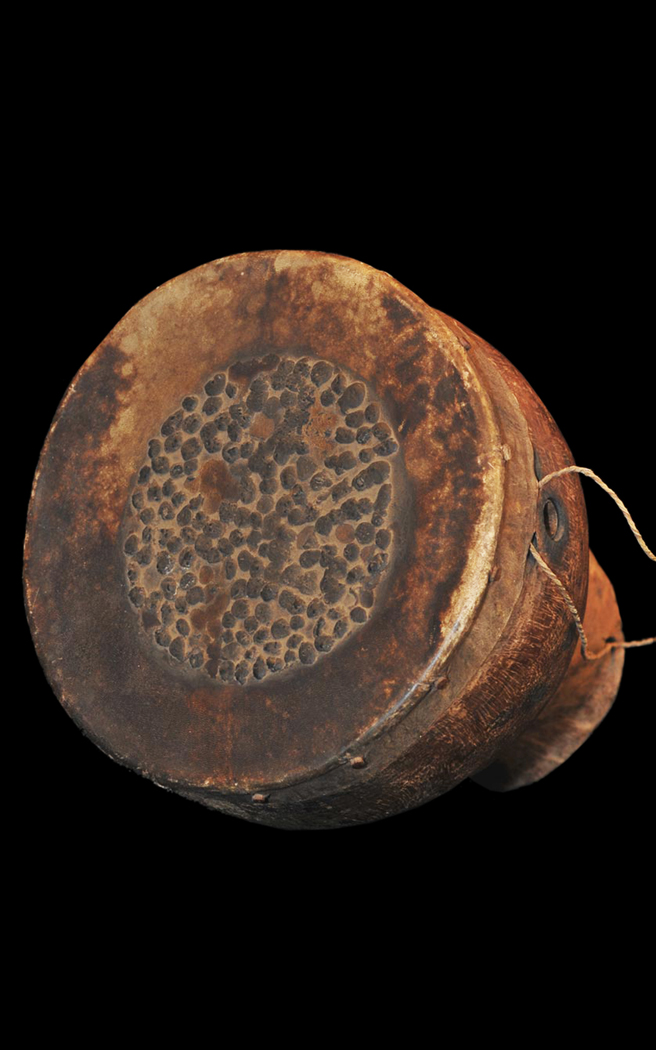
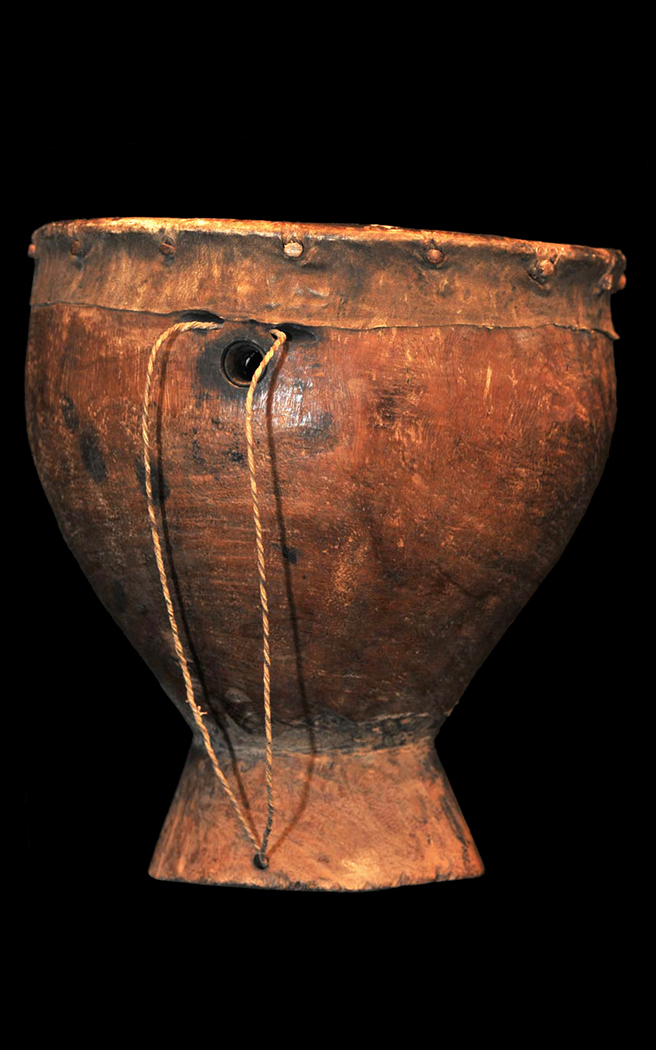
Katanga Province Drum (probably Baluba, Democratic Republic of the Congo)
This small single-headed drum from Katanga is probably of Luba origin. Its most remarkable feature is a mirliton incorporated into the side of the wooden body. A short hollow section, traditionally made from the neck of a calabash, carries a very thin membrane derived from a spider cocoon. When the drum is struck, the membrane vibrates with the air movement inside the resonator and produces a characteristic buzzing or nasalising effect.
This type of sound modification is documented for Luba drums from the Katanga region. Hugh Tracey's recordings from Kinkondje in 1952 describe an itumba with a mirliton fixed into its side, as well as mutumbwe drums equipped with similar devices. The buzzing sound was therefore not an incidental effect but part of the musical design of the instrument.
The drumhead also carries numerous small applications of wax. Such additions were used to alter the vibration of the membrane and lower its pitch, producing a deeper and more distinctive sound. Together with the mirliton, this demonstrates a sophisticated approach to modifying the acoustic properties of the drum through simple natural materials.
The drum belongs to the wider Luba tradition of ditumba drums, which were played in ensembles accompanying dance and ritual performances. Museum documentation from Katanga records several types of ditumba, differentiated by size and musical function. The combination of differently tuned drums and buzzing membranes created a characteristic ensemble sound in which rhythm and timbre were closely connected.
"The Itumba drum was a closed drum with a mirliton fixed into its side, 20" high and with 12 1/2" membrane. The Mutumbwe drums were both weighted with paste to lower their pitch, and had similar mirlitons."
Hugh Tracey, field recording documentation, Kinkondje, 1952, International Library of African Music.
"The ‘dya ndanya’ drum is the smallest and can only be played by the leader of the percussion ensemble."
Royal Museum for Central Africa, collection documentation, Katanga, Luba, ditumba drums.
Bibliography:
Tracey, Hugh: International Library of African Music – Luba Field Recordings. Kinkondje, 1952.
Boone, Olga: Les tambours du Congo Belge et du Ruanda-Urundi. Tervuren, 1951.
Brincard, Marie-Thérèse (ed.): Sounding Forms – African Musical Instruments. New York, 1989.
Meyer, Andreas: Afrikanische Trommeln – West- und Zentralafrika. Staatliche Museen Preußischer Kulturbesitz, Berlin, 1997.
Dagan, Esther A.: Drums: The Heartbeat of Africa. Galerie Amrad, 1993.
Wieschhoff, Heinz: Die afrikanischen Trommeln und ihre außerafrikanischen Beziehungen. Stuttgart, 1933.
Royal Museum for Central Africa, Tervuren: Collection documentation, Luba ditumba drums from Katanga.