Royal Kete drums / Tambours royaux / Asante, Ghana
Royal Kete drums / Tambours royaux / Asante, Ghana
"Kete" refers simultaneously to a drum ensemble, a musical repertoire, and a courtly dance tradition of the Akan peoples of Ghana. Historically, Kete was closely associated with the royal courts of the Asante and represented one of the most important ceremonial music traditions within the Akan chieftaincy system.
The instruments were considered insignia of political authority and belonged exclusively to chiefs and the Asantehene. Performances accompanied royal processions, the installation of chiefs, state ceremonies, and funerals of members of the royal lineage. The ensemble therefore fulfilled both musical and political functions within Akan society.
A traditional Kete ensemble consists of several drums of different size and function, including the kwadum (master drum), the apentema (hand drum), the abrukua or aburukuwa (support drum), and the petia (small stick drum). Additional instruments, such as the dawuro iron bell and the ntorowa rattle, provide the rhythmic framework of the performance.
The musical structure is based on the interaction between the master drum and the accompanying instruments. Individual rhythmic patterns are assigned to each drum and are combined according to established performance conventions. Different playing techniques are employed within the ensemble, including hand drumming, straight-stick techniques, and the use of curved drumsticks. The resulting polyrhythmic texture is one of the characteristic features of Akan court music.
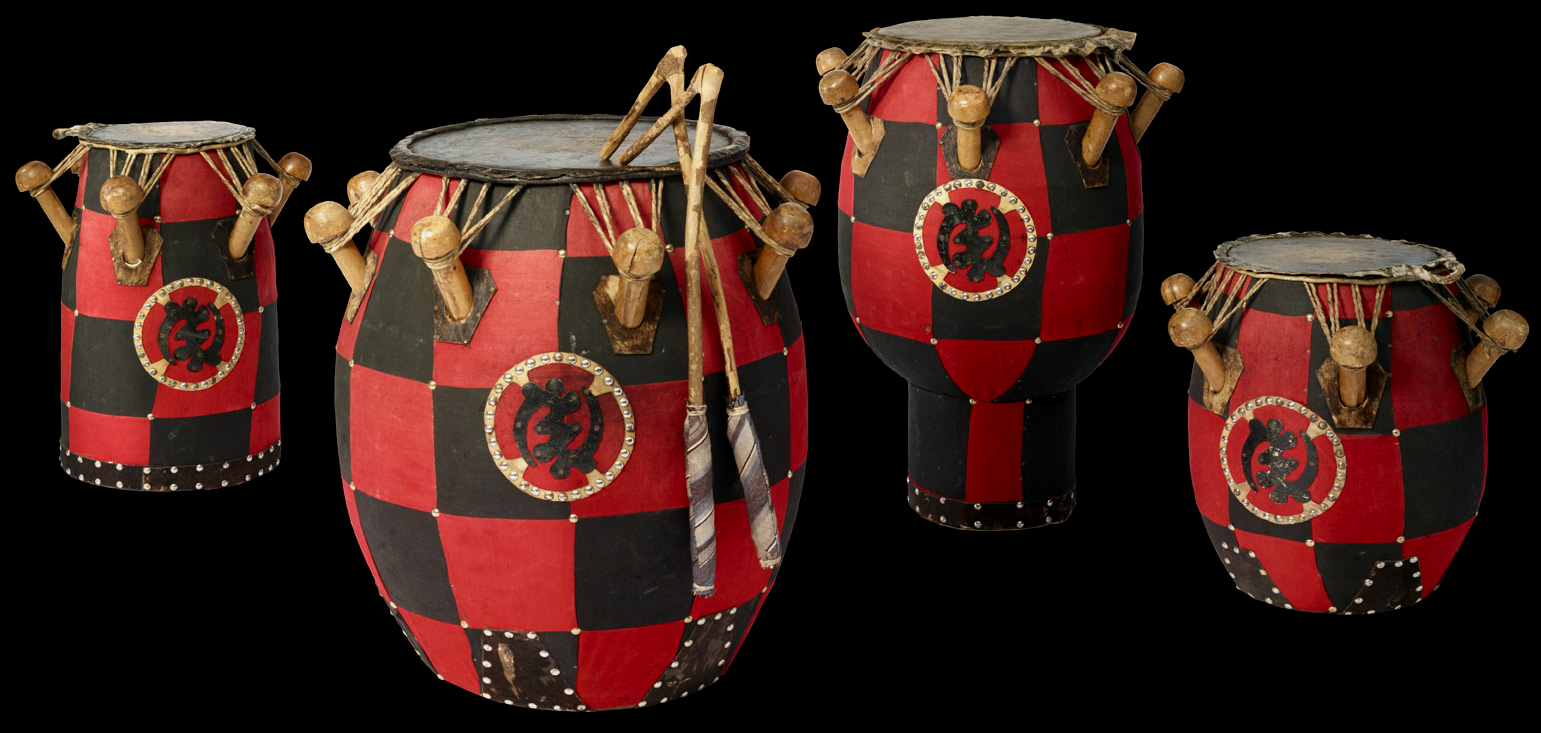
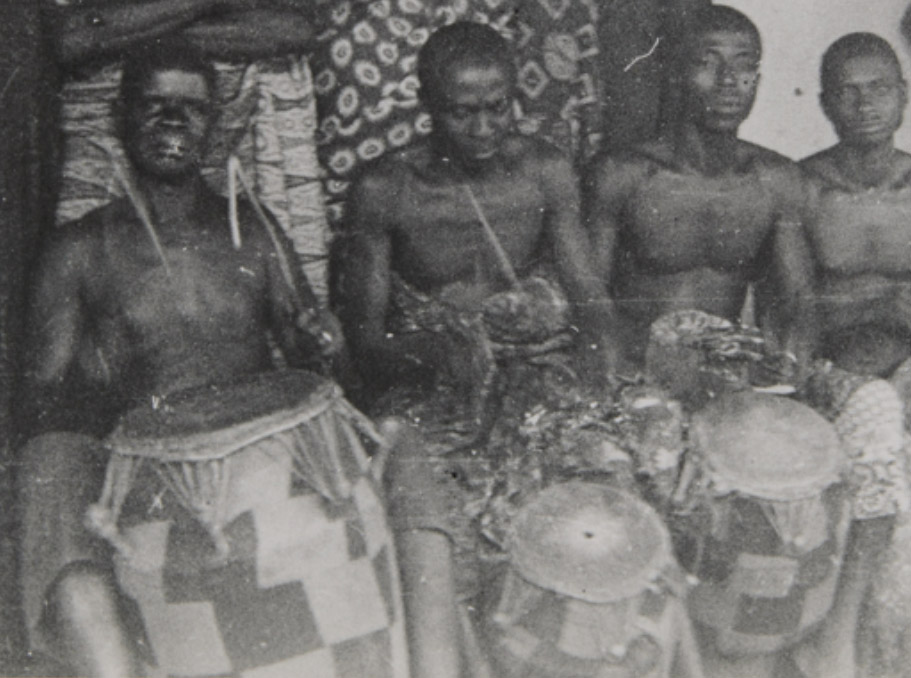
The drums shown here illustrate the traditional red-and-black checkerboard decoration of royal Kete ensembles. Among the Akan, both colours are closely associated with mourning, death, and ancestral remembrance. The historical photograph documents the use of similarly decorated drums in an ensemble performance and provides valuable evidence of early twentieth-century court music traditions in Ghana.
This kete set from the Siebenborn Collection belonged to a group of Ghanaian drummers who performed at the Berlin Ethnological Museum in 1993.
Because the original kete drums were not allowed to leave the king’s court, the musicians had to order a new set of drums and have them consecrated.
Before they returned to Ghana they sold their instruments in Germany.
Sound samples of this Kete ensemble can also be heard in the exhibition Talking with Drums at the Ethnographic Museum of the University of Zurich.
talkingwithdrums.ch
Bibliography:
Anku, W. (2009): Drumming among the Akan and Anlo Ewe of Ghana. African Music 8(3): 38–64.
Chernoff, J. M. (1979): African Rhythm and African Sensibility. Chicago: University of Chicago Press.
Koetting, James (1970): An Analytical Study of Ashanti Kete Drumming. Master's Thesis, University of California, Los Angeles.
Locke, David (1998): Drum Gahu: An Introduction to African Rhythm.
Nketia, J. H. K. (1963): Drumming in Akan Communities of Ghana.
Rattray, Robert Sutherland (1927): Religion and Art in Ashanti. London: Oxford University Press.