Slit Drum from the Kota Cultural Area (Gabon)
Slit Drum from the Kota Cultural Area (Gabon)
The Kota, also known as Bakota, comprise a group of related Bantu-speaking peoples whose cultural and linguistic area extends across northeastern Gabon and into neighbouring parts of the Republic of the Congo. The region lies within the wider Congo Basin and is characterised by extensive forest environments and long-standing cultural interaction between neighbouring communities. The designation "Kota Cultural Area" is therefore used here as a geographical and ethnographic reference rather than as a definitive attribution to a particular Kota subgroup.
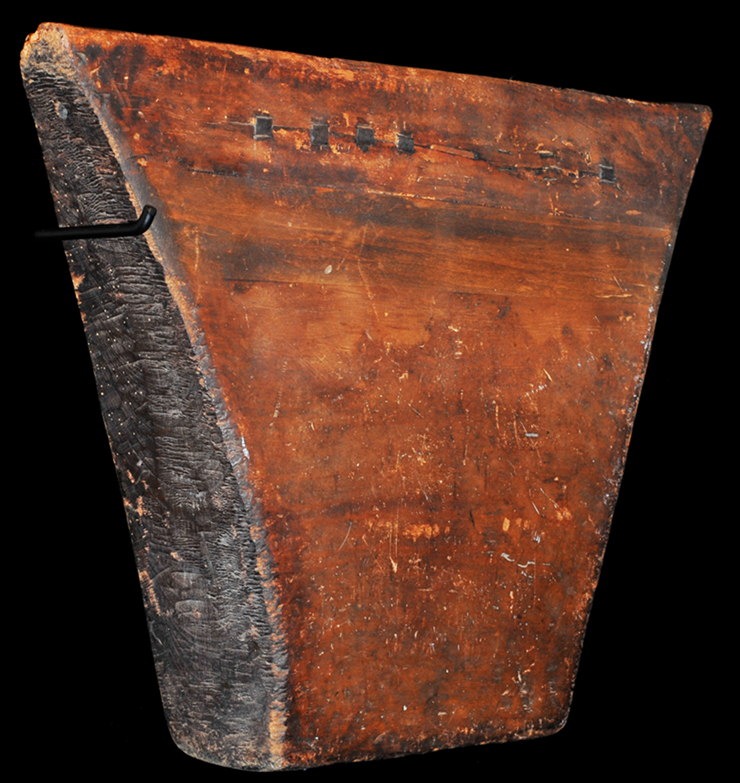
The present slit drum is provisionally associated with this cultural area on the basis of its form and presumed provenance. Slit drums occur in numerous forms throughout Central Africa, and comparable instruments are documented across a wide geographical range. Jean-Sébastien Laurenty's fundamental study Les tambours à fente de l'Afrique centrale demonstrates the considerable morphological and regional diversity of these instruments, including trapezoidal forms such as the present example.
Unlike a membranophone, the instrument has no stretched skin. Sound is produced by striking the wooden lips bordering the longitudinal slit. Their different thicknesses create contrasting tones. In Central African traditions, such acoustic differences could be organised in relation to the tonal and rhythmic structures of spoken languages, allowing trained specialists to reproduce patterns that could transmit information over considerable distances. The slit drum could therefore operate both as a musical instrument and as a medium of communication.
The present example is carved from a single block of wood and has a strongly tapering, trapezoidal form. Its substantial body, carefully proportioned sounding surfaces and extensive traces of use reveal the technical knowledge involved in its manufacture. The darkened side and heavily worn surfaces provide additional evidence of prolonged handling, transport and performance.
Knowledge of the signalling systems associated with slit drums was traditionally acquired through specialised forms of learning and apprenticeship. Experienced players transmitted not only the practical techniques of striking and controlling the instrument, but also the conventions necessary to encode and interpret messages. Such knowledge formed part of an oral tradition in which musical skill, linguistic knowledge and social experience were closely connected.
Slit drums were not restricted to communication. Their deep and penetrating sound also made them effective musical instruments, particularly in collective performance, dance and other communal contexts. The same acoustic properties that enabled their sound to travel over considerable distances contributed to their distinctive role within musical ensembles.
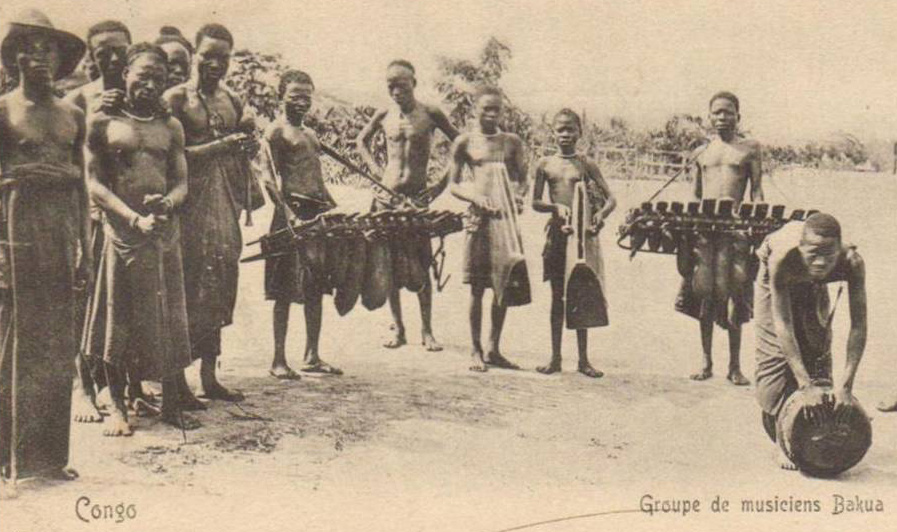
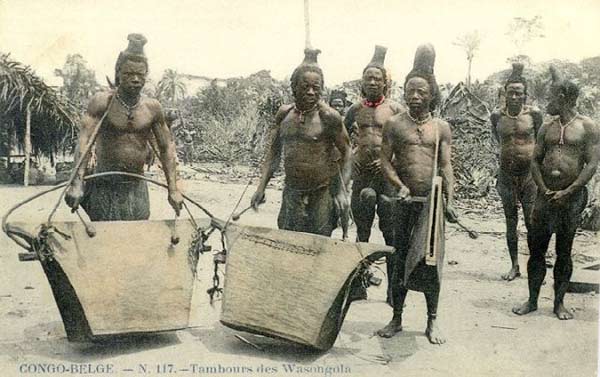
The historical photographs accompanying this object provide important comparative visual evidence. The photograph captioned Groupe de musiciens Bakua shows musicians in the former Belgian Congo with slit drums and other instruments, documenting their presence within a larger musical ensemble. A second historical photograph, Tambours des Wasongola, shows large slit drums being carried and played by a group of men. It provides valuable information about the physical scale of such instruments, their relationship to the players and their use in collective performance.
These photographs should be understood as historical comparative sources rather than as direct documentation of the present museum object. They nevertheless help to illuminate dimensions of slit-drum use that the surviving instrument alone cannot reveal, particularly the relationship between the instrument, the musician and the wider social setting in which it was performed.
From an art-historical perspective, the drum demonstrates how a seemingly austere geometric form can embody considerable technical and cultural complexity. Its visual character lies not in figurative carving or elaborate ornament, but in the proportions of the body, the carefully constructed sounding surfaces and the accumulated marks of use. Form, acoustics, craftsmanship, communication and social knowledge are united within a single object.
Bibliography
Carrington, John F. 1944. The Drum Language of the Lokele Tribe.
Carrington, John F. 1949. Talking Drums of Africa. London: Carey Kingsgate Press.
Brincard, Marie-Thérèse. 1989. Sounding Forms: African Musical Instruments. Washington, D.C.: National Museum of African Art, Smithsonian Institution.
Gilbert, Dorothy R. 1955. “The Lukumbi: A Six-Toned Slit Drum of the Batetela.” African Music: Journal of the International Library of African Music 1 (2): 21–23.
Kubik, Gerhard, Malamusi Moya Aliya, and András Varsányi. Afrikanische Musikinstrumente: Katalog und Nachdokumentation der Musikinstrumente aus Afrika südlich der Sahara in der Sammlung Musik des Münchner Stadtmuseums.
Laurenty, Jean-Sébastien. 1968. Les tambours à fente de l'Afrique centrale. Tervuren: Musée Royal de l'Afrique Centrale. 2 vols.
Royal Museum for Central Africa. Music of Central Africa: Instruments from the Democratic Republic of the Congo. Tervuren.
Historical Photographic Documentation
The historical photographs accompanying this object provide important comparative visual evidence for the use of Central African slit drums. The photograph captioned Groupe de musiciens Bakua shows musicians in the former Belgian Congo with slit drums and other instruments, documenting the presence of these instruments within a larger musical ensemble. A second historical photograph, Tambours des Wasongola, shows large slit drums being carried and played by a group of men. It provides valuable information about the physical scale of such instruments, their relationship to the players and their use in collective performance.
These photographs should be understood as historical comparative sources rather than as direct documentation of the present museum object or as evidence for a specific Kota attribution. Their value lies in documenting the broader Central African context in which slit drums were used in musical, communicative and communal settings.