Kuba Bukita Investiture Drum DRC
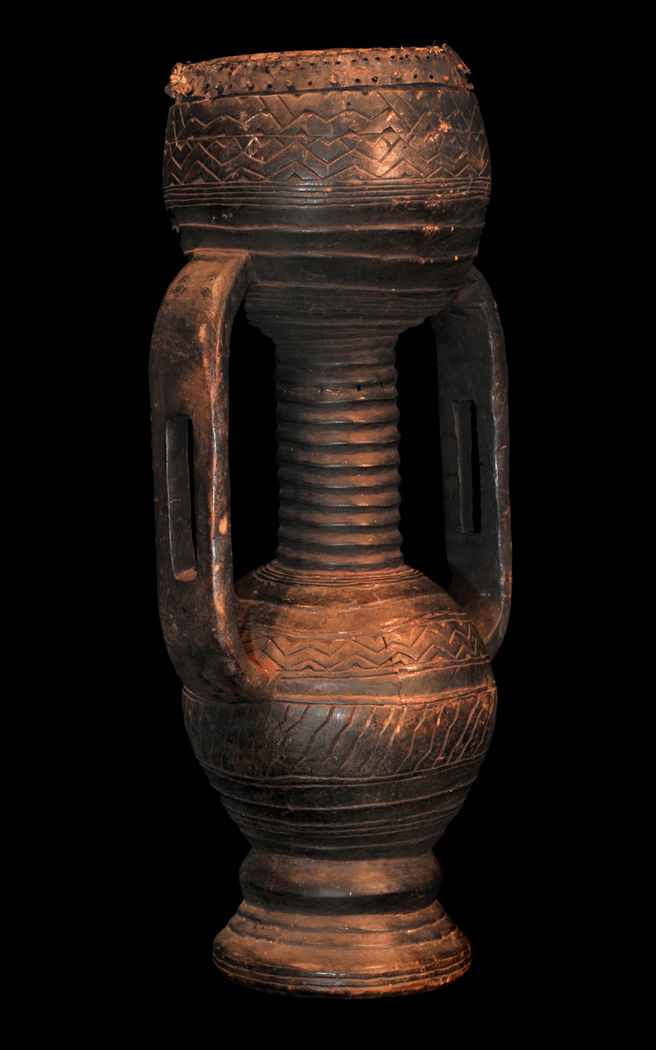
Kuba Bukita Investiture Drum (Kuba Kingdom, Democratic Republic of the Congo)
The Kuba Kingdom developed one of the most elaborate courtly art traditions of Central Africa, in which sculpture, textiles, regalia and musical instruments were closely connected with political status. Drums occupied an important position within this system. The present example represents a distinctive type of Kuba ceremonial drum known as a Bukita, whose unusual double-bodied construction and elaborate geometric decoration distinguish it from the more conventional tall drums used within Kuba musical traditions.
The drum consists of two rounded resonating bodies arranged vertically and connected by a narrow central section. Two large curved handles extend along the sides, joining the upper and lower parts and giving the instrument an almost architectural appearance. The symmetrical construction creates a powerful visual balance, while the central stem and handles transform the functional instrument into a highly sculptural object. Comparable two-bodied drums are documented in Kuba collections and in early ethnographic publications, and have been associated with exceptional ceremonial occasions, including the investiture of nobles.
Its ceremonial importance is reflected in the exceptional care devoted to its construction and decoration. Kuba prestige objects were closely associated with rank and political authority, and musical instruments could participate in the public presentation of status. Unlike ordinary dance drums, instruments of this category were used only on rare occasions. In the context of an investiture, the drum contributed to the ceremonial transformation of an individual into a recognised holder of office and placed the event within the highly ordered visual and acoustic world of the Kuba court.
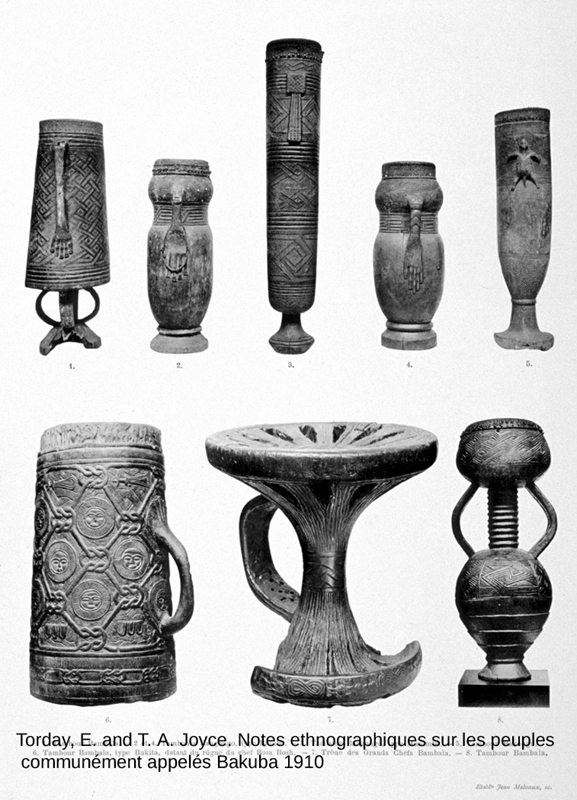
The historical significance of Kuba drums is further demonstrated by early ethnographic documentation. Emil Torday and T. A. Joyce published several examples of Kuba drums in their Notes ethnographiques sur les peuples communément appelés Bakuba of 1910, illustrating the remarkable diversity of forms developed within the Kuba kingdom. Their documentation already shows drums with highly elaborated bodies, handles and geometric surface designs, confirming that such instruments were regarded as significant elements of Kuba material culture at the beginning of the twentieth century.
The present Bukita is therefore significant not only as a musical instrument but also as an example of Kuba courtly sculpture. Its unusual double-bodied form, symmetrical handles and continuous geometric ornament demonstrate how musical objects could be transformed into prestigious works of visual art. In this drum, function, ceremony and artistic design are inseparably combined, reflecting the importance of material splendour in the representation of Kuba political authority.
Bibliography:Boone, Olga: Les tambours du Congo Belge et du Ruanda-Urundi. 2 vols. Tervuren: Annales du Musée du Congo Belge, Ethnographie 1, 1951.
Brincard, Marie-Thérèse (ed.): Sounding Forms – African Musical Instruments. New York, 1989.
Chauvet, Stephen: Musique Nègre. Paris, 1929.
Cornet, Joseph: Art from Zaire: 100 Masterworks from the National Collection. Kinshasa, 1975.
Dagan, Esther A.: Drums: The Heartbeat of Africa. Galerie Amrad, 1993.
Meyer, Andreas: Afrikanische Trommeln – West- und Zentralafrika. Staatliche Museen Preußischer Kulturbesitz, Berlin, 1997.
Torday, Emil & Joyce, T. A.: Notes ethnographiques sur les peuples communément appelés Bakuba, ainsi que sur les peuplades apparentées: Les Bushongo. Brussels, 1910.
Wieschhoff, Heinz: Die afrikanischen Trommeln und ihre außerafrikanischen Beziehungen. Stuttgart, 1933.