Africa
Kuba drum Congo
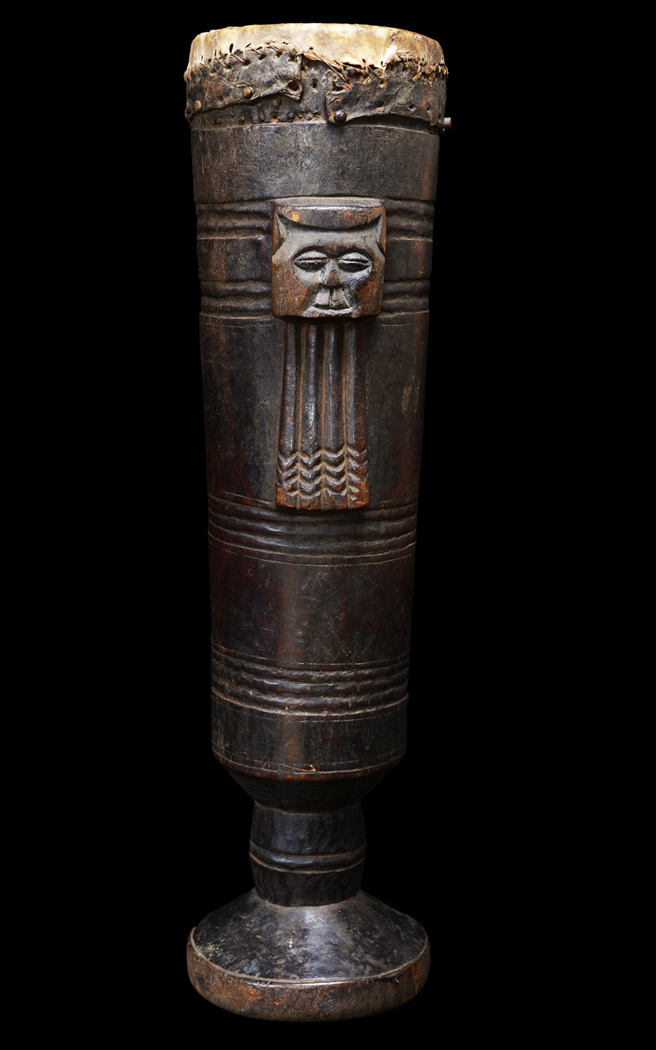
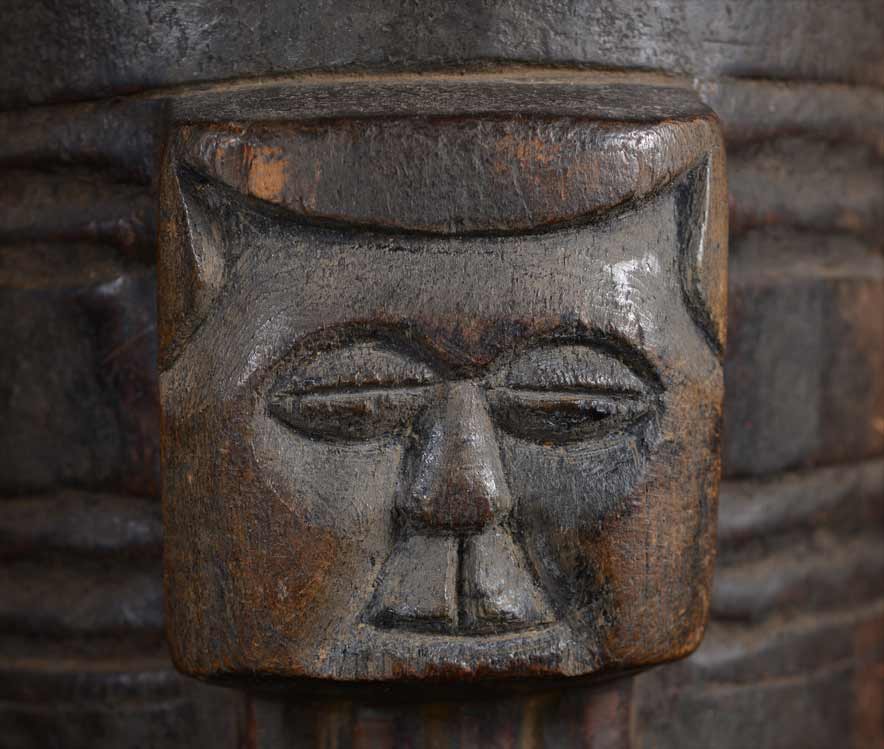
Kuba Drum (Democratic Republic of the Congo)
The Kuba Kingdom, located in the region between the Kasai and Sankuru Rivers in the present-day Democratic Republic of the Congo, developed one of Central Africa's most sophisticated court cultures. Political authority, artistic production, and ceremonial life were closely interconnected, and drums occupied a prominent position within this system. Beyond their musical function, they served as visual symbols of royal authority and social hierarchy.
Kuba drums were used during court ceremonies, royal processions, investitures, ritual performances, and public celebrations. In many contexts, they functioned as instruments of communication, announcing the arrival of important persons or marking significant ceremonial events. Their sound was therefore associated not only with music but also with political power and collective identity.
Characteristic of Kuba drums is their refined craftsmanship. The carefully carved wooden bodies often display balanced proportions and elegant forms, reflecting the highly developed woodworking traditions of Kuba artists. Equally distinctive is the method of attaching the drumhead, in which a leather strip is fastened around the rim of the drum body before the membrane is sewn to it. This construction technique represents one of the defining technological features of Kuba drums and distinguishes them from many neighboring traditions.
The artistic achievements of the Kuba Kingdom have attracted considerable attention within the fields of African art history, ethnology, and organology. Today, Kuba drums are regarded not only as musical instruments but also as important examples of Central African court art and material culture.
"The cultures of south Zaire, east Angola and the north-west province of Zambia are mostly characterized by various influential royal dynasties. The best-known drums of the region come from the Kuba kingdom, situated between Kasai and Sankuru. Their skins are attached using a characteristic technique. A strip of leather is placed around the top of the body and nailed to it; the skin is then stitched to the leather strip."
Andreas Meyer, Afrikanische Trommeln. West- und Zentralafrika. Berlin, 1997, p. 243.
References:
Boone, Olga : Les tambours du Congo Belge et du Ruanda-Urundi. 2Vol. 1951. Tervuren: Annales du Musée du Congo Belge; Ethnographie 1
Brincard, M.T. : Sounding Forms – African Musical Instruments 1989 Chauvet, Dr. Stephen. Musique Nègre. 1929
Cornet, Joseph : Art From Zaire. 1975
Dagan, Esther A. - Drums : The Heartbeat of Africa edited by Galerie Amrad 1993
Meyer, Andreas : Afrikanische Trommeln – West- und Zentralafrika. Staatliche Museen Preußischer Kulturbesitz, Berlin 1997
Wieschhoff, Heinz : Die afrikanischen Trommeln und ihre außerafrikanischen Beziehungen. Stuttgart 1933