Africa
Kuba drum Congo
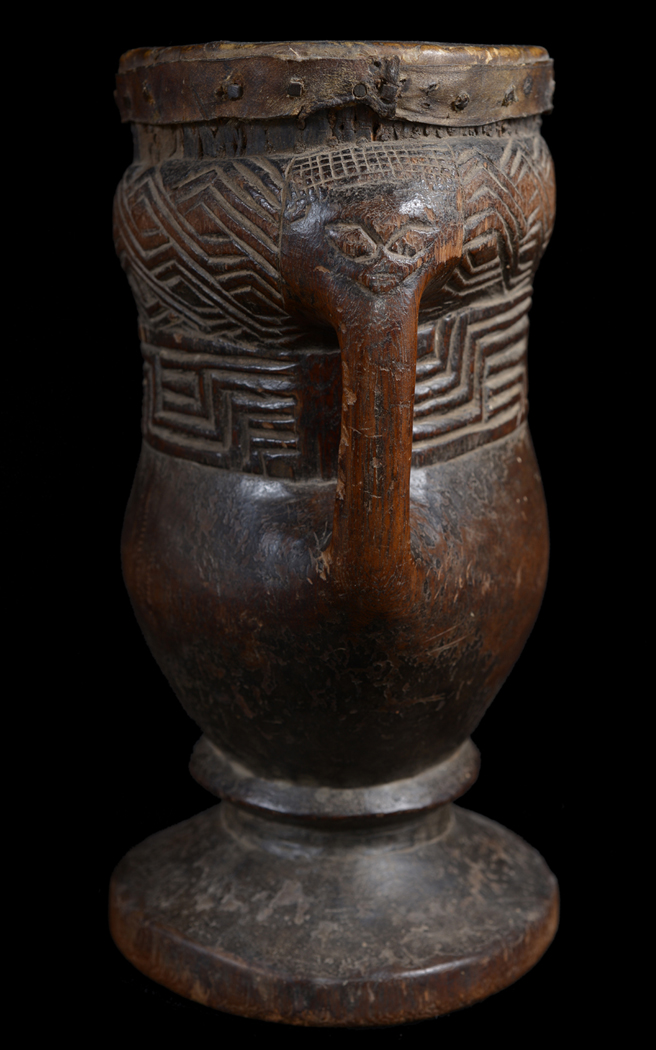
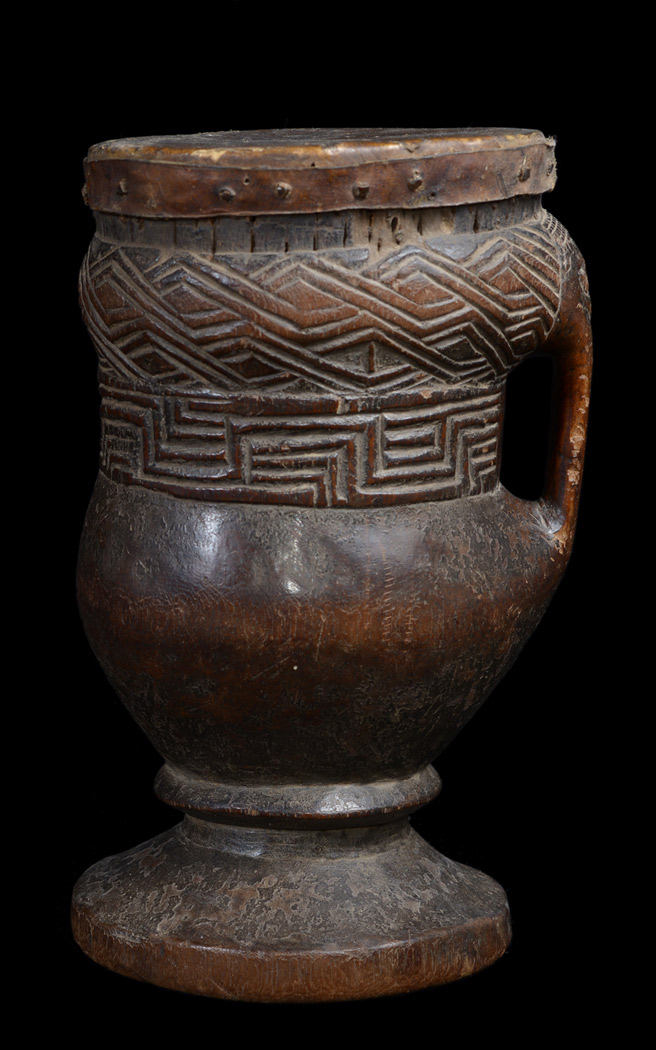
Kuba Drum (Kuba Kingdom, Democratic Republic of the Congo)
The Kuba Kingdom is renowned for a highly developed tradition of woodcarving in which geometric patterns and stylised human forms were applied to both ceremonial and functional objects. The present drum is an unusually small example, measuring approximately 27 cm in height.
Its compact body is closely related in shape to the characteristic cup-shaped vessels found in Kuba material culture. The upper section carries a stylised human face integrated into the carved surface, surrounded by bands of geometric ornament. The restrained treatment of the facial features and the regular incised patterns are characteristic elements of Kuba carving.
The drum is a single-headed membranophone. Its original Kuba method of attaching the membrane is no longer preserved. The remaining leather strip around the upper rim indicates that the drum originally used the characteristic Kuba construction in which a leather band was nailed to the rim and the skin was sewn to this band. The present skin has subsequently been attached with simple wooden nails.
Bibliography:Boone, Olga: Les tambours du Congo Belge et du Ruanda-Urundi. 2 vols. Tervuren: Annales du Musée du Congo Belge, Ethnographie 1, 1951.
Brincard, Marie-Thérèse (ed.): Sounding Forms – African Musical Instruments. New York, 1989.
Cornet, Joseph: Art from Zaire. 1975.
Dagan, Esther A.: Drums: The Heartbeat of Africa. Galerie Amrad, 1993.
Meyer, Andreas: Afrikanische Trommeln – West- und Zentralafrika. Staatliche Museen Preußischer Kulturbesitz, Berlin, 1997.
Torday, Emil & Joyce, T. A.: Notes ethnographiques sur les peuples communément appelés Bakuba, ainsi que sur les peuplades apparentées: Les Bushongo. Brussels, 1910.
Wieschhoff, Heinz: Die afrikanischen Trommeln und ihre außerafrikanischen Beziehungen. Stuttgart, 1933.
Bakpekpe (Budu), Boungou (Lokele), Bugu (Zande), Chondo (Kanyoka), Condo (Luba-Kasai), Dundu (Pygmées), Ebgbge (Pygmées), Emandru (Medje),
Gbugbu (Gbandi, Mayogo), Gogo (Mamvu), Gudugudu (Ndo), Gudu-gudu (Abangba), Gugu (Zande), Igogo (Pygmées), Igogo deja (Budu), Igogo tade (Budu)
Ikokola (Boyela, Ngando), Ikokole (Batwa, Bolia, Ekonda, Twa), Ikole (Mongala), Ikookole (Mongo), Kandji (Ngoma) (Kongo), Kankonko (Sala Mpasu)
Khoko (Kongo), Kiyondo (Songye), Kyondo (Luba), Lenga (Gubu), Lokele (Bongando), Lokole (Batwa, Boyela, Ekonda, Elinga, Enga, Kutu, Mongo, Ndengese
Nkundu, Saka),Lokolé (Mongo, Mputu),Lokombe (Boyela, Ndengese, Tetela),Lokombe (Lukumbe) (Mongo),Lokuku (Ekonda),Lukumbe (Hamba, Mondja,Tetela)
Lunkufi (Songye), Magbo (Mayogo), Makpo (Budu / Mbuti), Makpo (Kpokpo) (Pygmées, Pygmées), Mandru (Mangbetu), Mgungu (Mbuti), Mokoto (Binza)
Molonge (Sengele), Mond (Lunda), Mondo (Kongo, Kwese, Mpangu, Suku, Tshokwe, Yaka), Mongungu (Ngombe), Mpopwo (Bari), Mudimba (Kanyoka, Luba)
Mungungu (Bali), Mutumba (Lunda, Sala Mpasu), Ndundu (Pygmées), Nedundu (Medje), Nekbokbo (Medje), Nekpokpo (Mangbetu), Nemandru (Mangbetu)
Nengwangu (Mayogo), Ngombi (Boa), Ngoto (Lobala), Ngufu (Yaka), Nkoko (Yaka), Nkombe (Lokombe) (Boyela), Nkonko (Kongo), Nkumvi (Luba)
N'kupila (Yaka), Shakudi (Mongo, Tetela), Tshikunvu (Lunda), Tshingoma (Kongo), Tshingufu (Chokwe, Tshokwe), Wungu (Hamba), Yeye (Mayogo)