Africa
Kuba Investiture Drum DRC
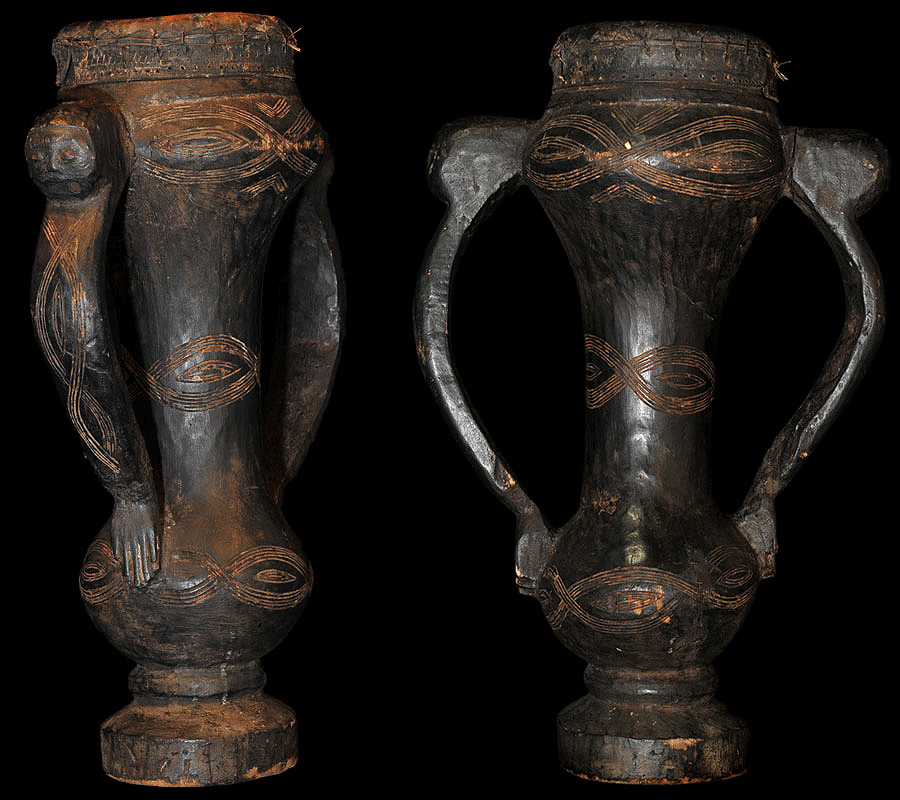
Kuba Investiture Drum (Kuba Kingdom, Democratic Republic of the Congo)
The Kuba Kingdom developed one of the most elaborate traditions of courtly art in Central Africa, in which sculpture, textiles, regalia and musical instruments were closely associated with political authority. Drums held an important place within this ceremonial world. The present example represents a particularly elaborate type of Kuba investiture drum, whose sculptural conception differs significantly from the more conventional forms known from the same cultural area.
The drum is dominated by a strongly anthropomorphic design. Two carved figures extend along the sides of the body, their arms ending in clearly modelled hands. At the upper ends of the arms are two sculpted heads, each integrated into the structure of the instrument. One of these heads contains a small circular cavity in which a foreign substance or material has been inserted. Its precise meaning cannot be established without further documentation, but the feature indicates that the sculptural elements may have possessed a significance beyond purely decorative function.
The relationship between the human figure and the drum is characteristic of the wider Kuba artistic tradition, in which objects associated with political and ceremonial life were frequently transformed through elaborate sculptural design. The carefully controlled proportions of the body, the paired figures and the extensive linear ornamentation create a highly coherent visual composition. The drum consequently functions simultaneously as a musical instrument and as a representation of authority expressed through the human form.
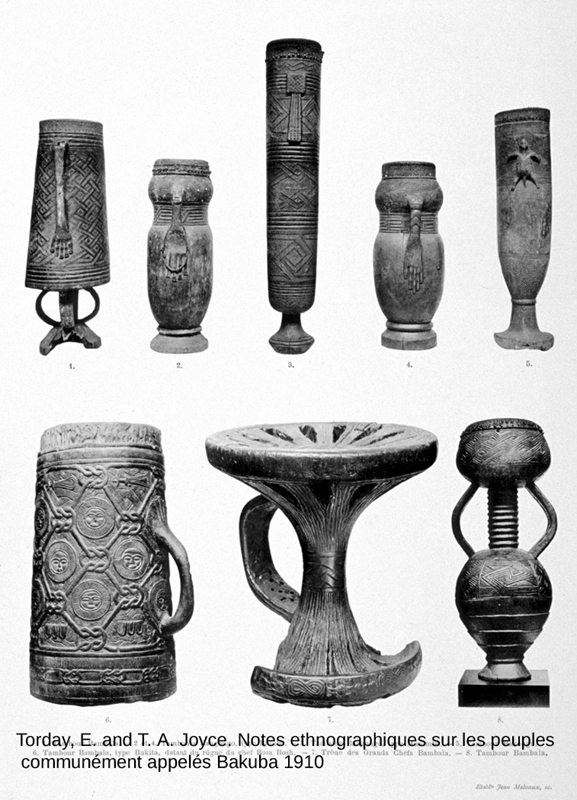
Early ethnographic documentation illustrates the considerable variety of Kuba drums. Emil Torday and T. A. Joyce published several examples in Notes ethnographiques sur les peuples communément appelés Bakuba (1910), including highly elaborated drums with sculptural additions and geometric decoration. The historical examples demonstrate that Kuba drum makers developed a range of forms rather than a single standard type. The present instrument is particularly remarkable for the explicit transformation of its structural elements into human figures.This drum therefore belongs to the distinctive field of Kuba courtly art in which musical function and sculptural representation meet. The hands, arms and carved heads give the instrument an anthropomorphic presence, while the carefully incised surface connects it with the wider visual vocabulary of Kuba art. Its significance lies in this combination of sound-producing function, ceremonial authority and figural sculpture.
Bibliography:Boone, Olga: Les tambours du Congo Belge et du Ruanda-Urundi. 2 vols. Tervuren: Annales du Musée du Congo Belge, Ethnographie 1, 1951.
Brincard, Marie-Thérèse (ed.): Sounding Forms – African Musical Instruments. New York, 1989.
Chauvet, Stephen: Musique Nègre. Paris, 1929.
Cornet, Joseph: Art from Zaire: 100 Masterworks from the National Collection. Kinshasa, 1975.
Dagan, Esther A.: Drums: The Heartbeat of Africa. Galerie Amrad, 1993.
Meyer, Andreas: Afrikanische Trommeln – West- und Zentralafrika. Staatliche Museen Preußischer Kulturbesitz, Berlin, 1997.
Torday, Emil & Joyce, T. A.: Notes ethnographiques sur les peuples communément appelés Bakuba, ainsi que sur les peuplades apparentées: Les Bushongo. Brussels, 1910.
Vansina, Jan: The Children of Woot: A History of the Kuba Peoples. Madison, 1978.
Wieschhoff, Heinz: Die afrikanischen Trommeln und ihre außerafrikanischen Beziehungen. Stuttgart, 1933.