Africa
Kuba Investiture Drum
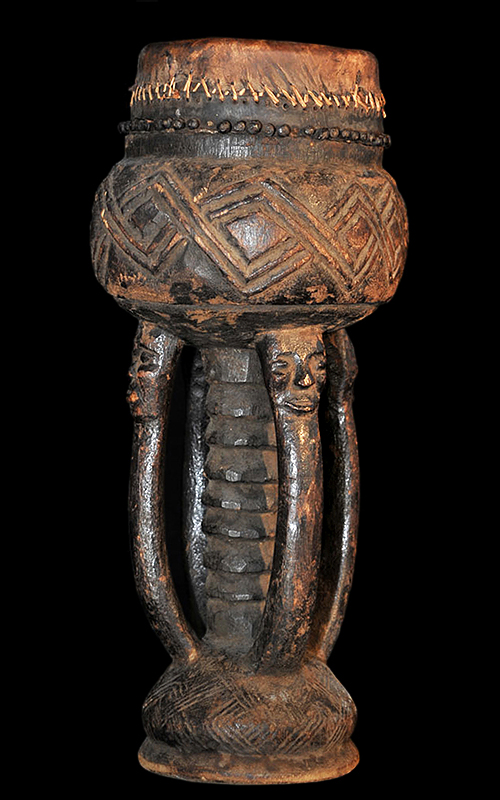
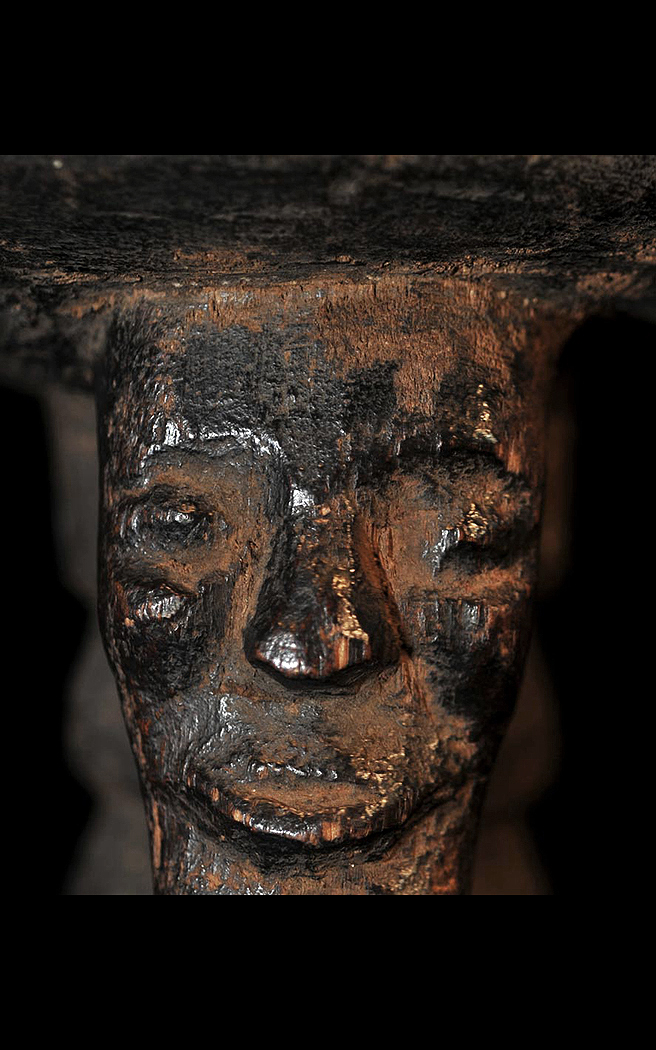
Kuba Investiture Drum (Kuba Kingdom, Democratic Republic of the Congo)
Among the royal arts of Central Africa, the Kuba Kingdom occupies a distinguished position because of the exceptional refinement of its sculpture, textile production, metalwork, and ceremonial regalia. Musical instruments formed an essential part of this courtly tradition, and drums in particular served as powerful symbols of political authority and social status. The present example represents an investiture drum from the historic Kuba Kingdom, located between the Kasai and Sankuru Rivers in the present-day Democratic Republic of the Congo.
Unlike many drums intended for daily musical performance, Kuba investiture drums belonged to a highly restricted ceremonial sphere. Historical sources indicate that such instruments were reserved for exceptional occasions, particularly during the installation and recognition of nobles. Within the hierarchical structure of the Kuba court, music functioned not merely as entertainment but as a visible and audible expression of political legitimacy. Drums therefore became important ceremonial objects associated with rank, prestige, and royal authority.
From an organological perspective, the instrument is a single-headed membranophone carved from a solid block of wood. Kuba drum makers developed a distinctive method for attaching the drumhead. A leather band was first secured around the upper rim of the drum body with wooden nails, after which the animal skin was sewn directly onto the leather strip. This construction technique, characteristic of Kuba drums, differs considerably from the tensioning systems found in many neighboring regions of Central Africa and provides an important criterion for identifying instruments from the Kuba cultural area.
"The best-known drums of the region come from the Kuba kingdom, situated between Kasai and Sankuru. Their skins are attached using a characteristic technique. A strip of leather is placed around the top of the body and nailed to it; the skin is then stitched to the leather strip."
Meyer, Andreas: Afrikanische Trommeln – West- und Zentralafrika. Staatliche Museen Preußischer Kulturbesitz, Berlin 1997, p. 243.
Boone, Olga: Les tambours du Congo Belge et du Ruanda-Urundi. 2 vols. Tervuren: Annales du Musée du Congo Belge, Ethnographie 1, 1951.
Brincard, Marie-Thérèse: Sounding Forms – African Musical Instruments. 1989.
Chauvet, Stephen: Musique Nègre. 1929.
Cornet, Joseph: Art from Zaire. 1975.
Dagan, Esther A.: Drums: The Heartbeat of Africa. Galerie Amrad, 1993.
Meyer, Andreas: Afrikanische Trommeln – West- und Zentralafrika. Staatliche Museen Preußischer Kulturbesitz, Berlin 1997.
Wieschhoff, Heinz: Die afrikanischen Trommeln und ihre außerafrikanischen Beziehungen. Stuttgart 1933.