Kuba / Bakuba Drums / Democratic Republic of the Congo
Kuba / Bakuba Drums (Democratic Republic of the Congo)
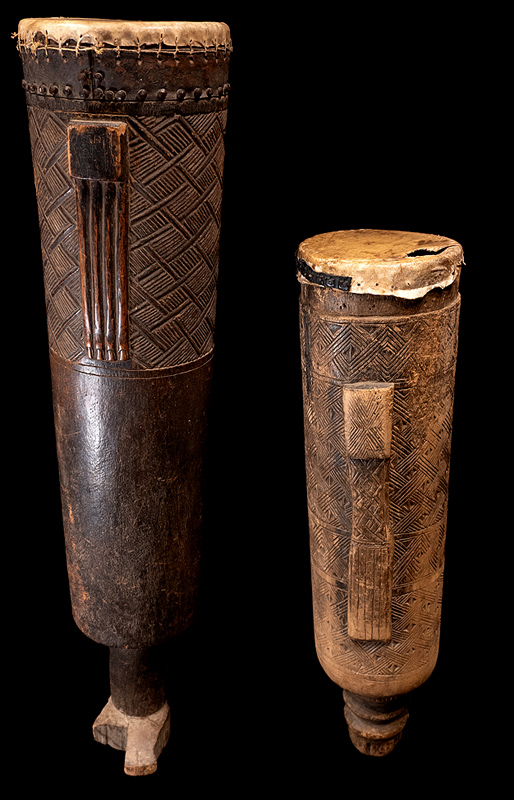
These two tall drums are attributed to the Kuba region of the Democratic Republic of the Congo and belong to a distinctive tradition of elaborately carved Kuba musical instruments. Their elongated cylindrical bodies rise from carefully shaped bases and are covered with densely incised geometric ornament. The two examples demonstrate both the characteristic formal language of Kuba drum carving and the considerable variation that individual craftsmen introduced into the decoration of the instrument.
A particularly remarkable feature of both drums is the stylized representation of a human hand carved into the front of the resonator. The hand is arranged vertically and is accompanied above by a separate rectangular carved panel rather than by the human face found on some related Kuba drums. The anthropomorphic treatment transforms an otherwise functional surface into a strongly sculptural composition and connects these instruments with the wider tradition of figurative and symbolic woodcarving in Kuba art.
The right-hand drum is especially notable for the exceptional fineness of its carving. Its entire upper body is covered with an intricate network of closely spaced geometric patterns, composed of intersecting lines and repeated motifs. The precision and density of the incised decoration create a highly refined surface in which the ornamental design becomes an integral part of the sculptural form of the drum.
The left-hand drum displays the same fundamental decorative concept, although its carving is somewhat broader and less densely executed. In both examples, the geometric ornament is carefully organized into distinct zones, creating a strong visual rhythm around the cylindrical resonator. The contrast between the decorated upper section and the comparatively plain lower body further emphasizes the formal structure of the instruments.
Kuba artistic traditions are particularly renowned for their sophisticated geometric vocabulary. Similar patterns occur on textiles, baskets, wooden vessels, prestige objects, architectural elements, and other forms of material culture. The repeated use of interlocking lines and carefully balanced geometric fields demonstrates that the decoration of the drums belongs to a much broader visual tradition rather than being an isolated form of ornament.
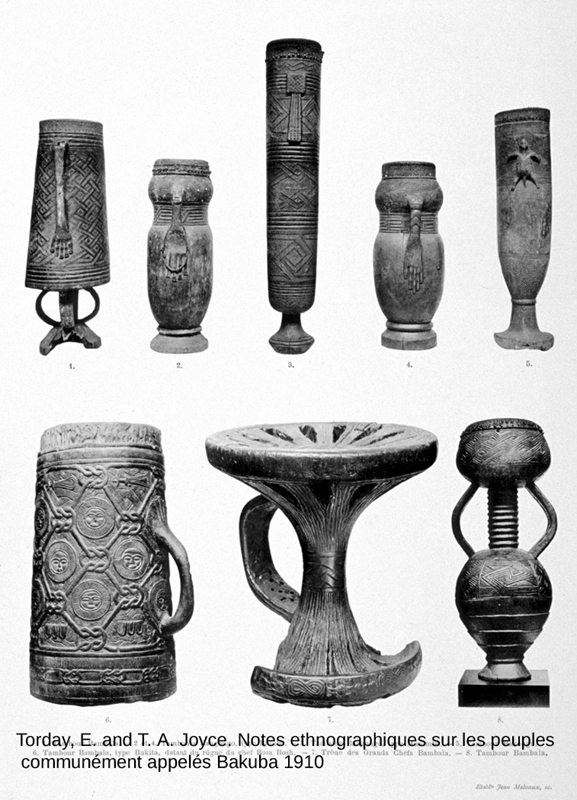
Historical ethnographic documentation provides important evidence for the diversity of Kuba drums. Early twentieth-century publications by Emil Torday and T. A. Joyce illustrate a number of Kuba instruments with highly developed carved decoration and sculptural features. Comparable drums were also documented by Olga Boone in her study of drums from the Congo region. These historical sources place the present examples within a well-established tradition of Kuba drum making.
Boone, Olga. 1951. Les tambours du Congo belge et du Ruanda-Urundi. Tervuren: Annales du Musée du Congo Belge, Ethnographie 1. 2 vols.
Brincard, Marie-Thérèse. 1989. Sounding Forms: African Musical Instruments. Washington, D.C.: National Museum of African Art, Smithsonian Institution.
Chauvet, Stephen. 1929. Musique Nègre.
Cornet, Joseph. 1975. Art from Zaire.
Dagan, Esther A., ed. 1993. Drums: The Heartbeat of Africa. Montreal: Galerie Amrad.
Meyer, Andreas. 1997. Afrikanische Trommeln – West- und Zentralafrika. Berlin: Staatliche Museen zu Berlin – Preußischer Kulturbesitz.
Torday, Emil, and T. A. Joyce. 1910. Notes ethnographiques sur les peuples communément appelés Bakuba, ainsi que sur les peuplades apparentées. Brussels.
Wieschhoff, Heinz. 1933. Die afrikanischen Trommeln und ihre außerafrikanischen Beziehungen. Stuttgart.