Drum (Bulup) / Lele - Kuba / Congo
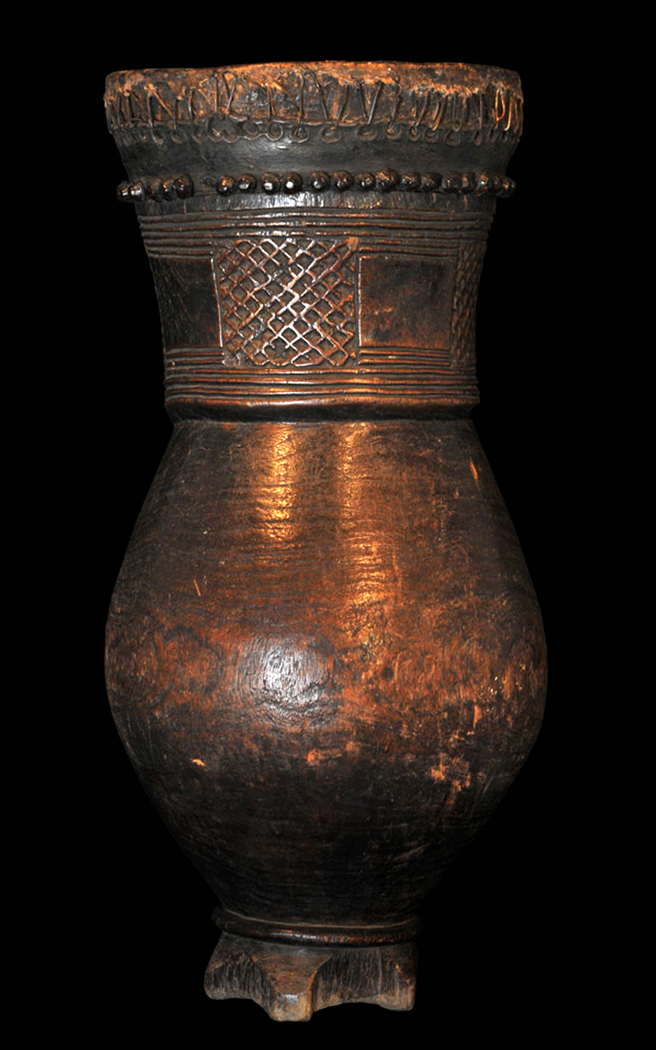
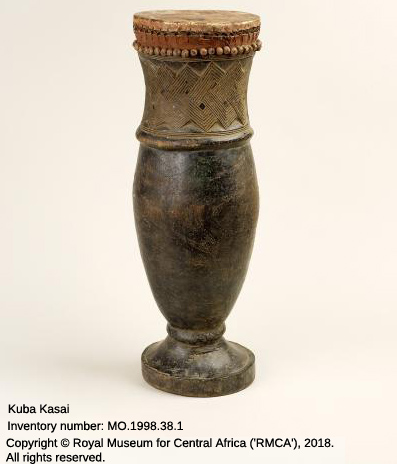
Bulup Drum (Kuba, Kasai Region, Democratic Republic of the Congo)
The Bulup drum belongs to the royal musical tradition of the Kuba Kingdom, one of the most highly centralized political systems in Central Africa. Founded during the seventeenth century between the Kasai and Sankuru rivers, the kingdom developed a complex court culture in which music, sculpture, weaving, and decorative arts became important expressions of political authority and social identity.
Within Kuba society, drums fulfilled a variety of functions. They accompanied court ceremonies, public celebrations, dances, and ritual performances and were closely associated with the ceremonial life of the royal court. Like many other prestige objects of the Kuba elite, drums also served as visual representations of status and rank.
From an organological perspective, the Bulup is a single-headed membranophone carved from a solid block of wood. Its elegant, vase-shaped body differs considerably from the cylindrical and goblet-shaped drums commonly found in neighboring regions. The present example displays a carefully balanced form and a restrained decorative program consisting of geometric motifs carved around the upper section of the resonator.
Particularly characteristic is the method used to attach the drumhead. As Andreas Meyer has pointed out, Kuba drummakers employed a distinctive construction technique in which a leather strip was fixed around the upper edge of the drum body and secured with wooden pegs. The membrane was then stitched directly to this leather band, creating a fastening system that became a defining feature of Kuba drums.
The Bulup illustrates the remarkable craftsmanship of the Kuba Kingdom, where artistic refinement extended far beyond sculpture and textiles and also shaped the production of musical instruments.
"The cultures of south Zaire, east Angola and the north-west province of Zambia are mostly characterized by various influential royal dynasties. The best-known drums of the region come from the Kuba kingdom, situated between Kasai and Sankuru. Their skins are attached using a characteristic technique. A strip of leather is placed around the top of the body and nailed to it; the skin is then stitched to the leather strip."
Meyer, Andreas: Afrikanische Trommeln – West- und Zentralafrika. Staatliche Museen Preußischer Kulturbesitz, Berlin, 1997, p. 243.
Boone, Olga: Les tambours du Congo Belge et du Ruanda-Urundi. 2 Vol. 1951.
Brincard, M. T.: Sounding Forms – African Musical Instruments. 1989.
Chauvet, Stephen: Musique Nègre. 1929.
Cornet, Joseph: Art from Zaire. 1975.
Dagan, Esther A.: Drums: The Heartbeat of Africa. Galerie Amrad, 1993.
Meyer, Andreas: Afrikanische Trommeln – West- und Zentralafrika. Staatliche Museen Preußischer Kulturbesitz, Berlin, 1997.
Vansina, Jan: The Children of Woot: A History of the Kuba Peoples. University of Wisconsin Press, 1978.
Wieschhoff, Heinz: Die afrikanischen Trommeln und ihre außerafrikanischen Beziehungen. Stuttgart, 1933.