Lobala Slit Drum | Democratic Republic of the Congo
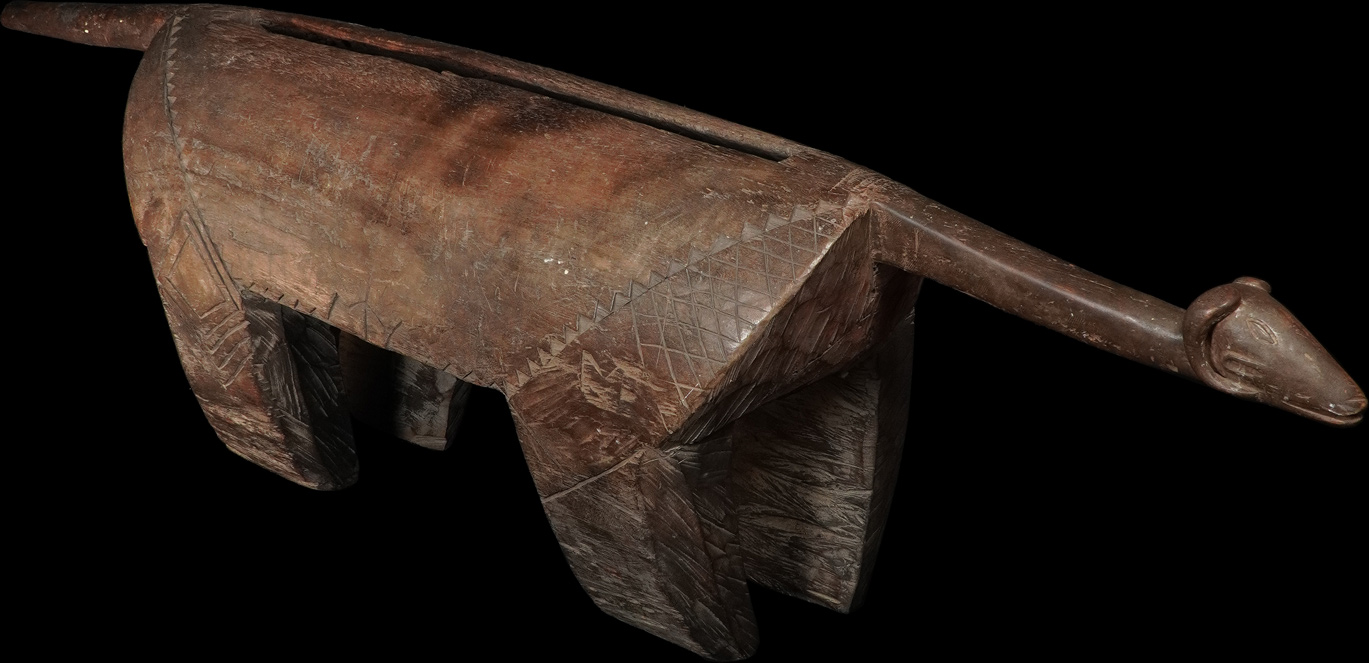
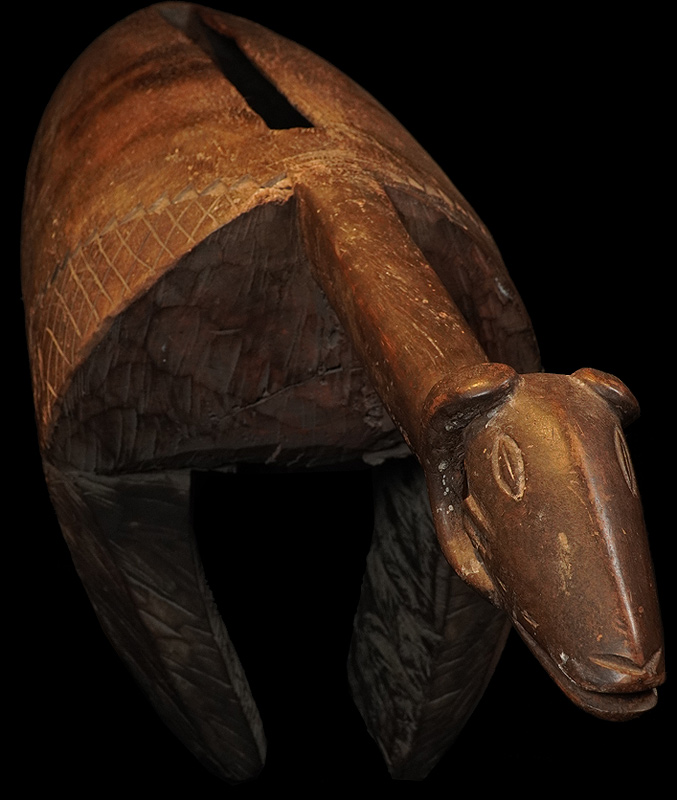
Zoomorphic Slit Drum (Lobala, Democratic Republic of the Congo)
Length: 220 cm
This monumental zoomorphic slit drum, carved from a single block of wood, belongs to the musical traditions of the Lobala people of the Ubangi region. Its elongated animal form combines the functional requirements of a resonating instrument with a striking sculptural presence. The massive body rests on four carved legs, while the projecting extensions at either end evoke the head and tail of a stylized animal.
The upper surface is defined by a long, narrow slit through which the hollow interior is struck to produce sound. The instrument's considerable dimensions and carefully articulated silhouette distinguish it from smaller, more compact forms of Central African slit drums.
In the Ubangi region, large zoomorphic slit drums were associated with local chiefs and other socially prominent individuals. Their possession could express authority and prestige, while their sound served communicative and musical purposes. These instruments were used to transmit messages between settlements and could also provide rhythmic accompaniment within larger musical ensembles.
The communicative function of a slit drum depends on the contrasting tones produced by striking the two lips of its opening. In several Central African traditions, these tonal differences reproduce coded elements of spoken language. Trained players can use established rhythmic and tonal patterns to convey information understood by members of the community. Messages may announce meetings, report significant events or communicate matters concerning local leadership and collective life.
The transmission of messages could extend beyond a single village. According to the documentation of Central African slit drums preserved by the Royal Museum for Central Africa in Tervuren, the sound of large instruments could carry over considerable distances, depending on the instrument's size, the force of the strokes, atmospheric conditions and the surrounding terrain. In some areas, drums in neighbouring settlements acted as relays, passing messages onward across a wider territory.
Knowledge of this form of communication required specialised training. The player had to master the established conventions of the drum language and know how to structure a message so that its meaning could be recognised by listeners. Although only selected individuals were authorised to play in some communities, the messages themselves could be understood by a much wider audience familiar with the spoken language and its tonal structure.
Jean-Sébastien Laurenty's study of Central African slit drums documents the diversity of their forms, regional names and social functions. Large zoomorphic examples associated with the Ubangi region, including those of the Lobala, represent a distinctive instrument type in which sound production, sculptural design and social authority intersect. The present drum illustrates this relationship through its imposing scale, animal-like silhouette and carefully structured surface ornament.
Musée royal de l'Afrique centrale, Tervuren. Educational text on Central African slit drums, their zoomorphic forms, communicative functions and social significance.
Literature / References
Laurenty, Jean-Sébastien (1968): Les tambours à fente de l'Afrique centrale. Annales, Série in-8°, Sciences humaines, no. 6. Tervuren: Musée royal de l'Afrique centrale.
Kubik, Gerhard (1989): Musikgeschichte in Bildern – Westafrika. Leipzig.