Africa
lozi drum Zambia
Lozi Drum (Lozi, Western Zambia)
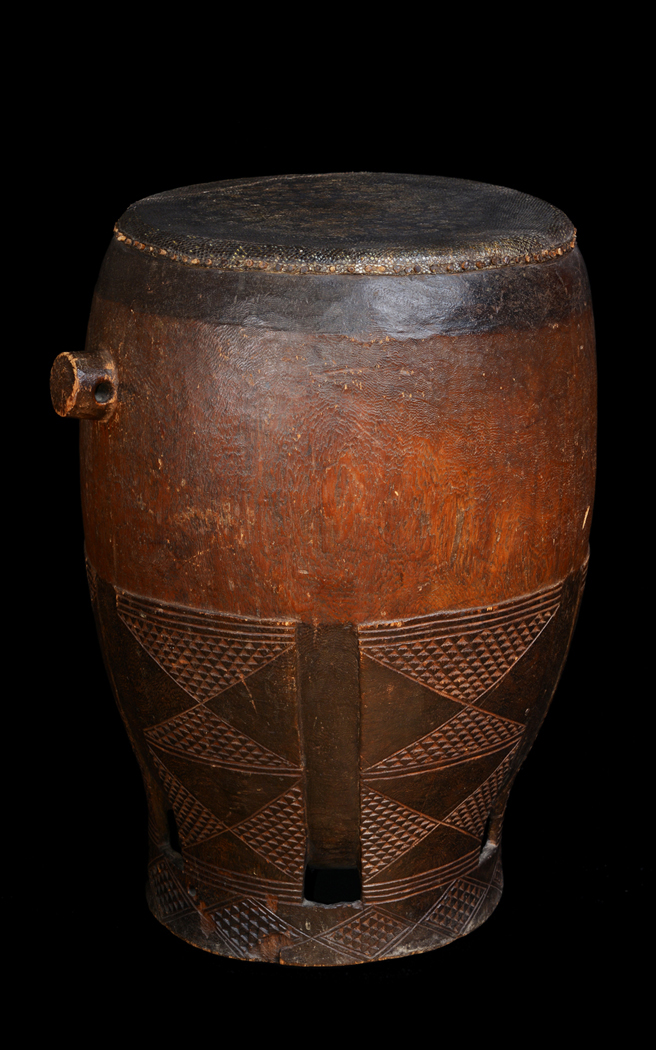
This ceremonial drum originates from the Lozi Kingdom (historically Barotseland) in present-day western Zambia. It belongs to the royal musical tradition of the Lozi people, whose centralized kingdom developed one of the most elaborate court cultures in south-central Africa. Within this tradition, drums fulfilled functions that extended far beyond musical accompaniment. They served as instruments of political authority, public communication, and ceremonial display, announcing important events at the royal court and reinforcing the prestige of the Litunga, the Lozi king.
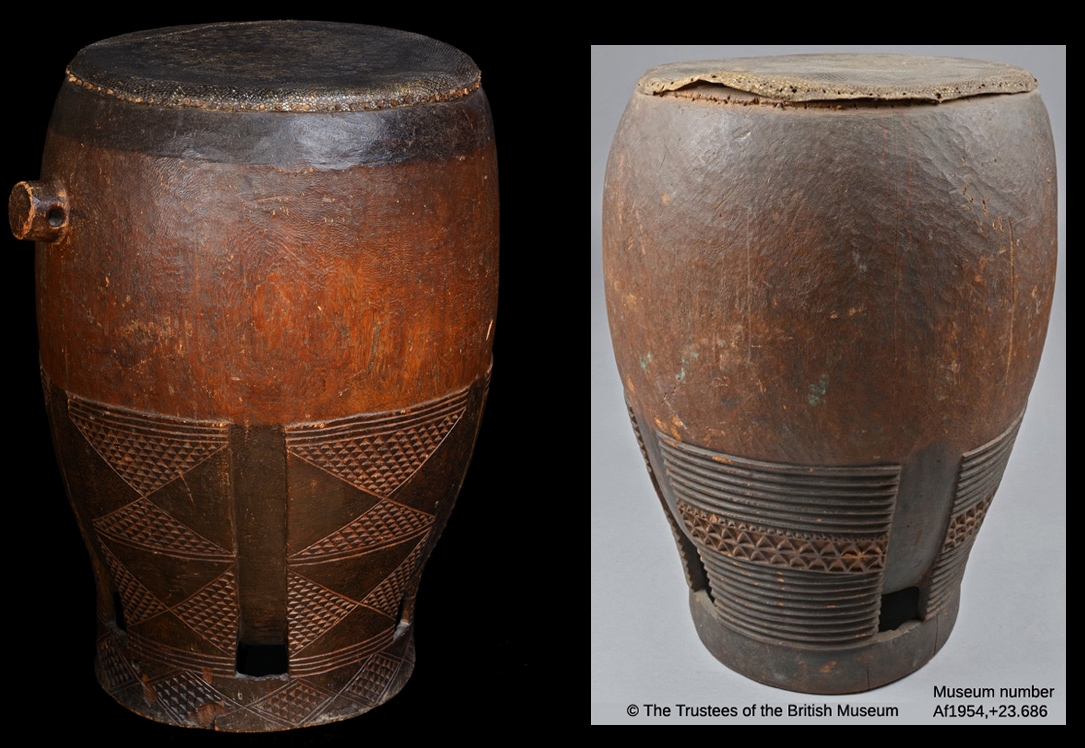
The drum is a large goblet-shaped, single-headed wooden membranophone carved from a single log. Its lower body is decorated with six carefully carved vertical panels, while a circular sound hole is cut into the base to improve resonance. The drumhead is traditionally made from monitor lizard (Varanus) skin and is secured around the rim by a hide band fastened with wooden pegs or nails. The body is partially fire-blackened, leaving a lighter undecorated band around the centre, a decorative treatment documented on several historic examples from the region.
Royal drums occupied an important position within Lozi ceremonial life. Historical accounts describe their use for announcing court sessions, royal processions, public ceremonies, and other events of political significance. Like many African court drums, they functioned both as musical instruments and as audible symbols of royal authority, their powerful sound carrying messages across considerable distances.
The present example closely corresponds to a Lozi drum preserved in the British Museum (Museum no. Af1954,23.686), purchased at Stevens' sale 26/27 August 1930, lot 600, by Mr Webb for Sir Henry Wellcome (price not recorded), as 'From Uniamezi, Africa' [Unyamwezi].. Comparable instruments have also been illustrated in early ethnographic publications documenting the musical traditions of northern Zambia and the neighbouring Congo region. Their consistent construction and decorative style demonstrate the continuity of Lozi royal craftsmanship throughout the twentieth century.
Drumming occupies a central place in the musical traditions of Zambia, where numerous ethnic groups have developed distinctive drum forms adapted to ritual, ceremonial, political, and recreational purposes. Among the Lozi, royal drums represent one of the highest expressions of this tradition, combining technical craftsmanship, ceremonial function, and symbolic authority into a single object.
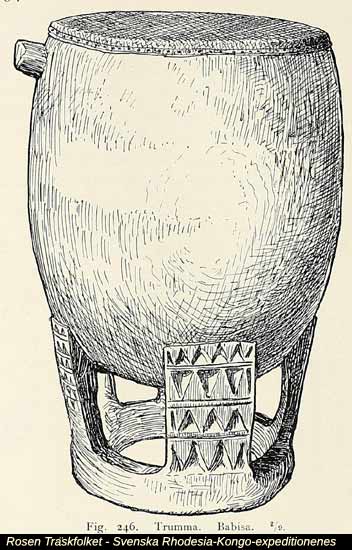
"Fig. 246 visar en nästan pukformig trumma. Den är 47,5 cm hög och har upptill en diameter av 29 cm. Foten, som är skuren i samma stycke som den egentliga trumstocken, är prydd med rader av inskurna trianglar... Trumskinnet av Varanus är fastspänt med tränaglar. En snarlik trumma från Marungu är avbildad i Ankermanns monografi över afrikanska musikinstrument."
Eric von Rosen. Träskfolket – Svenska Rhodesia-Kongo-expeditionens etnografiska forskningsresultat. Stockholm, 1916.
"The most widely used musical instrument in Zambia is the drum. Zambian drums come in a variety of sizes, shapes and purposes, and have specific names depending on their tribal origins and functional roles. They are generally accompanied by singing and dancing."
General description of Zambian musical traditions.
Bibliography
Brown, Ernest Douglas. Drums of Life: Royal Music and Social Life in Western Zambia. PhD Dissertation, University of Washington, 1984.
Jones, Arthur Morris. African Music in Northern Rhodesia and Some Other Places. London, 1958.
Kubik, Gerhard. Musikgeschichte in Bildern – Ostafrika. Leipzig, 1982.
Rosen, Eric von. Träskfolket – Svenska Rhodesia-Kongo-expeditionens etnografiska forskningsresultat. Stockholm, 1916.
Ankermann, Bernhard. Die afrikanischen Musikinstrumente. Berlin, 1901.