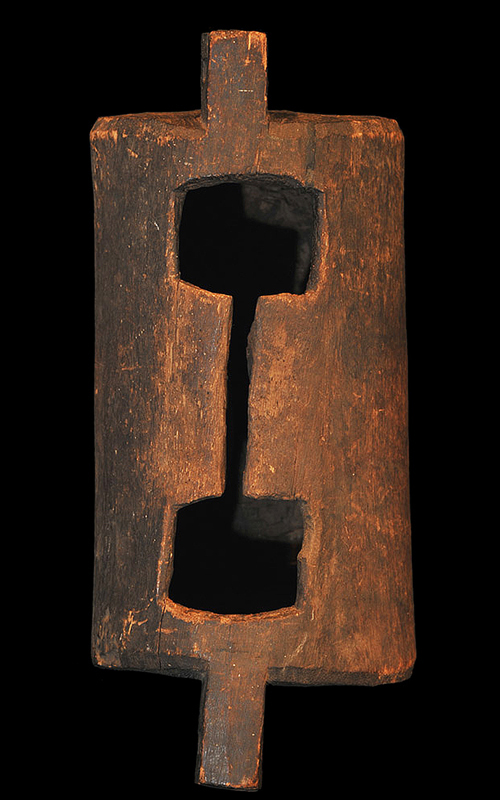
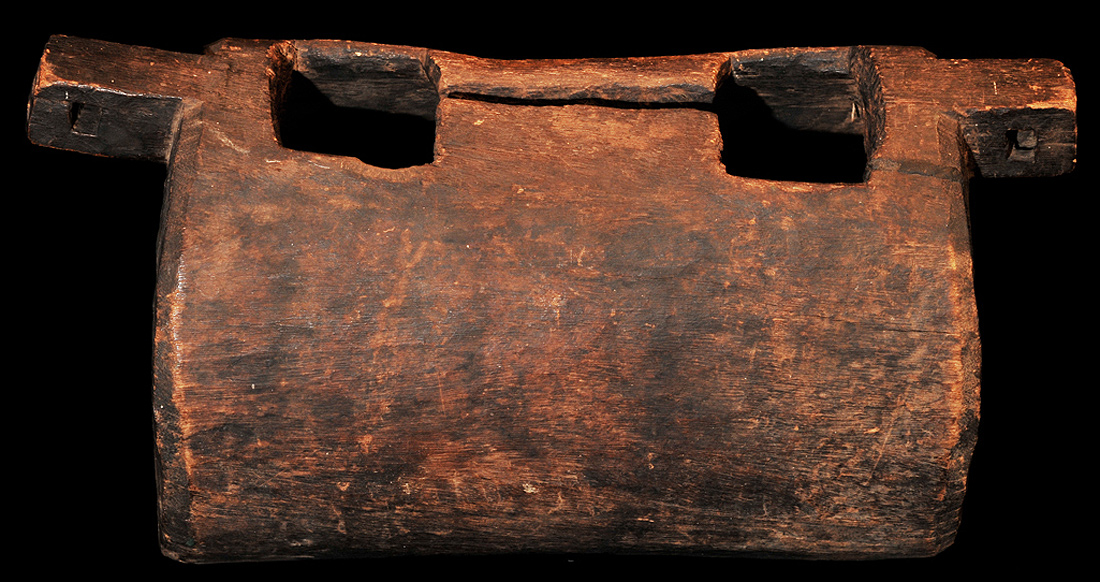
Maniema Area Slit Drum
Democratic Republic of the Congo
Slit drums are idiophones in which the wooden body itself produces the sound. The walls surrounding the slit are worked to different thicknesses, allowing contrasting tones to be produced when the sounding surfaces are struck. In Central Africa, such instruments were used both for musical performance and for the transmission of signals and messages.
The restrained form of this example is characteristic of an instrument whose acoustic construction is integrated directly into its wooden body. The extensive wear visible on the surface records prolonged use and handling. Rather than relying on figurative decoration, its aesthetic character derives from the balance between the solid outer form and the carefully opened interior.
Maniema was an important area of distribution for Central African slit drums. Museum collections and organological studies document several different forms from the region, demonstrating the considerable morphological variety of these instruments. The present example represents a distinctive variation within this wider Central African tradition.
Bibliography
Carrington, John F. 1944. The Drum Language of the Lokele Tribe.
Carrington, John F. 1949. Talking Drums of Africa. London: Carey Kingsgate Press.
Brincard, Marie-Thérèse. 1989. Sounding Forms: African Musical Instruments. Washington, D.C.: National Museum of African Art, Smithsonian Institution.
Kubik, Gerhard, Malamusi Moya Aliya, and András Varsányi. Afrikanische Musikinstrumente: Katalog und Nachdokumentation der Musikinstrumente aus Afrika südlich der Sahara in der Sammlung Musik des Münchner Stadtmuseums.
Laurenty, Jean-Sébastien. 1968. Les tambours à fente de l'Afrique centrale. Tervuren: Musée Royal de l'Afrique Centrale. 2 vols.
Royal Museum for Central Africa. Music of Central Africa: Instruments from the Democratic Republic of the Congo. Tervuren.