Yombe (Mayombe) drum Congo
Yombe (Mayombe) drum / Ngoma / Tambour
Democratic Republic of the Congo
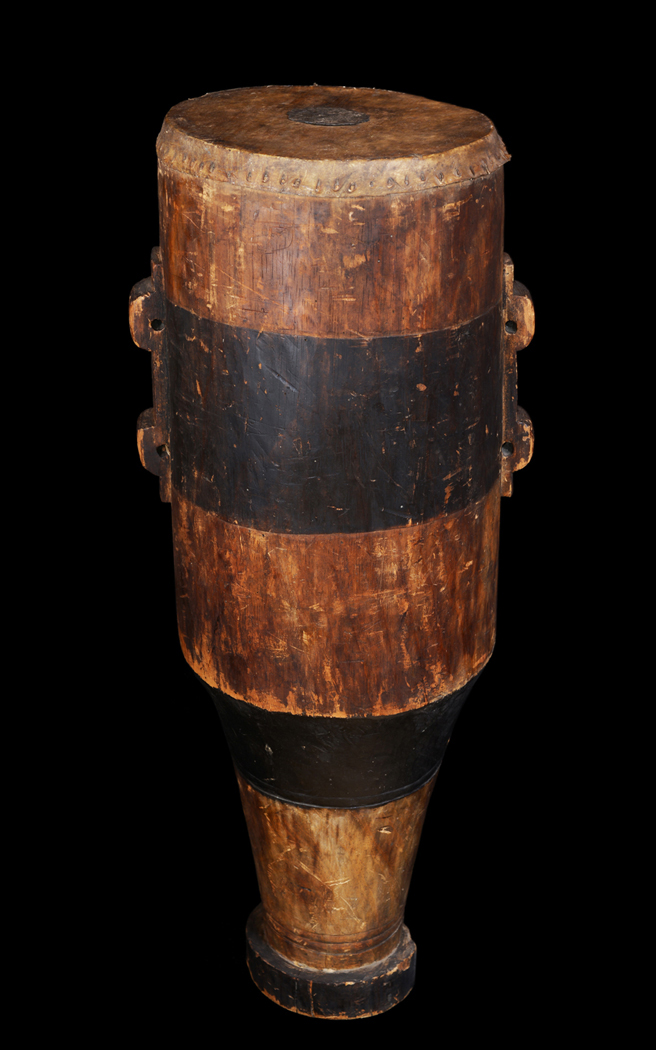
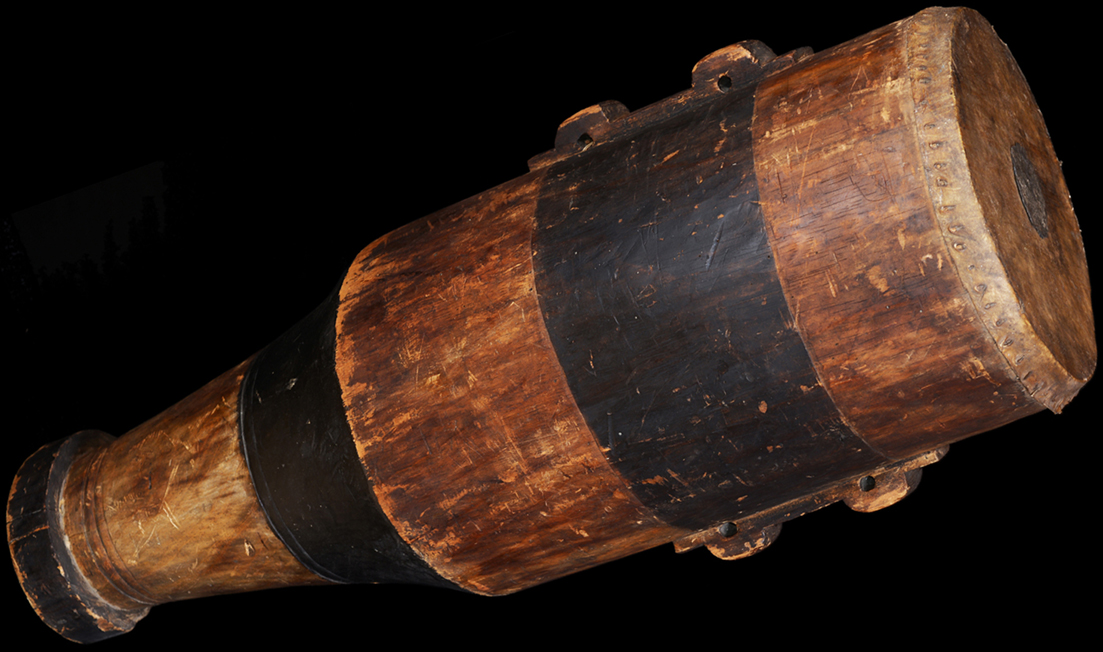
This single-headed drum represents a distinctive drum type of the Yombe (Mayombe) of the Lower Congo region. Carved from a single piece of wood, it is characterized by a tall tubular body that tapers gradually towards a short conical base. Its simple and well-balanced proportions reflect a regional tradition of drum making that differs significantly from the long Ingomba drums of the former Kingdom of Loango and from the hourglass drums of neighbouring peoples.
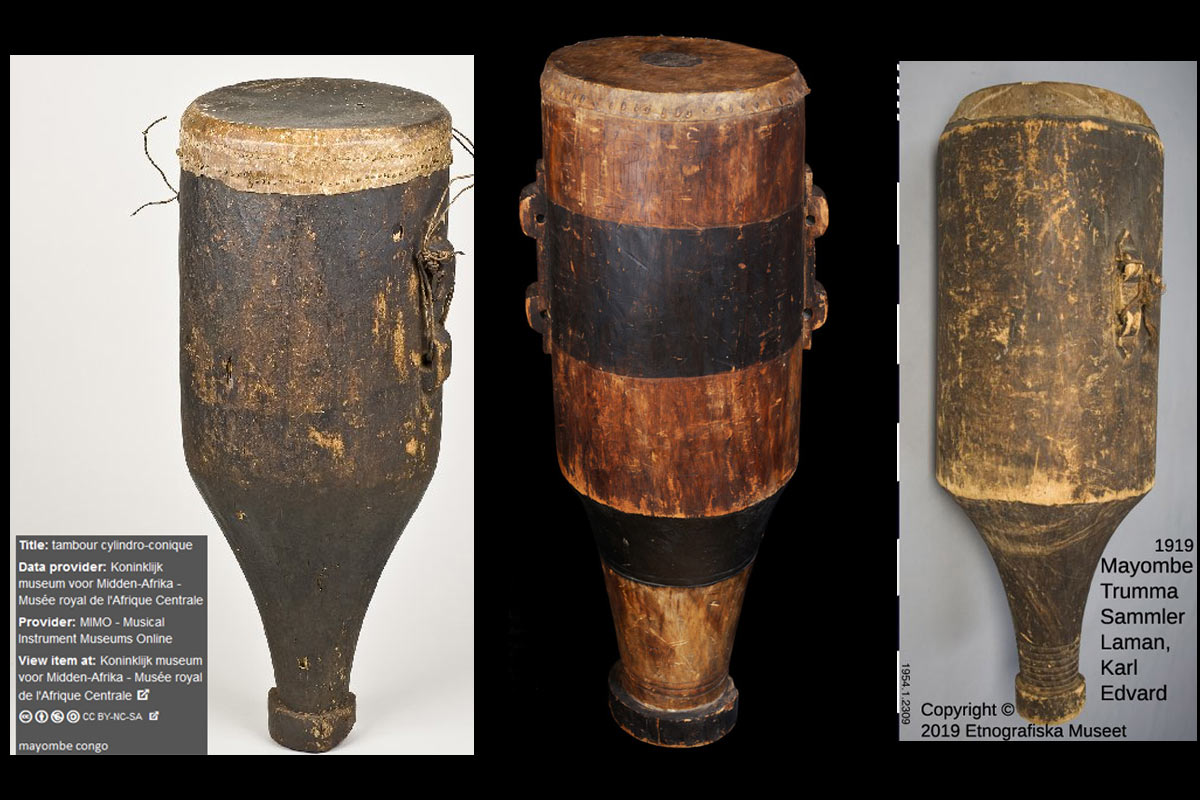
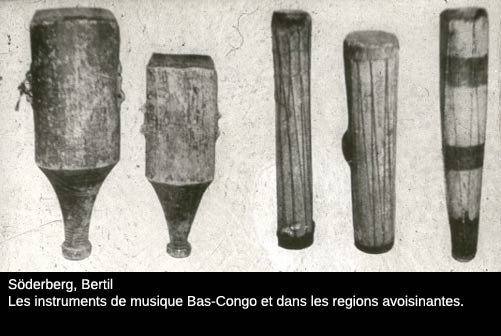
Comparable examples are preserved in the collections of the Royal Museum for Central Africa (Tervuren) and the Etnografiska Museet in Stockholm, including an instrument collected by the Swedish missionary Karl Edvard Laman in 1919. Bertil Söderberg classified this form as a distinct group of tubular, slightly conical single-headed drums occurring among several Kongo-speaking peoples of the Lower Congo. He further noted that a Mayombe drum previously described by Victor-Charles Mahillon probably belongs to the same organological group.
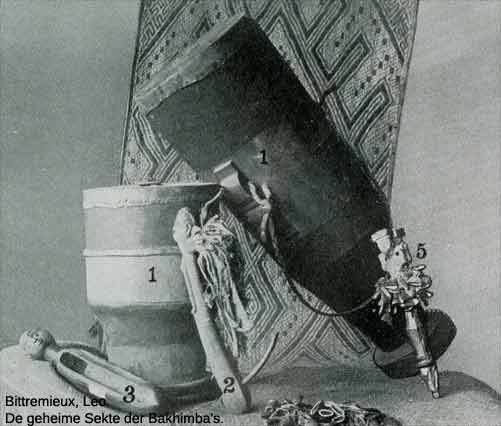
The membrane of the present instrument is attached directly to the wooden body by wooden pegs, while pairs of lateral suspension loops carry straps connected to a broad back strap. This arrangement allows the drum to hang slightly inclined in front of the player, leaving both hands free for performance while providing stable support for an instrument of this size. Comparable suspension loops can also be observed on historical museum specimens of the same drum type.
Although relatively restrained in its decoration, the elegant proportions and characteristic construction distinguish this drum as an important example of the musical traditions of the Mayombe region. Together with the documented museum specimens and historical publications, it represents a well-established regional drum type within the wider Kongo cultural area.
Source
"Le deuxième type de tambours à peau unique, tendue par des courroies ou des cordes, est un tambour tubulaire et un peu conique."
Bertil Söderberg, Les instruments de musique au Bas-Congo et dans les régions avoisinantes. Stockholm, 1956, p. 130.
"La collection de Laman contient un tambour appelé ndidi, provenant de chez les Sundi, aux environs de Nganda..."
Bertil Söderberg, Les instruments de musique au Bas-Congo et dans les régions avoisinantes. Stockholm, 1956, p. 130.
"Un tambour, mentionné par Mahillon, provenant du Mayombe, pourrait être classé ici."
Bertil Söderberg, Les instruments de musique au Bas-Congo et dans les régions avoisinantes. Stockholm, 1956, p. 130.
Historical documentation
Comparable Yombe (Mayombe) drums are preserved in the collections of the Royal Museum for Central Africa (Tervuren) and the Etnografiska Museet, Stockholm (Karl Edvard Laman Collection, 1919). Similar examples are illustrated by Victor-Charles Mahillon, Leo Bittremieux and Bertil Söderberg, documenting the continuity of this characteristic Lower Congo drum type during the late nineteenth and early twentieth centuries.
Literature
Bittremieux, Leo (1911). De geheime Sekte der Bakhimba's. Leuven: J. Reekmans-Vanderwaeren.
Bittremieux, Leo (1936). La société secrète des Bakhimba au Mayombe. Bruxelles: G. Van Campenhout.
Boone, Olga (1951). Les tambours du Congo Belge et du Ruanda-Urundi. 2 vols. Tervuren: Annales du Musée du Congo Belge, Ethnographie 1.
Mahillon, Victor-Charles. Catalogue descriptif et analytique du Musée instrumental du Conservatoire Royal de Musique de Bruxelles.
Söderberg, Bertil (1956). Les instruments de musique au Bas-Congo et dans les régions avoisinantes. Stockholm.
Tollebeek, Jo (2011). Mayombe – Ritual Sculptures from the Congo.
Wieschhoff, Heinz (1933). Die afrikanischen Trommeln und ihre außerafrikanischen Beziehungen. Stuttgart.