Africa
Senufo Drum Ivory Coast
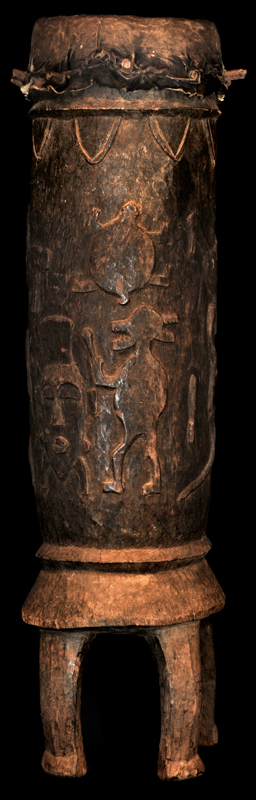
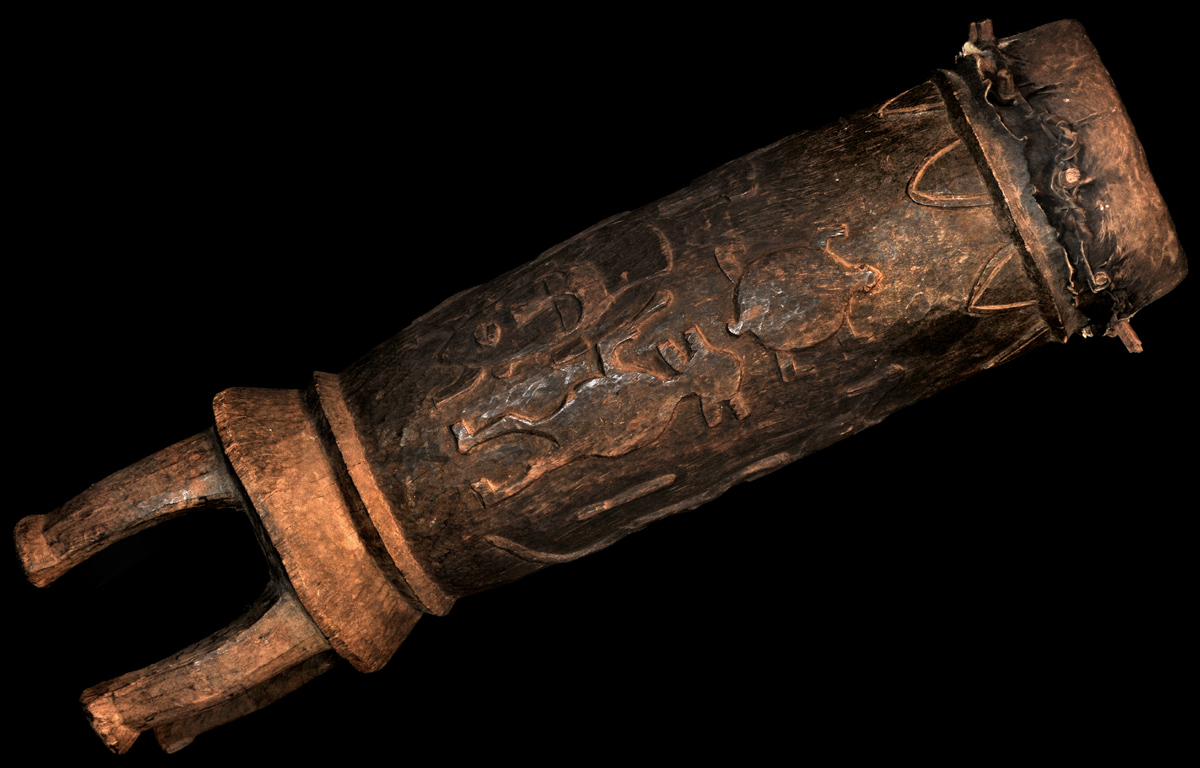
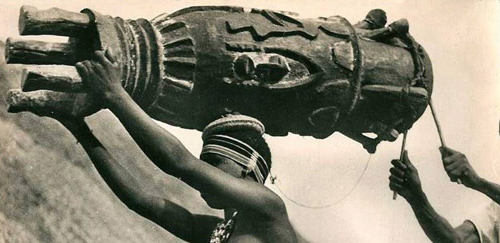
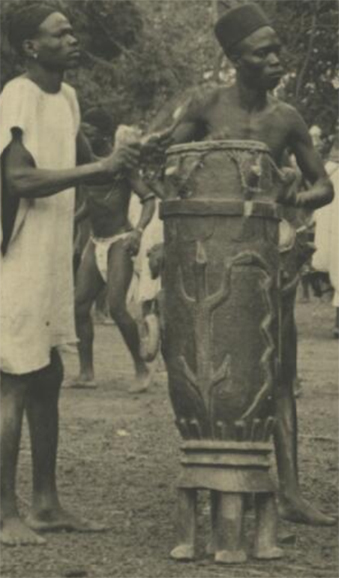
Tobinge Drum (Senufo, Ivory Coast)
The tobinge is one of the most distinctive ceremonial drums of the Senufo peoples of northern Côte d'Ivoire, southern Mali, and western Burkina Faso. Within Senufo society, drums occupy an important position in ritual life and accompany ceremonies that regulate social organization, the transmission of knowledge, and the relationship between the living and the spiritual world.
The present drum belongs to the tradition of the Poro, the men's initiation association that represents one of the central institutions of Senufo culture. The Poro is not only a religious organization but also an educational system through which knowledge, ethical values, and social responsibilities are transmitted from one generation to the next. Musical performance forms an essential component of these ceremonies, and specific instruments are reserved for particular ritual contexts.
From an organological perspective, the tobinge is a single-headed membranophone with a characteristic conical body resting on four supporting legs. The membrane is attached by means of wooden pegs, while the exterior is decorated with carved anthropomorphic and zoomorphic motifs. Such imagery reflects important elements of Senufo mythology and demonstrates the close relationship between sculpture and musical instruments within Senufo art.
Unlike many drums that primarily accompany dance or entertainment, the tobinge functioned within a restricted ceremonial context. Its performance was directly connected with initiation rituals and mask ceremonies, emphasizing the sacred character of both the instrument and its music.
"Among the most skilfully crafted drums of the region is the cone-shaped tobinge of the Senufo, whose skin is secured by means of pegs. Its body stands on four supporting legs and its exterior is decorated with zoomorphic relief carvings. The drum is played at the ceremonies of the mask-societies."
Meyer, Andreas: Afrikanische Trommeln – West- und Zentralafrika. Staatliche Museen Preußischer Kulturbesitz, Berlin, 1997, p. 241.
Gagliardi, Susan Elizabeth: Senufo sans frontières. La dynamique des arts et des identités en Afrique de l'Ouest. 2015.
Glaze, Anita J.: Art and Death in a Senufo Village. Indiana University Press, 1982.
Grootaers, Jan-Lodewijk; Eisenburger, Ineke: Forms of Wonderment: The History and Collections of the Afrika Museum, Berg en Dal. 2002.
Koloss, Hans-Joachim; Förster, Till: Die Kunst der Senufo – Elfenbeinküste. 1990.
Meyer, Andreas: Afrikanische Trommeln – West- und Zentralafrika. Staatliche Museen Preußischer Kulturbesitz, Berlin, 1997.