Tanzania Drum, exact regional attribution unknown
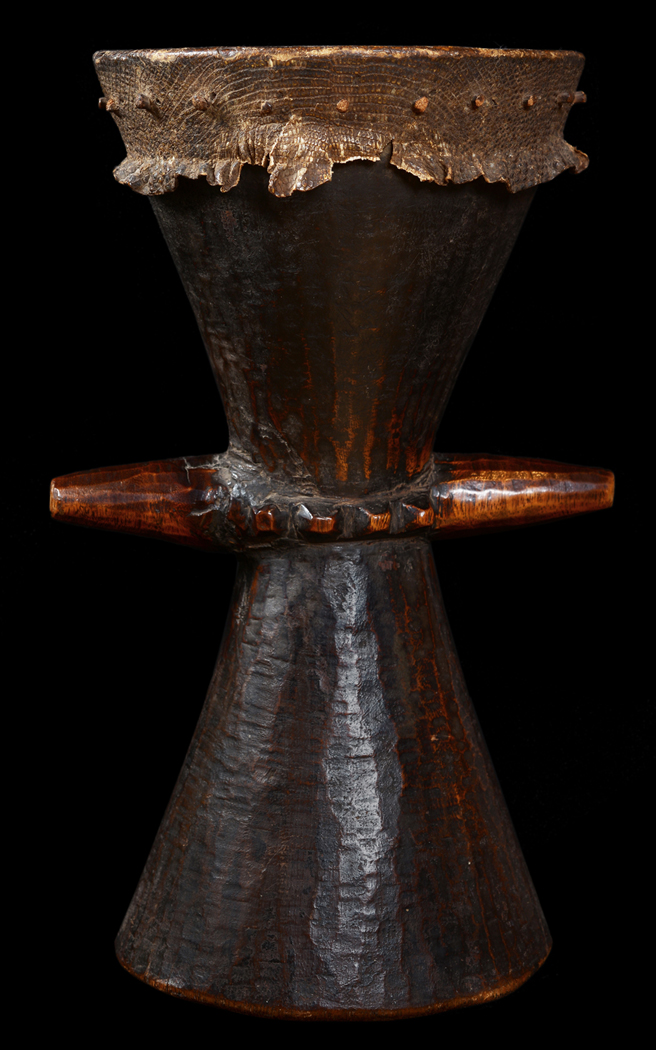
Tanzania Drum (Tanzania, exact regional attribution unknown)
This small single-headed drum, approximately 40 cm in height, is distinguished by an unusual anthropomorphic conception. The two lateral projections extending from the narrow central section can be interpreted as stylised arms, giving the instrument the appearance of a compact human body. Comparable figural drums are known from Tanzania, particularly from the artistic traditions of southeastern Tanzania, but no identical example has so far been located that would allow a secure attribution of this drum to a particular ethnic group.
The strongly articulated form is accompanied by carefully executed incised lines covering the wooden surface. Their regularity suggests the use of an adze in shaping and finishing the body. The combination of sculptural modelling and controlled linear incision indicates that considerable attention was given to the visual treatment of the instrument. Figural drums from Tanzania demonstrate that musical instruments could also serve as vehicles for anthropomorphic representation, although the precise meaning of such imagery varies according to cultural and ceremonial context.
The drumhead is made from monitor lizard skin and is secured to the wooden body with small wooden pegs. The use of reptile skin is documented for drums in several regions of Africa and is associated with durable membranes suitable for percussion instruments. In Tanzania, drums are used in a wide range of musical contexts, including dance, communal celebrations and ritual performances. Without information concerning the original place and circumstances of use, however, the specific function of this example cannot presently be established.
The unusual proportions and the apparent representation of arms suggest that the carver deliberately transformed the functional body of the drum into an anthropomorphic form. This relationship between musical function and sculptural expression is particularly significant in the context of Tanzanian woodcarving, where human forms and body features occur on a wide variety of objects with different practical and ceremonial functions.
At present, the exact regional and ethnic attribution of this drum remains open. Its distinctive form, small dimensions, monitor lizard membrane and finely worked surface make it an unusual example of Tanzanian musical material culture.
Further information concerning its provenance, local name or use would be of considerable importance for its identification and interpretation. If readers possess information about a comparable drum or can identify this particular type, the Drum Museum would be very grateful for any information or contact.
Jahn, Fred (ed.): Tanzania: Meisterwerke afrikanischer Skulptur / Sanaa za Mabingwa wa Kiafrika. Munich, 1994.
Brincard, Marie-Thérèse (ed.): Sounding Forms – African Musical Instruments. New York, 1989.
Kubik, Gerhard: Tanzania's Music by Regions. 1984.
Kubik, Gerhard: Tansanian Music Bibliography. 1984.
Hartwig, Gerald W.: Sculpture in East Africa. African Arts 11, no. 4, 1978, pp. 62–96.
Meyer, Andreas: Afrikanische Trommeln – West- und Zentralafrika. Staatliche Museen Preußischer Kulturbesitz, Berlin, 1997.
Wieschhoff, Heinz: Die afrikanischen Trommeln und ihre außerafrikanischen Beziehungen. Stuttgart, 1933.
Hartenberger World Musical Instrument Collection: Makonde Figural Drum (Likuti) and Makonde Ritual Drum.