Africa
Central African Slit Drum
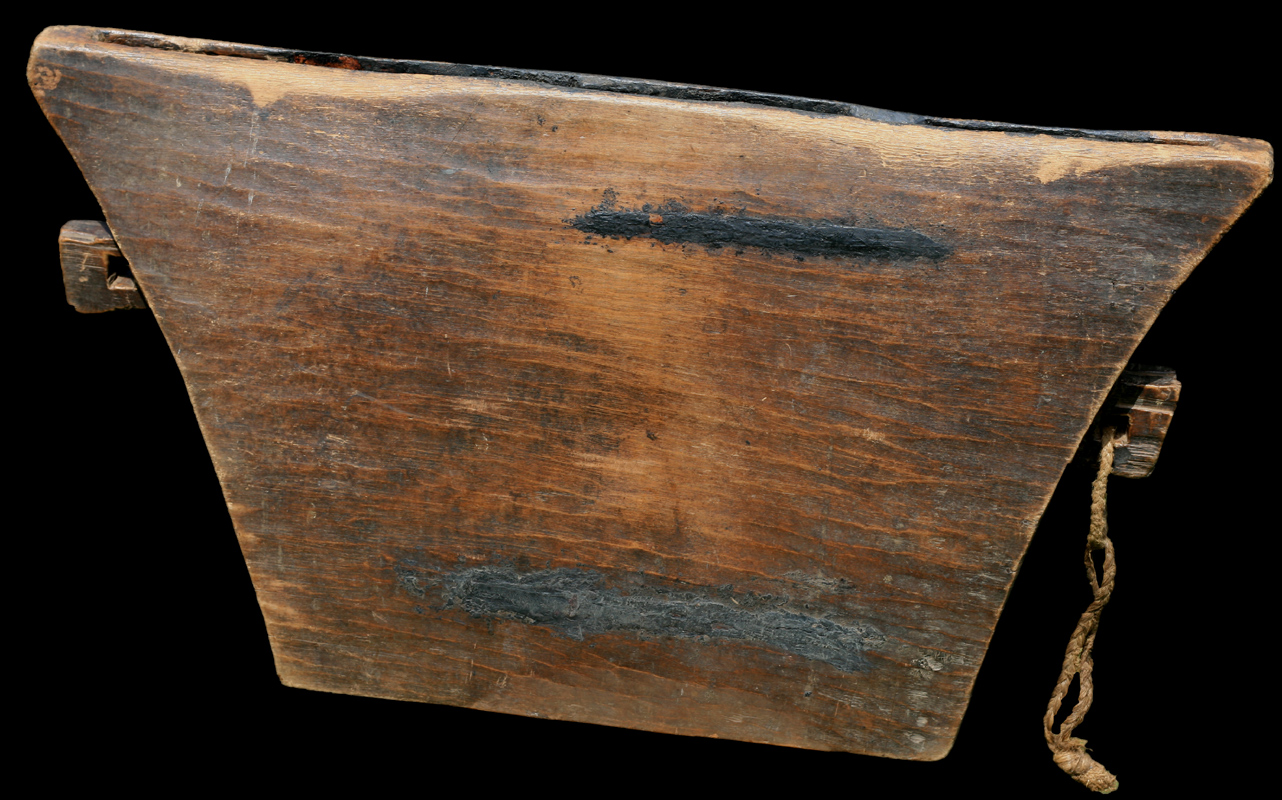

Central African Slit Drum probably Wasongola / Songola (Democratic Republic of the Congo)
The Wasongola, also known as Songola, are a Bantu-speaking people of the Democratic Republic of the Congo, traditionally living in the forested regions of the central and eastern part of the country, particularly around the Lualaba River and its tributaries. Their cultural traditions developed within a region characterised by extensive forest environments and long-standing interaction between neighbouring communities.
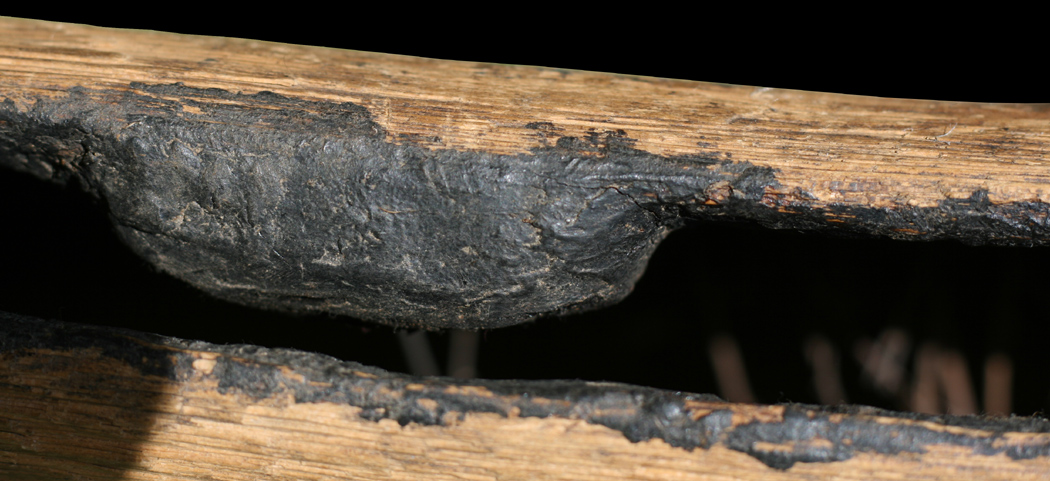
This large, portable slit drum, probably associated with the Wasongola / Songola of the Democratic Republic of the Congo, is distinguished by its broad, slightly tapering wooden body and its unusual carrying system. Unlike stationary slit drums, the instrument was designed to be suspended from the player's body and played while being carried. Its longitudinal opening was hollowed into the wooden body, leaving two resonating walls of different thicknesses. When struck, these produce contrasting pitches that can be combined into rhythmic and tonal patterns.
A distinctive feature of this particular instrument is its carrying system. At both sides of the wooden body are carefully carved openings into which wooden spacer bars could be inserted. Together with a rope or strap, these elements allowed the drum to be suspended around the player's body while keeping it securely positioned in front of the torso. This construction distinguishes the present object from stationary forms of Central African slit drums and provides important evidence for its intended mobile use.
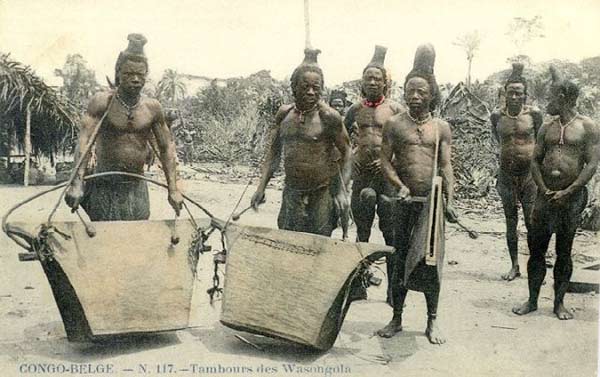
The historical photograph accompanying the object provides a rare visual comparison. It shows two men carrying large slit drums horizontally in front of their bodies. The position of the players and the construction of the carrying system correspond closely with the features preserved on the present drum. The photograph therefore supports the interpretation that this type of slit drum was specifically designed for mobile performance rather than stationary playing.
Slit drums were among the important means of communication in Central Africa. Their contrasting pitches could be organised according to the tonal and rhythmic structure of local languages, enabling trained specialists to reproduce patterns that conveyed information over considerable distances. At the same time, such instruments were used in communal music, dance and ceremonial contexts. Their function therefore extended beyond signalling and included participation in the social and musical life of the community.
The present drum preserves clear evidence of intensive use. The worn wooden surface, the damaged edges of the slit and the traces around the carrying attachments reflect repeated handling and performance. Together with the distinctive construction of the instrument and the historical photographic evidence, these features provide an unusually direct insight into the practical use of a portable Central African slit drum: carried by the musician, secured in front of the body and played as both a sounding instrument and a means of communication.
Bittremieux, Léo: De geheime Sekte der Bakhimba's. Leuven, 1911.
Bittremieux, Léo: La société secrète des Bakhimba au Mayombe. Bruxelles: G. Van Campenhout, 1936.
Boone, Olga: Les tambours du Congo Belge et du Ruanda-Urundi. 2 vols. Tervuren: Annales du Musée du Congo Belge, Ethnographie 1, 1951.
Brincard, Marie-Thérèse (ed.): Sounding Forms – African Musical Instruments. New York, 1989.
Laurenty, Jean-Sébastien: Les tambours à fente de l'Afrique centrale. Tervuren, 1968.
Wassing, R.: Muziek en dans in Afrika. Museum voor Land- en Volkenkunde, Rotterdam, 1960.
Wieschhoff, Heinz: Die afrikanischen Trommeln und ihre außerafrikanischen Beziehungen. Stuttgart, 1933.