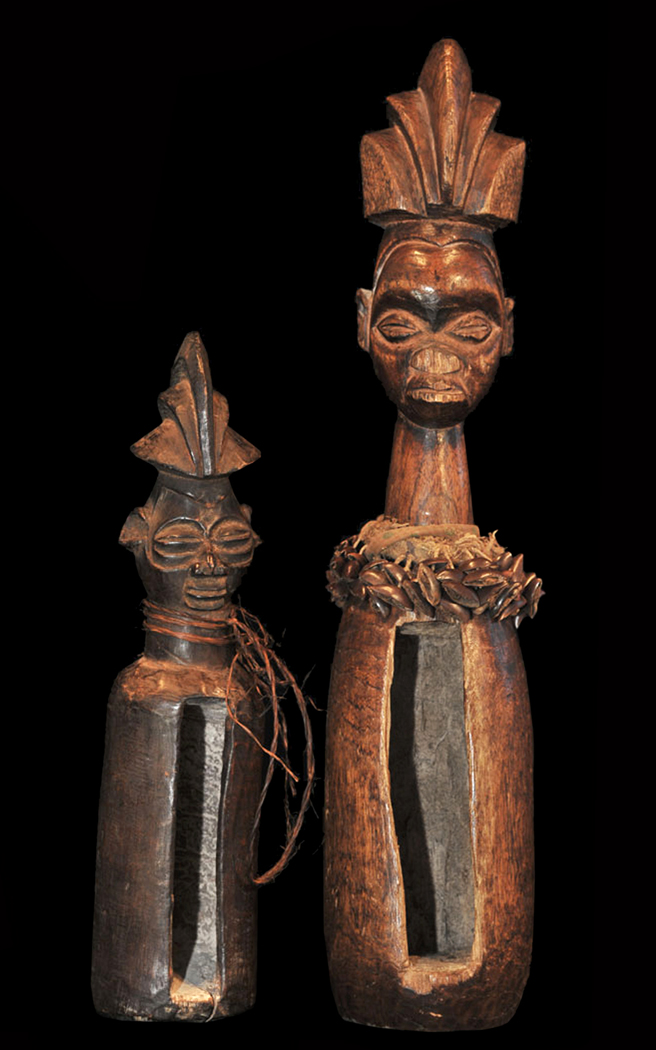
Yaka–Suku slit gong (Mukoku) / Democratic Republic of the Congo
Yaka–Suku slit gong (Mukoku) / Slit idiophone / Tambour à fente
Democratic Republic of the Congo
The Mukoku is a carved slit idiophone used by the Yaka and Suku peoples of the Kwango region in the southwestern Democratic Republic of the Congo. Although commonly referred to as a slit drum, it produces sound through the vibration of its wooden body and therefore belongs organologically to the family of slit idiophones. Among the Yaka, the Mukoku forms an integral part of the ritual equipment of the Nganga, the diviner-healer, where music, sculpture and ritual practice are inseparably connected.
The instrument is carved from a single block of wood with an elongated resonating slit and is often crowned by an anthropomorphic figure. This sculptural treatment reflects the characteristic Yaka tradition in which ritual objects combine symbolic imagery with practical function. Rather than serving solely as a musical instrument, the Mukoku occupies a central place within ceremonies of divination, healing and initiation.
René Devisch has shown that Yaka healing is understood as a process of symbolic regeneration in which illness is interpreted within a broader social and spiritual framework. During the initiation of a Nganga, groups of slit gongs accompany the candidate through successive ritual stages marking the transformation from an ordinary person into a ritual specialist. During divination sessions, the Mukoku is struck with carefully structured rhythmic patterns while the healer invokes spiritual forces and punctuates ritual speech. The instrument therefore contributes not only to the acoustic atmosphere of the ceremony but also to its symbolic and therapeutic effectiveness.
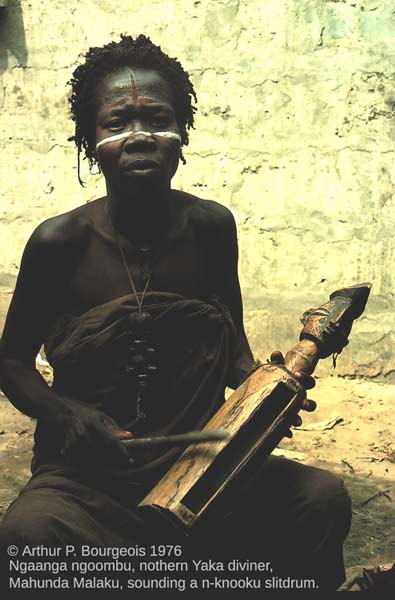
Ethnographic studies further describe the Mukoku as one of the principal ritual objects belonging to the Nganga. Depending on the context, it may serve as a sounding instrument, a ceremonial seat or a container associated with the preparation and presentation of ritual medicines. Historical field photographs by Arthur P. Bourgeois document the Mukoku in active use by Yaka diviners, preserving valuable evidence of its performance practice and ceremonial significance.
Source
"During rites of initiation of a diviner, a chorus of slit-gongs will be sounded as the initiate is led through a series of activities that transform her from an ordinary human to a spiritual agent. Also in divination sessions with a family group or an individual, the diviner will strike the gong with intricate rhythms while calling upon spiritual powers or punctuate statements with a single sharp strike upon the instrument."
Arthur P. Bourgeois, Art of the Yaka and Suku. Meudon: Alain et Françoise Chaffin, 1984.
"But as Devisch and Bourgeois have argued, they are not only important for the sounds they create when struck by a stick during a ritual. They are visually significant as well."
Arthur P. Bourgeois, Art of the Yaka and Suku. Meudon: Alain et Françoise Chaffin, 1984.
"Healing is viewed as a process of regeneration."
René Devisch, The Therapist and the Source of Healing among the Yaka of Zaire. Culture, Medicine and Psychiatry, Vol. 14, 1990.
"The therapist explicitly acts as a symbolic substitute of the patient's maternal uncle."
René Devisch, The Therapist and the Source of Healing among the Yaka of Zaire. Culture, Medicine and Psychiatry, Vol. 14, 1990.
Historical photograph
Field photograph by Arthur P. Bourgeois (1976) showing the Yaka diviner (Nganga Ngoombu) Mahunda Malaku of northern Yaka sounding a Mukoku slit idiophone. The image documents the instrument in its original ritual context and provides valuable ethnographic evidence of its performance practice.
Literature
Bourgeois, Arthur P. (1984). Art of the Yaka and Suku. Meudon: Alain et Françoise Chaffin.
Devisch, René (1990). The Therapist and the Source of Healing among the Yaka of Zaire. Culture, Medicine and Psychiatry, Vol. 14.
de Beir, L. (1975). Religion et magie des Bayaka.
Himmelheber, Hans (1960). Negerkunst und Negerkünstler.
Himmelheber, Hans. Zaire 1938/39. Photographic Documents on the Arts of the Yaka, Pende, Tshokwe and Kuba.
Pemberton, John. Insight and Artistry in African Divination.
Plancquaert, Michel (1930). Les Sociétés Secrètes chez les Bayaka.
Plancquaert, Michel (1932). Les Jaga et les Bayaka du Kwango.