Himalaya
Himalayan Folk Drum Damphu
Introduction
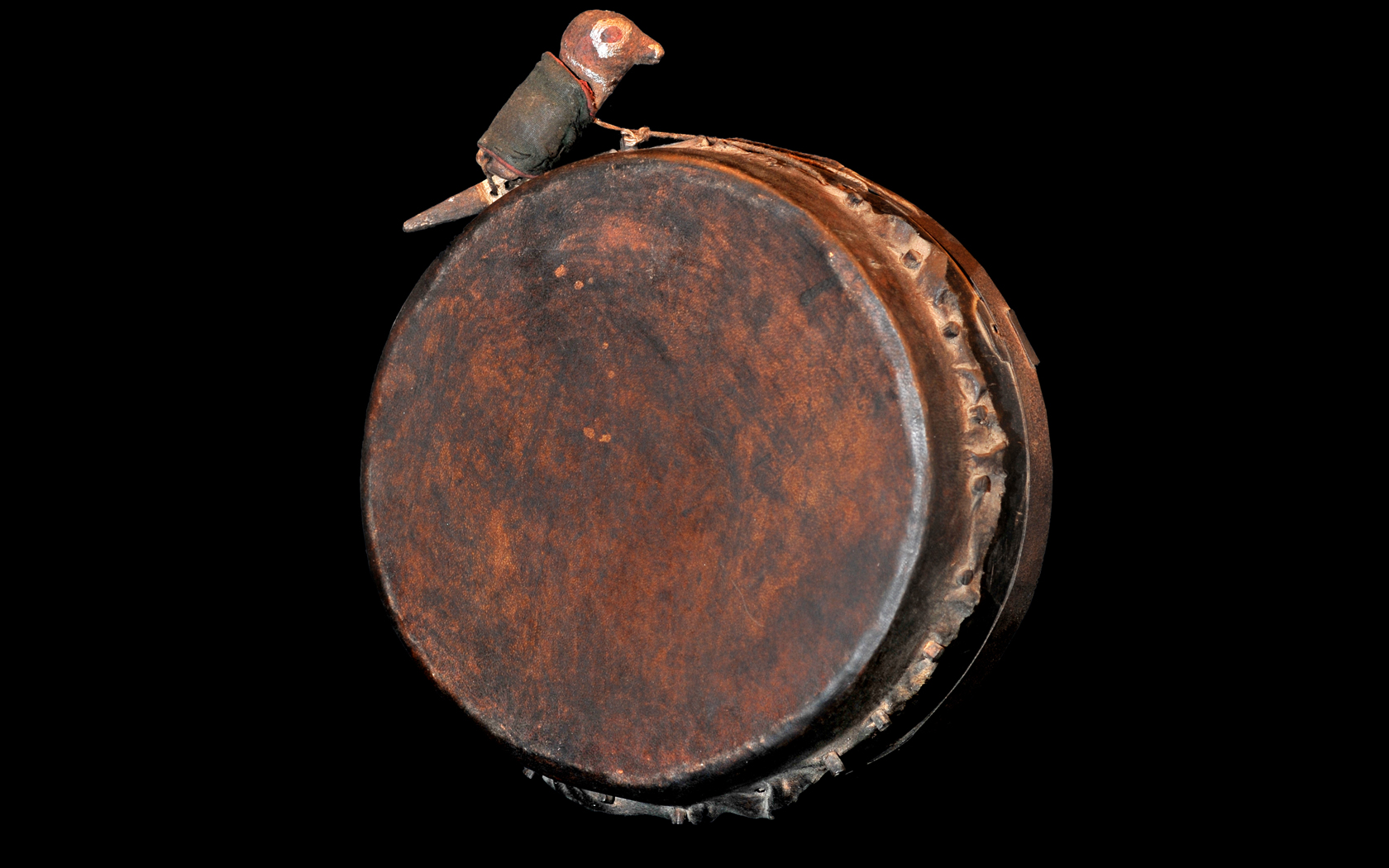
The Damphu is a traditional frame drum of the Tamang people of Nepal. Played with a bamboo beater, it accompanies religious ceremonies, communal celebrations, and important social occasions, making it one of the most characteristic musical instruments of Tamang culture.
Construction
A remarkable variant of the Damphu features a carved bird mounted above the drumhead. The figure is connected to an internal mechanism operated by strings, allowing the musician to animate the bird while playing. Although Damphu drums vary in size, they share the same basic construction and the distinctive movable bird.
Cultural Context
The Damphu plays an important role in ceremonies of worship, ritual performances, festivals, and community gatherings. Its rhythmic accompaniment is closely associated with Tamang traditions, where music reinforces both social cohesion and spiritual expression.
Artistic Significance
The bird-shaped Damphu represents a unique combination of musical instrument, sculpture, and kinetic art. Beyond its musical function, the animated bird conveys symbolic meanings that may vary according to the ritual context, reflecting the close relationship between mythology, spiritual beliefs, and musical performance in Tamang tradition.
excerpt from: Dutta, Krishnendu (2014) A Glimpse of Tamang Musical Instruments. Journal of International Academic Research for Multidisciplinary Impact Factor 1.393, ISSN: 2320-5083, Volume 2, Issue 7
Bibliography:
Adhikari, Biraj. Sikkim: The Wounds of History. Pub Biraj Adhikari
Arha, R.S. Singh, Latika. (2008) Glimpses of Sikkim. Jaipur, India: ABD Publishers
Bhargava, Gopal. (2008) Encyclopedia of Art and Culture in India (Sikkim & U.T.)India: Isha Books
Dutta, Krishnendu (2014) A Glimpse of Tamang Musical Instruments. Journal of International Academic Research for Multidisciplinary Impact Factor 1.393, ISSN: 2320-5083, Volume 2, Issue 7
Edgar, J. Ware. (2005) Sikhim and the Thibetan Frontier. Varanasi: Pilgrims Publishing
Ghosh, Mandira. (2004) Folk Music of the Himalayas. Gurgaon, India: Shubhi Publications
Levin, Theodore. Where Rivers and Mountains Sing – Sound, Music, And Nomadism in Tuva and Beyond. Bloomington and Indianapolis: Indiana University Press
Raatan, T. (2008) Encyclopedia of North-East India (In 3 Vols) (Sikkim, Nagaland, Tripura) (Vol 3). Delhi: Kalpaz Publications
Tamang – Peoples of Sikkim (Series). Pilgrims Publishing.