Shaman Drum Body with Buddhist Lotus Handle
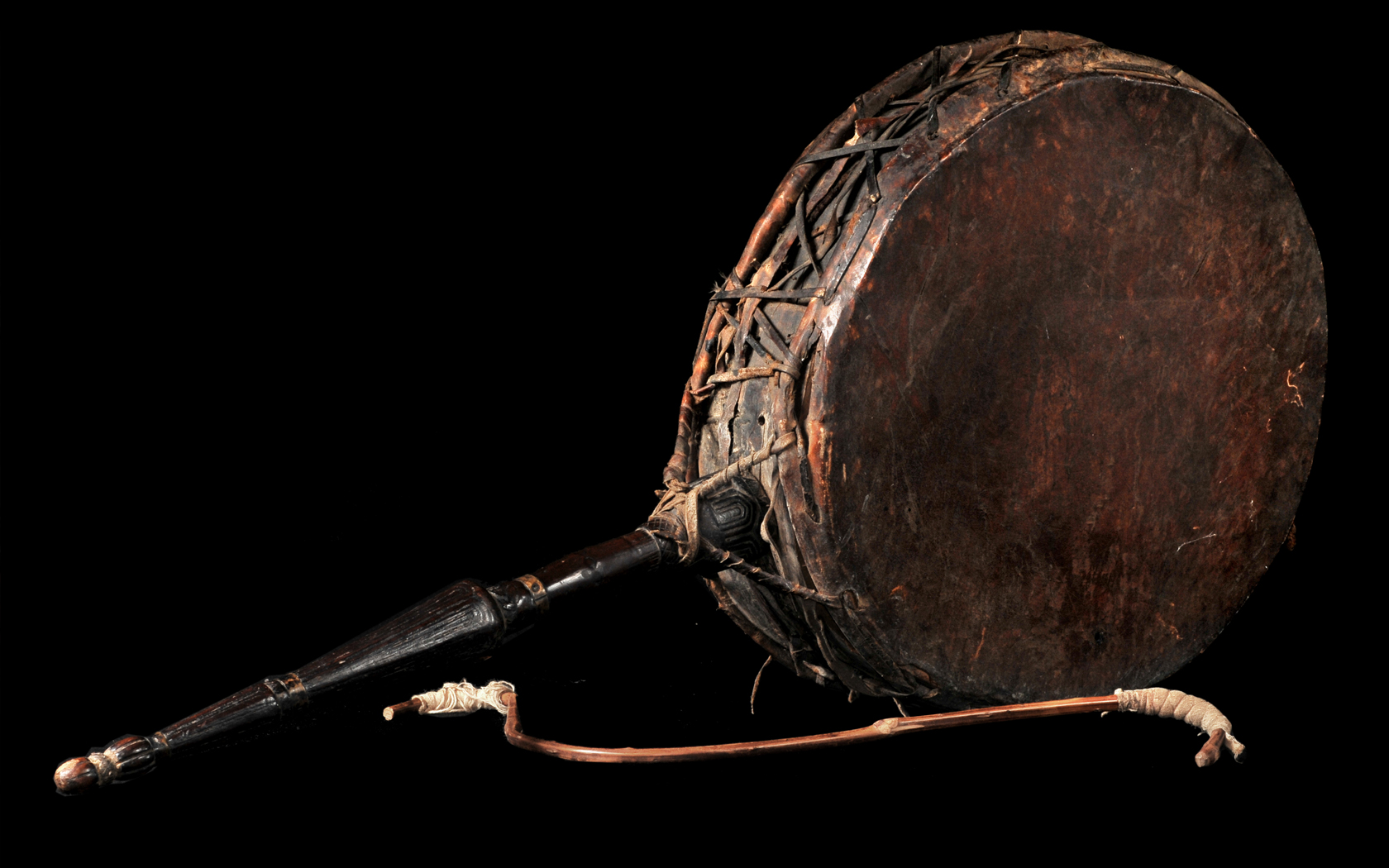
Hybrid Himalayan Frame Drum (Nepal)
This remarkable Himalayan frame drum combines characteristics traditionally associated with both indigenous shamanic and Tibetan Buddhist ritual traditions. Its construction demonstrates that the distinction between the Tamang dhyāngro and the Buddhist nga is not always clear-cut. Rather than representing two entirely separate categories of ritual instruments, both drum types belong to a closely related organological tradition that developed within the same cultural landscape of the Nepal Himalayas.
The drum consists of a bent wooden frame covered on both sides with animal hide, preserving the characteristic construction of the Himalayan double-headed frame drum. Unlike the elaborately decorated bodies of many Buddhist nga drums, the wooden frame remains exposed and undecorated, corresponding closely to the indigenous manufacturing tradition of the Tamang dhyāngro. In contrast, the handle is carved as a stylised lotus, the most characteristic handle form of Buddhist ritual drums and one of the principal symbols of Buddhist religious iconography.
The principal differences concern symbolic and decorative features rather than their fundamental construction. Buddhist examples are frequently ornamented, painted and equipped with lotus handles, whereas shamanic drums generally retain visible wooden frames and often employ ritual dagger (phurbu) handles. Nevertheless, these distinctions represent variations within a shared organological concept rather than evidence of entirely separate technological traditions.
This drum therefore represents an important example of Himalayan religious and artistic interaction. Its hybrid appearance reflects a process of cultural exchange in which ritual specialists from neighbouring traditions adopted selected symbolic forms while preserving the functional identity of their ceremonial instruments. Instead of illustrating a strict boundary between Buddhism and indigenous shamanism, the instrument demonstrates the permeability of religious traditions and the dynamic transmission of ritual technologies across cultural communities.
Interpretation
The interpretation presented here follows the comparative ethnological research of Michael Oppitz. His studies of Himalayan ritual traditions demonstrate that Buddhist nga drums and Tamang shamanic dhyāngro drums belong to a common organological tradition whose structural, functional and historical similarities are considerably more pronounced than their visible differences. Hybrid instruments combining features of both traditions should therefore be understood as products of long-term cultural interaction rather than as anomalies or later alterations.
Selected References
Oppitz, Michael (2013): Morphologie der Schamanentrommel.
Oppitz, Michael (2013): Schamanen im Blinden Land. (5 DVDs + 2 CDs).
Pannier, F. (2007): Art chamanique népalais – Nepalese Shamanic Art. Galerie Le Toit du Monde.
Nioradze, G. (1925): Der Schamanismus bei den sibirischen Völkern. Strecker und Schröder.
Eliade, Mircea (1964): Shamanism: Archaic Techniques of Ecstasy.
Diószegi, Vilmos; Hoppál, Mihály (1978): Shamanism in Siberia. Akadémiai Kiadó, Budapest.
Hoppál, Mihály (1994): Schamanen und Schamanismus. Pattloch, Augsburg.
Diószegi, Vilmos (1963): Glaubenswelt und Folklore der sibirischen Völker.
Manker, Ernst (1938): Die Lappische Zaubertrommel – Die Trommel als Denkmal materieller Kultur. Acta Lapponica I.
Manker, Ernst (1950): Die Lappische Zaubertrommel – Die Trommel als Urkunde geistigen Lebens. Acta Lapponica VI.
Hitchcock, John; Jones, R. (eds.) (1976): Spirit Possession in the Nepal Himalayas.
Mastromattei, R.; Farano, F. (2006): Rta. Sciamani in Eurasia. Il rito che sopravvive.
Riboli, Diana (2000): Tunsuriban. Shamanism in the Chepang of Central and Southern Nepal.
de Sales, Anna (1991): Je suis né de vos jeux de tambours. La religion chamanique des Magar du Nord.