Himalaya
Tamang Shaman Drum Nepal
Introduction
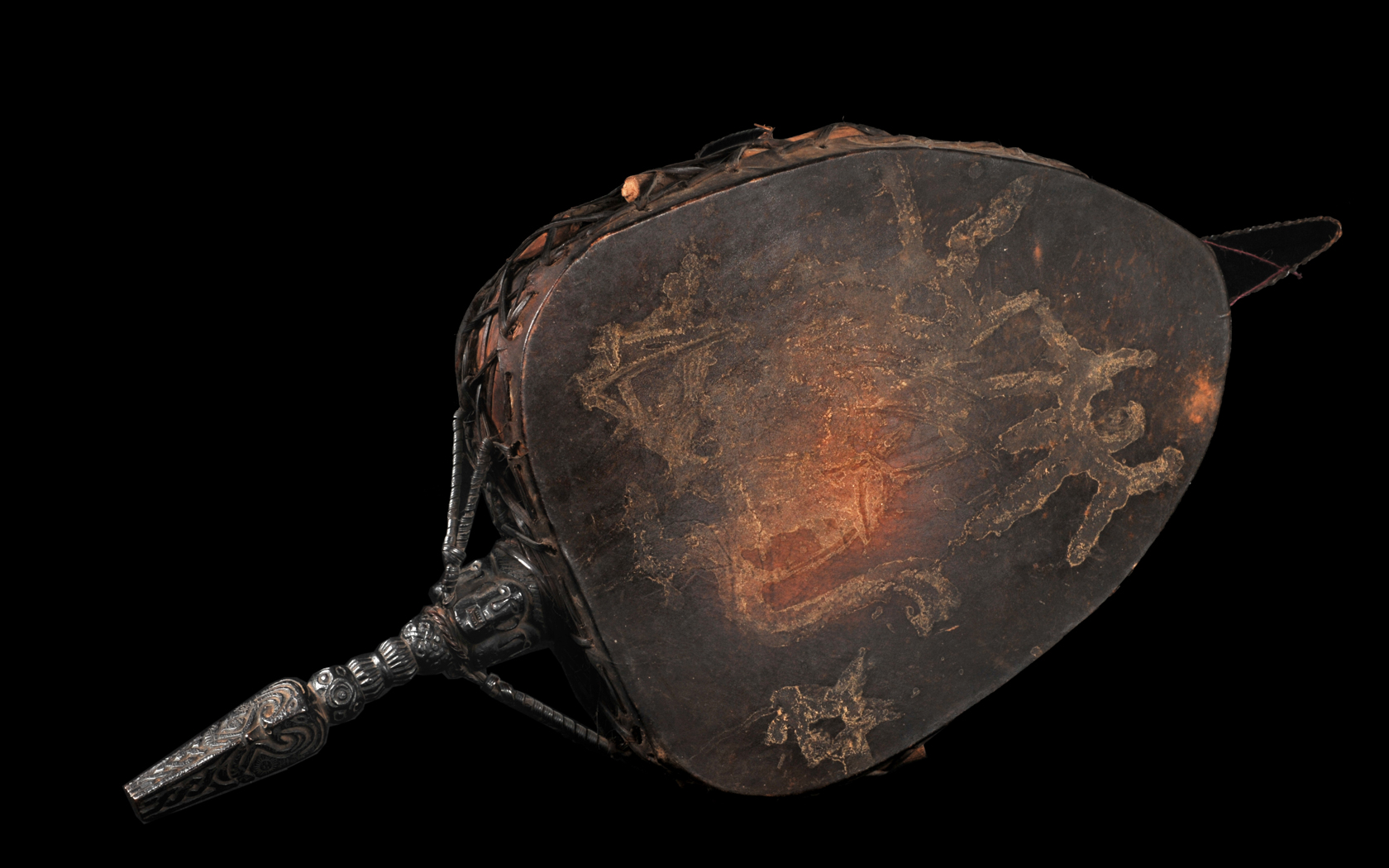
The Dhyangro (also transliterated Dhyāngro or Denguru) is the principal ritual frame drum of the Tamang shamans (bompo) of the Nepal Himalayas. More than a musical instrument, it is regarded as a sacred ritual implement through which communication with ancestral spirits, protective deities, and other supernatural beings is established. During healing ceremonies, divination, funerary rites, and seasonal rituals, the drum provides the rhythmic framework that enables the shaman to enter an altered state of consciousness and perform ritual mediation on behalf of the community.
Organology
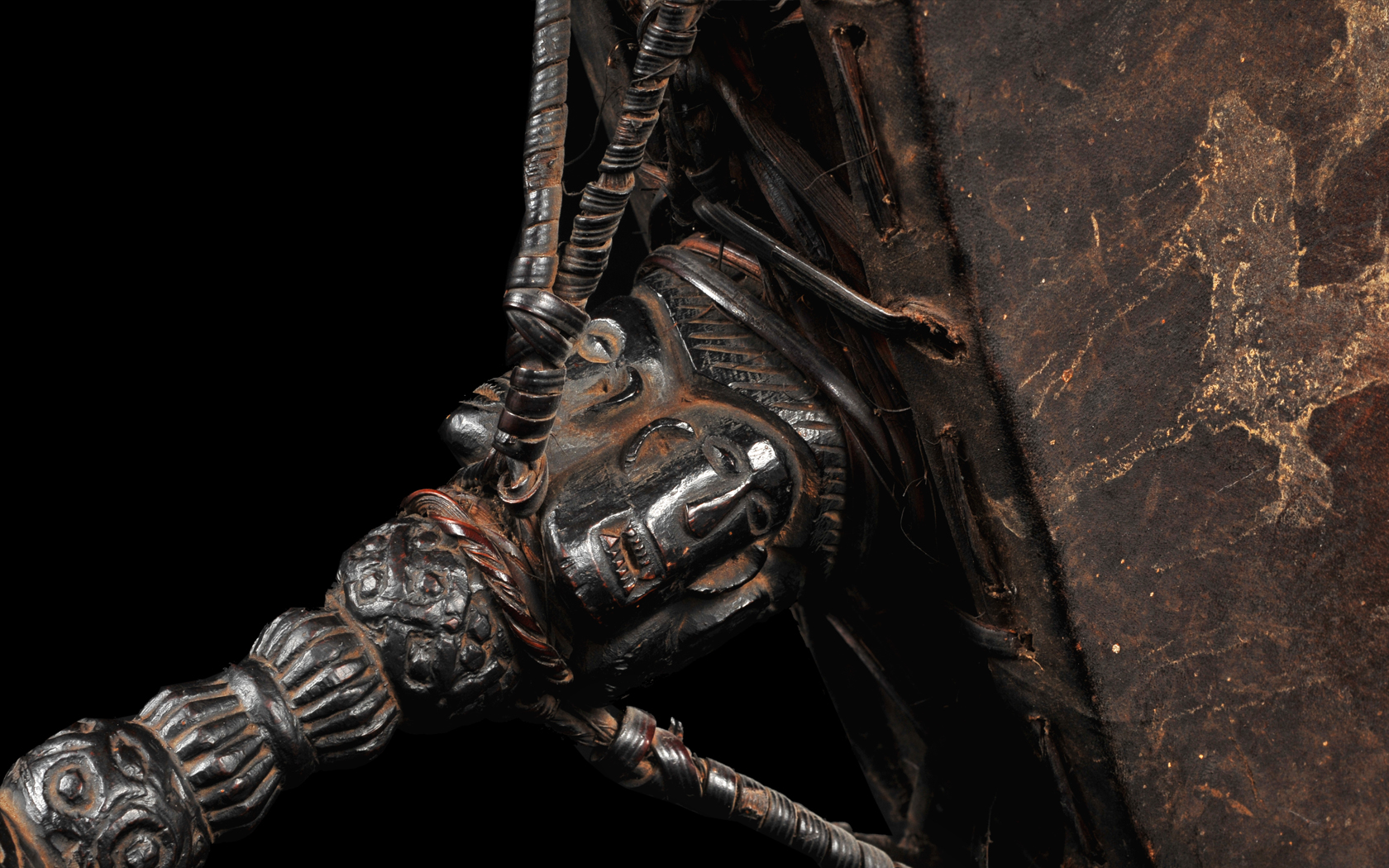
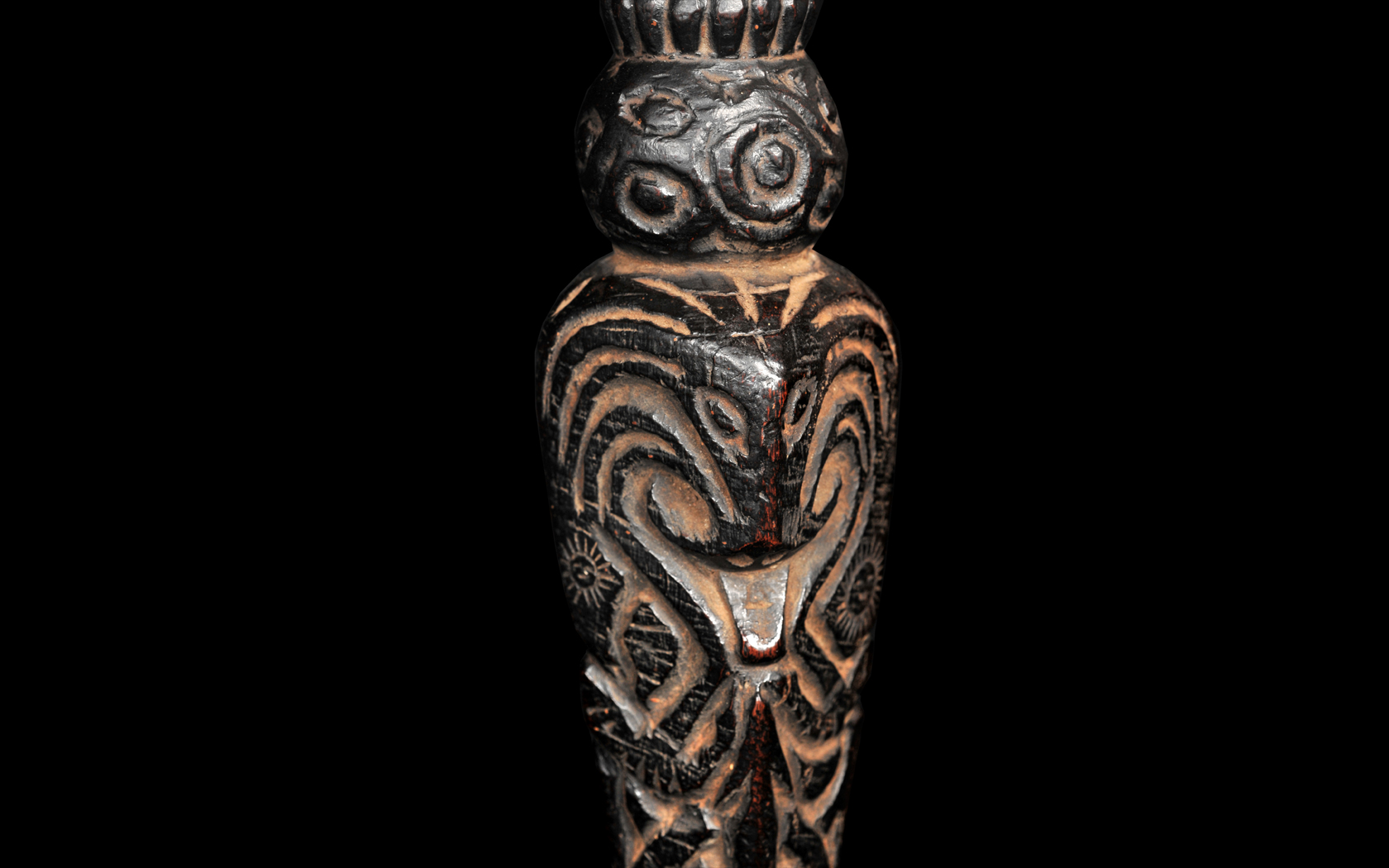
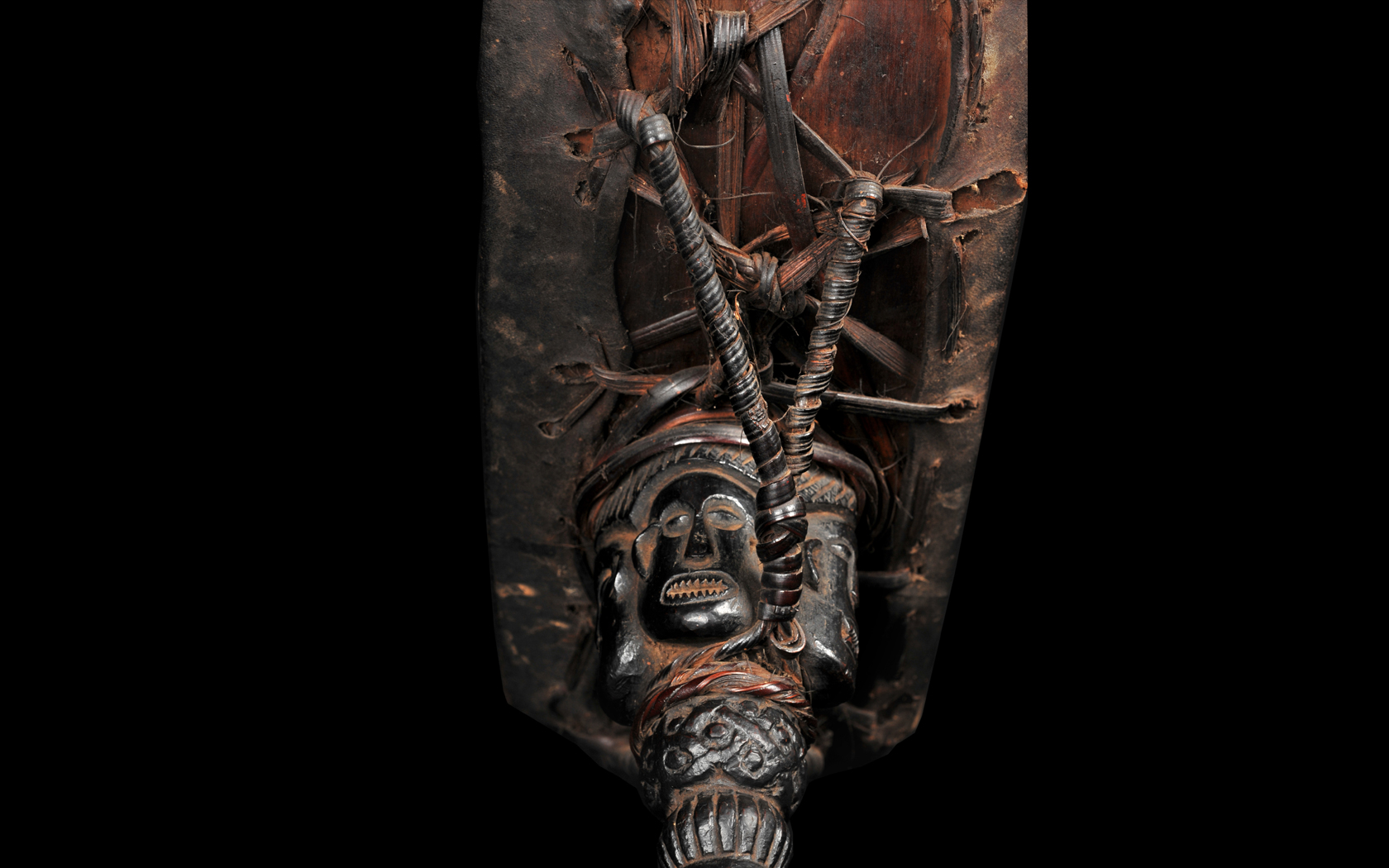
The Dhyangro is a double-headed frame drum consisting of a wooden frame covered with a stretched animal-hide membrane. A carved wooden handle is attached under the wooden frame , frequently fashioned in the form of a three-sided phurba (ritual dagger), one of the most important ritual symbols of the Himalayan religious tradition. Many examples display carved representations of protective deities, anthropomorphic heads, or symbolic motifs reflecting the cosmological concepts of Tamang shamanism.
Ritual Function
Throughout the ritual performance, the Dhyangro accompanies invocations, mythological recitations, healing rites, spirit negotiations, and ceremonial dances. Its repetitive rhythmic patterns structure the sequence of the séance while supporting the shaman's chants and ritual movements. Within Tamang cosmology, the drum is understood as an indispensable ritual instrument whose sound facilitates communication between the human and spiritual worlds and reinforces the performative dimensions of shamanic practice.
Ethnological Significance
The Tamang Dhyangro belongs to the wider family of Himalayan and Inner Asian shamanic frame drums, many of which have been interpreted by ethnologists as symbolic representations of the universe. Their construction, iconography, and ritual use embody a complex system of religious concepts in which music, mythology, healing, and cosmology are inseparably connected. As both a sacred object and a musical instrument, the Dhyangro illustrates the central role of sound in ritual communication and remains one of the most significant ceremonial instruments of the Himalayan shamanic traditions.
"The shaman’s drum is not just a rhythm instrument with which faith healers add an acoustic component to their rituals. It is a self-contained embodiment of the cosmos in which their owners travel in the course of their séances. (...) The drum’s numerous functions—as a musical instrument accompanying the recitation of mythical songs, as a pacemaker of ritual dances, as a vehicle on which the shaman travels through space, as a defensive and assault weapon against negative powers, as a diagnostic and prognostic instrument—make it a kind of all-purpose companion to its owner."
Excerpt from:
Michael Oppitz: Forschungen an den Rändern der Schrift. Exhibition catalogue, Galerie Buchholz, Berlin, 26 January – 14 April 2018.
Bibliography:
Oppitz, Michael (2013): Morphologie der Schamanentrommel.
Oppitz, Michael (2013): Schamanen im Blinden Land. (5 DVDs + 2 CDs).
Pannier, F. (2007): Art chamanique népalais – Nepalese Shamanic Art. Galerie Le Toit du Monde.
Nioradze, G. (1925): Der Schamanismus bei den sibirischen Völkern. Strecker und Schröder.
Eliade, Mircea (1964): Shamanism: Archaic Techniques of Ecstasy.
Diószegi, Vilmos; Hoppál, Mihály (1978): Shamanism in Siberia. Akadémiai Kiadó, Budapest.
Hoppál, Mihály (1994): Schamanen und Schamanismus. Pattloch, Augsburg.
Diószegi, Vilmos (1963): Glaubenswelt und Folklore der sibirischen Völker.
Manker, Ernst (1938): Die Lappische Zaubertrommel – Die Trommel als Denkmal materieller Kultur. Acta Lapponica I.
Manker, Ernst (1950): Die Lappische Zaubertrommel – Die Trommel als Urkunde geistigen Lebens. Acta Lapponica VI.
Hitchcock, John; Jones, R. (eds.) (1976): Spirit Possession in the Nepal Himalayas.
Mastromattei, R.; Farano, F. (2006): Rta. Sciamani in Eurasia. Il rito che sopravvive.
Riboli, Diana (2000): Tunsuriban. Shamanism in the Chepang of Central and Southern Nepal.
de Sales, Anna (1991): Je suis né de vos jeux de tambours. La religion chamanique des Magar du Nord.