New Guinea
Bedamuni Drum New Guinea
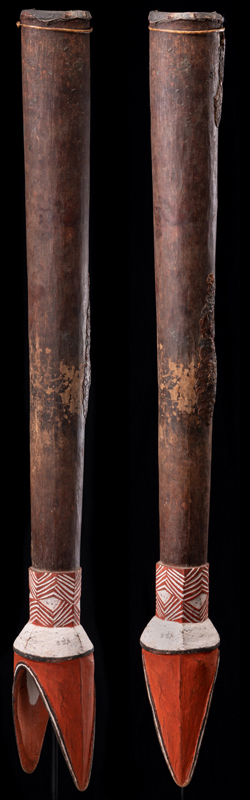
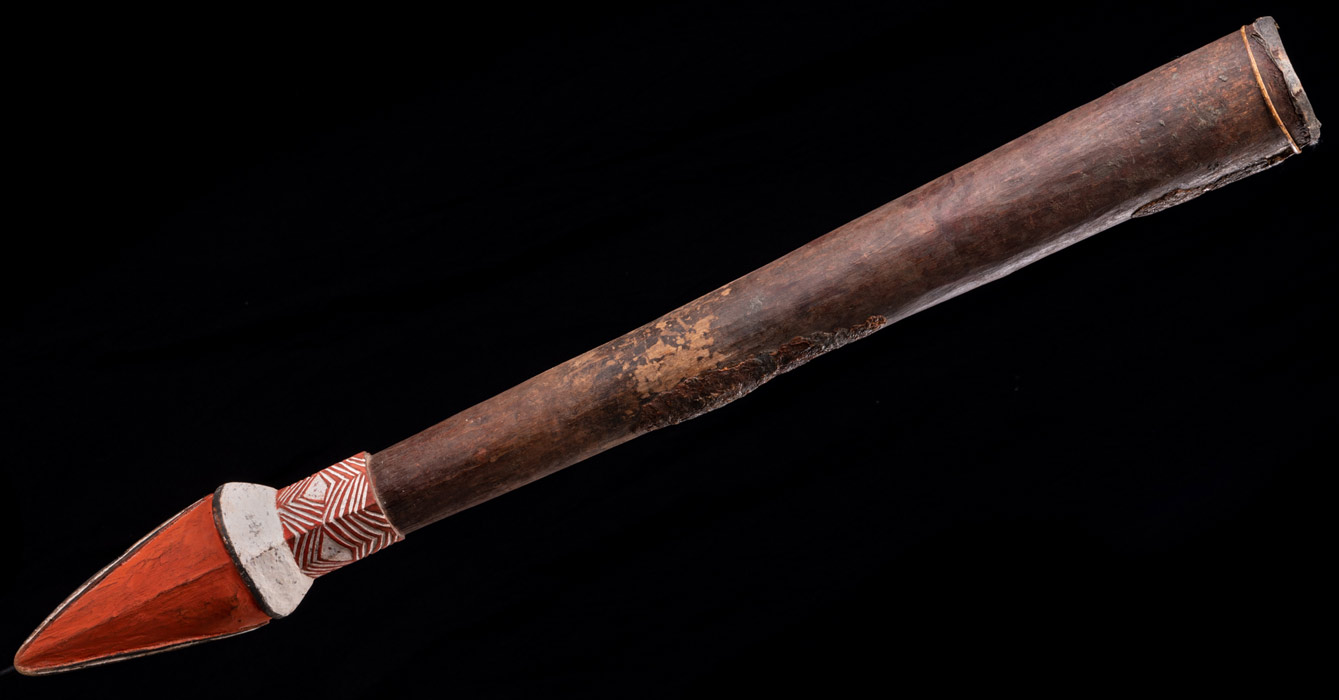
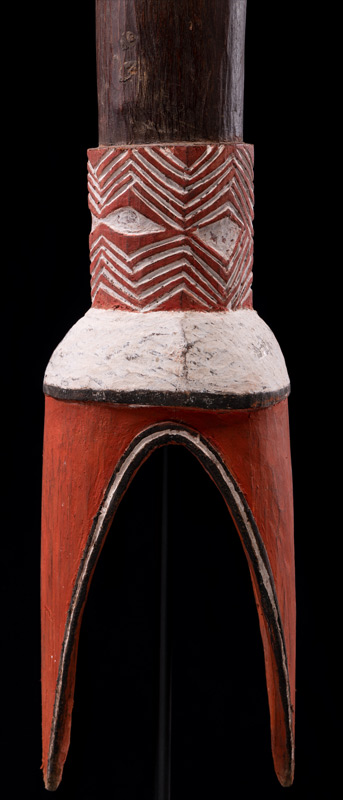
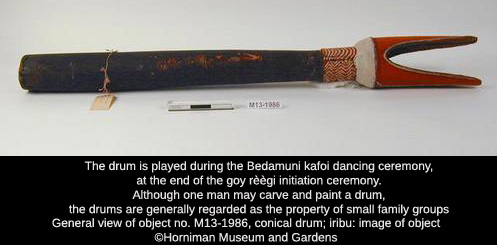
Nomad River Drum (Iribu) (Bedamuni / Bedamini, New Guinea, Papua New Guinea)
The iribu is a traditional hand drum of the Bedamuni, also known as Bedamini or Beami, of the Nomad River region in the Western Province of Papua New Guinea. The instrument occupies a particular position in Bedamuni ceremonial life and is played by men during the kafoi dancing ceremony. The kafoi is associated with the final stage of the boys' initiation, known as goy lèègi, and the drum provides the central rhythmic element of the performance.
The present instrument belongs to the distinctive long and slender form of Bedamuni iribu. Earlier drums used for the same ceremonial context were shorter and had a more compact, almost cubic-shaped lower end. According to field information recorded by Albert G. van Beek, the shorter form was replaced during the late 1960s by the elongated type, which was adopted in connection with the neighbouring Samo tradition. Both forms have carved distal ends representing crocodile jaws.
The drum is a single-headed membranophone carved from wood and designed to be held in one hand while the membrane is struck with the other. The drumhead is traditionally made from lizard skin. Small lumps of beeswax are attached to the membrane and serve to regulate its sound. Tuning is an important part of the performance: the membrane is adjusted until the drum produces a characteristic two-toned sound, described as moving from a low to a higher tone.
This two-toned sound has a specific significance within Bedamuni musical thought. It is understood as the voice of Awamuni, the cultural hero who is said to have given the Bedamuni their cultural identity. When correctly tuned, the drum is said to call a-ta, meaning "father-son". The acoustic quality of the instrument is therefore not regarded merely as a technical matter, but forms an essential part of its ceremonial identity.
The performance technique is equally distinctive. The rhythm of the drum is deliberately not synchronized with the bodily movements of the dancer. When several men perform together, their drumming is likewise not necessarily synchronized. The resulting rhythmic structure is described by Barry Craig as strikingly complex to an untrained listener. The drum therefore functions not simply as an accompaniment to the dance, but as an integral component of the ceremonial performance.
The present iribu is particularly significant as an example of a specialized Bedamuni ceremonial drum whose sound, playing technique and ritual context are closely interconnected. Its long form, crocodile-jaw termination and characteristic two-tone tuning correspond closely with the documented Bedamuni tradition described in the literature on the musical instruments of the region.
"Properly tuned, the drum has to sound two-toned, somewhat like `ba-u´(from low to high) otherwise the performance is not right. This sound is said to be the voice of Awamuni, the culture hero that gave the Bedamuni their cultural identity.
An intriguing detail is that drum rhythm and the bodily movement of the performer should not be in phase.
In fact, when a ceremony has a number of performers (sometimes three or four) they too will not drum in phase.
This, together with burst of singing from groups of young girls in the men´s sleeping area,
makes the whole performance completely cacophonic to the untrained ear and eye, yet strangely impressive."
Barry Craig (ed.), Living Spirits with Fixed Abodes: The Masterpieces Exhibition of the Papua New Guinea National Museum and Art Gallery. University of Hawai'i Press, Honolulu, 2011, p. 192.
Bibliography:
Craig, Barry (ed.): Living Spirits with Fixed Abodes: The Masterpieces Exhibition of the Papua New Guinea National Museum and Art Gallery. Honolulu: University of Hawai'i Press, 2011.
Feld, Steven: Sound as a Symbolic System: The Kaluli Drum. Bikmaus 4(3): 78–89.
Schieffelin, Edward L.: The Sorrow of the Lonely and the Burning of the Dancers. New York: St. Martin's Press, 1976.
Schieffelin, Edward L. & Feld, Steven: Kaluli Dance. In: The International Encyclopedia of Dance. Oxford University Press, 1998.
van Beek, Albert G.: Field research among the Bedamuni, cited in Craig, Barry (ed.), Living Spirits with Fixed Abodes. Honolulu: University of Hawai'i Press, 2011.