New Guinea
Collingwood bay Drum New Guinea
1905-06, GERMAN NG, The Maisin Archives, Cape Nelson Station, Wanigela, Collingwood Bay, ORO Province.
Collingwood Bay Drum (New Guinea, Papua New Guinea)
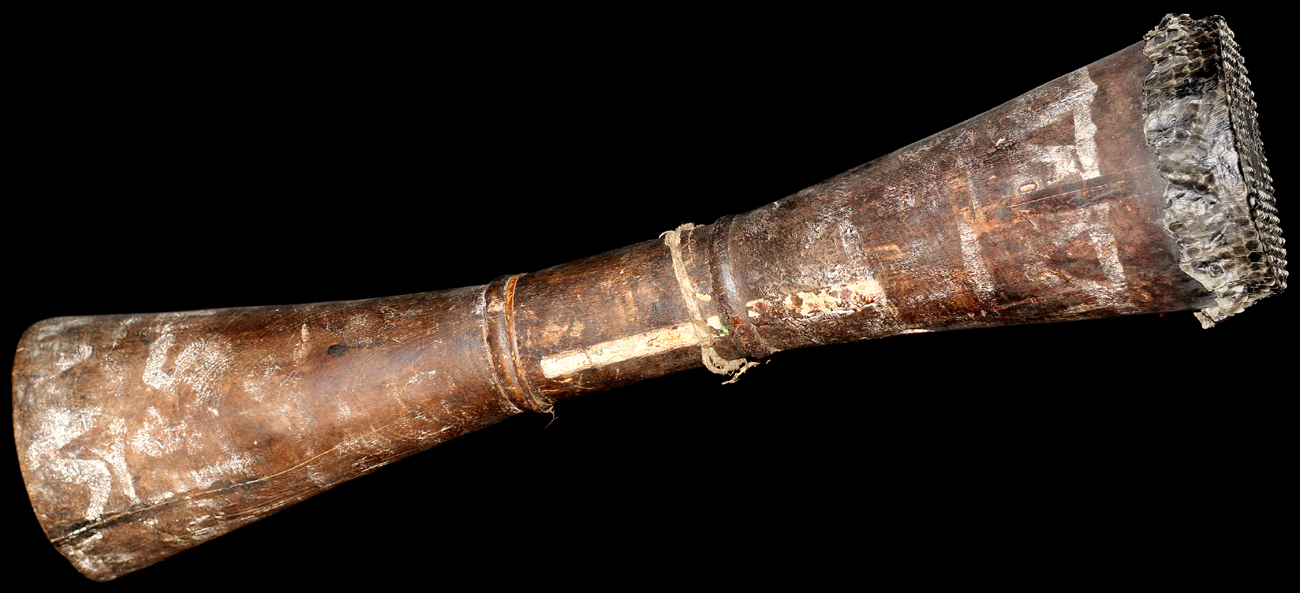
The present drum comes from the Collingwood Bay region of northeastern Papua New Guinea. Collingwood Bay is an important cultural region situated at the western edge of the Massim area, with a number of distinct communities and long-standing connections between coastal and inland groups. The precise ethnic attribution of this individual drum is not documented.
The instrument is a single-headed hand drum with a long, slender wooden body and a strongly flared lower section terminating in two projecting prongs. The drumhead is attached at one end of the carved body, while the opposite end is open. This distinctive form is characteristic of a group of drums from the wider Collingwood Bay and Massim region and is represented in early ethnographic and museum collections.
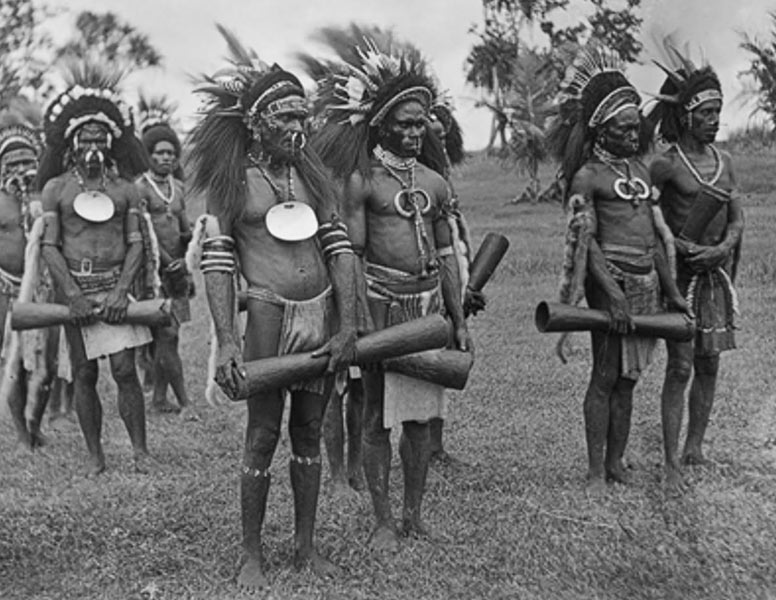
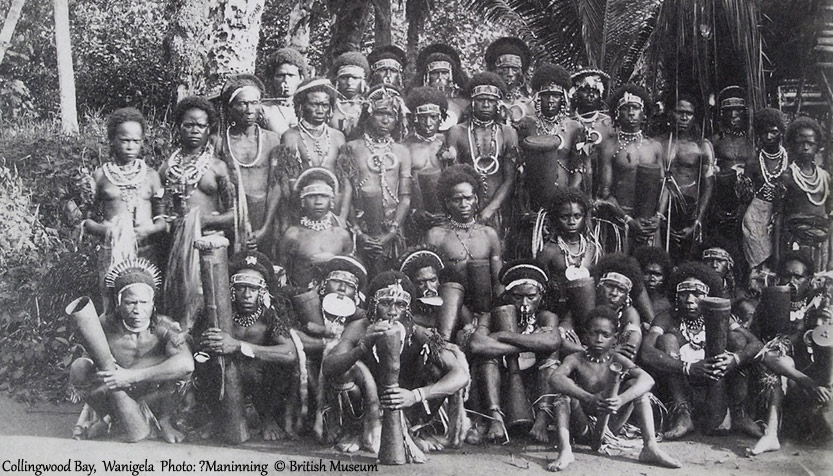
Drums occupy an important position in the musical traditions of Collingwood Bay. They accompany dancing and singing during ceremonial and communal occasions, providing the rhythmic foundation for performances. Ethnographic documentation from the region records ensembles in which different drums produce contrasting voices, while dancers and singers perform in organized groups.
The historical photograph accompanying this object is particularly valuable in this respect. It shows men from the Collingwood Bay region carrying and playing drums of closely related form during a traditional performance. Such early photographic documentation provides important evidence for the use of these instruments in their original cultural setting.
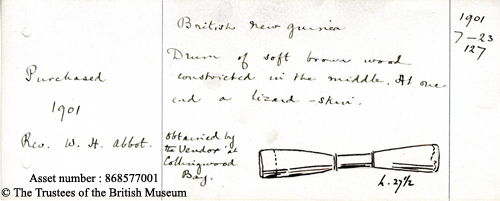
The present drum is also of historical interest because of its early European documentation. The accompanying British Museum record for a comparable Collingwood Bay drum notes that it was purchased in 1901 and was collected by the Reverend W. H. Abbott. The object record describes it as a drum made from soft brown wood, with a lizard-skin membrane. Comparable material documentation helps place the present example within the historical corpus of Collingwood Bay drums collected during the early colonial period.
The drum is therefore significant both as a musical instrument and as a historical document of the material culture of northeastern New Guinea. Its unusual elongated form, together with the surviving early photographic and museum documentation of comparable instruments, makes it an important example of the drum traditions of the Collingwood Bay region.
"The old artifacts that Maisin do keept end to be made of harder stuff - wood, shell, and stone. They were made by men and protected by men. Their male guardians regard them as heirlooms, as memories of the fathers, uncles, and grandfathers who once used them. The most common artifacts are drums and shell ornaments, kept in good repair to be used on ceremonial occasions calling for self-decoration and dancing."
John Barker, Dangerous Objects: Changing Indigenous Perceptions of Material Culture in a Papua New Guinea Society.
Bibliography:
Asor, M. (1974): An Oral Tradition from Wanigela. Oral History 3(3): 2–11.
Barker, John: Dangerous Objects: Changing Indigenous Perceptions of Material Culture in a Papua New Guinea Society.
Beran, Harry (1980): Massim Tribal Art. Wollongong: Wollongong City Gallery.
Hamson, Michael & Aldridge, Richard (2009): Art of the Massim & Collingwood Bay. Palos Verdes Estates, California: Michael Hamson Oceanic Art.
Malinowski, Bronislaw (1916): Baloma – The Spirits of the Dead in the Trobriand Islands.
Newton, Douglas (1975): Massim – Art of the Massim Area, New Guinea. New York: The Museum of Primitive Art.
Norick, Frank Albert (1976): An Analysis of the Material Culture of the Trobriand Islands Based upon the Collection of Bronislaw Malinowski. Ann Arbor, Michigan and London: University Microfilms International.
Finsch, Otto (1888): Reisen in Kaiser-Wilhelms-Land und Neu-Guinea an Bord des Dampfers Samoa.
Finsch, Otto (1888): Ethnologische Erfahrungen und Belegstücke aus der Südsee – beschreibender Katalog einer Sammlung im K.K. Naturhistorischen Hofmuseum in Wien.