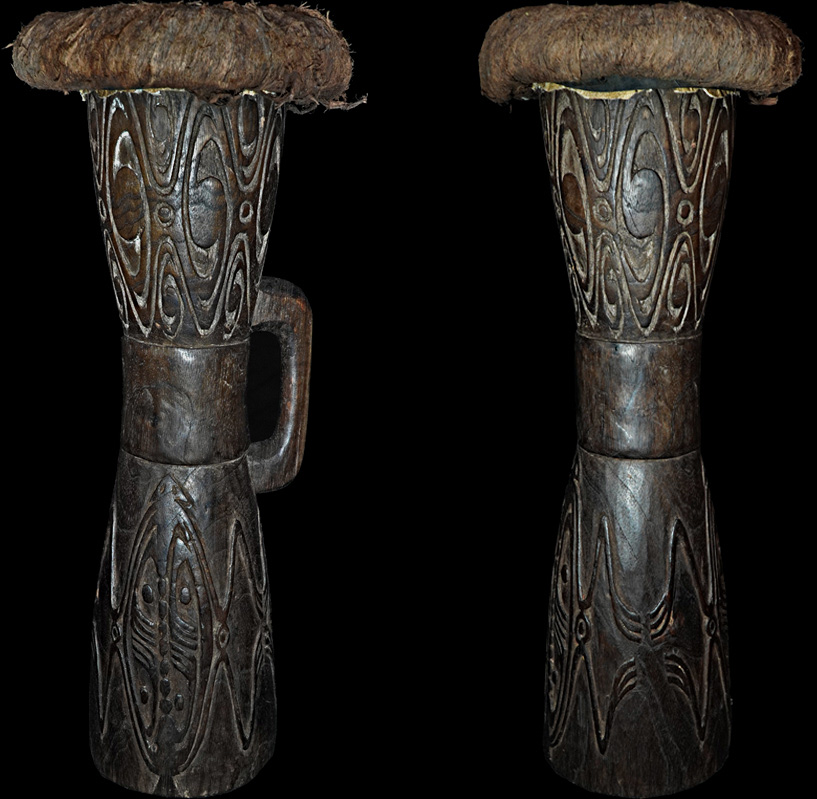
Drum from the Lake Sentani region (West Papua, New Guinea)
This hand drum from the Lake Sentani region of western New Guinea combines a characteristic hourglass-shaped body with an elaborate system of deeply carved relief decoration. The upper section is covered with flowing, interlocking curves, elongated oval forms and raised elements arranged in a rhythmic pattern. The lower body features a striking symmetrical composition centred on an elongated oval figure, with a clearly defined head, two eye-like openings and four limb-like extensions. The raised contours and incised lines create a pronounced sculptural effect, combining figural representation with the characteristic curvilinear vocabulary of Lake Sentani art.
The drumhead is secured beneath a thick, fibrous hoop. The carefully shaped wooden body and its carved decoration combine the practical construction of a musical instrument with a strong emphasis on sculptural form. The ornamentation is particularly noteworthy for its combination of flowing, spiral-like lines and a more explicitly figural motif on the lower body.
Simon Kooijman, in The Art of Lake Sentani (1959), distinguished two principal forms of wooden hand drum in the region: a broad, substantial type with a cylindrical, conical or hourglass-shaped body, and a longer, narrower type with only a slight central constriction. The present drum belongs to the broader category. Kooijman also emphasized the characteristic spiral motifs found on Sentani drums, which distinguish their decoration from that of related instruments from neighbouring Humboldt Bay.
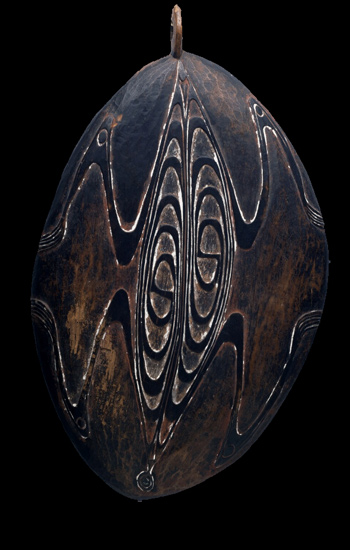
The figural carving on the lower body invites comparison with animal motifs documented in Lake Sentani art. In Art of Northwest New Guinea (1992), Suzanne Greub illustrates a carved wooden dish from Lake Sentani whose incised design was identified by local people as a frog or a varan (monitor lizard). According to the accompanying description, the motif probably represents a clan ancestor. Greub further notes that such animal figures can be difficult to identify when their anatomical features are rendered in a highly stylized manner.
The central oval body, paired eye-like forms and four limb-like extensions on the present drum bear a noteworthy formal resemblance to the animal motif illustrated by Greub. This comparison raises the possibility that the carving represents a stylized animal figure belonging to a related regional visual tradition. A frog or monitor lizard, and a possible association with an ancestral figure, may therefore be considered as interpretive parallels. However, the specific identity and cultural meaning of the motif on this drum have not been independently established.
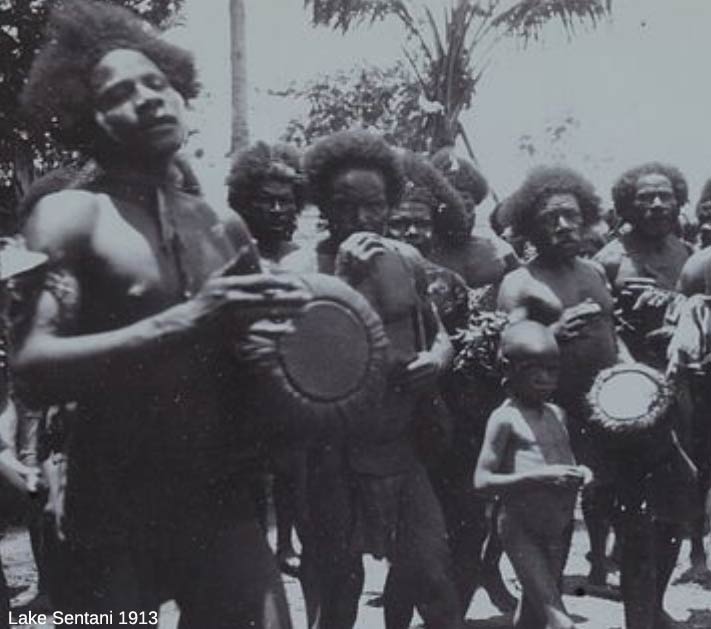
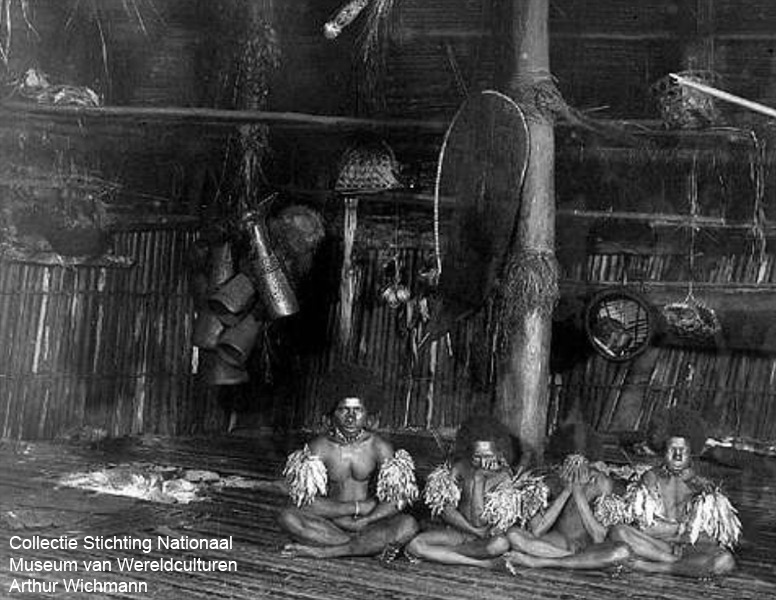
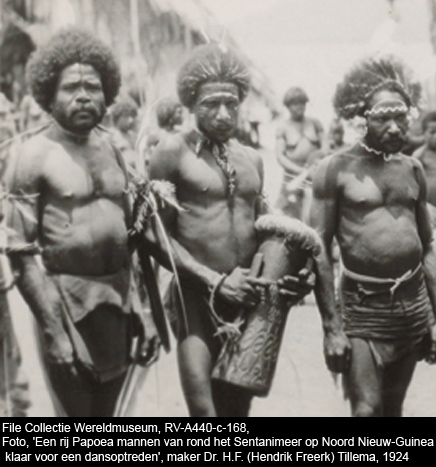
Historically, wooden hand drums formed part of the ceremonial equipment associated with the mau and ondoforo houses and could also be kept by ordinary villagers. They belonged to a wider musical and ceremonial culture in which drumming accompanied singing, dancing and communal gatherings.
Sources
"As far as we know two types of drum were in use in the Lake Sentani region: one broad and massive, in the shape of a cylinder, cone or hour-glass; the other long and narrow, with a slight central constriction. [...] They differ from the Humboldt Bay drums, however, in their decoration. This includes the series of spiral motifs which are so characteristic of Lake Sentani art."
Kooijman, Simon (1959): The Art of Lake Sentani. The Museum of Primitive Art, New York, p. 22.
For a comparative discussion of stylized animal motifs and their possible ancestral associations, see:
Greub, Suzanne (1992): Art of Northwest New Guinea – From Geelvink Bay, Humboldt Bay and Lake Sentani. See the discussion accompanying the Lake Sentani dish illustrated on pp. 112–114.
Bibliography:
Kooijman, Simon (1959):
The Art of Lake Sentani. The Museum of Primitive Art, New York.
Greub, Suzanne (1992):
Art of Northwest New Guinea – From Geelvink Bay, Humboldt Bay and Lake Sentani.
Webb, Virginia-Lee (2011):
Ancestors of the Lake: Art of Lake Sentani and Humboldt Bay, New Guinea. The Menil Collection.