New Guinea
Drum New Guinea
New Guinea Drum (Papua New Guinea)
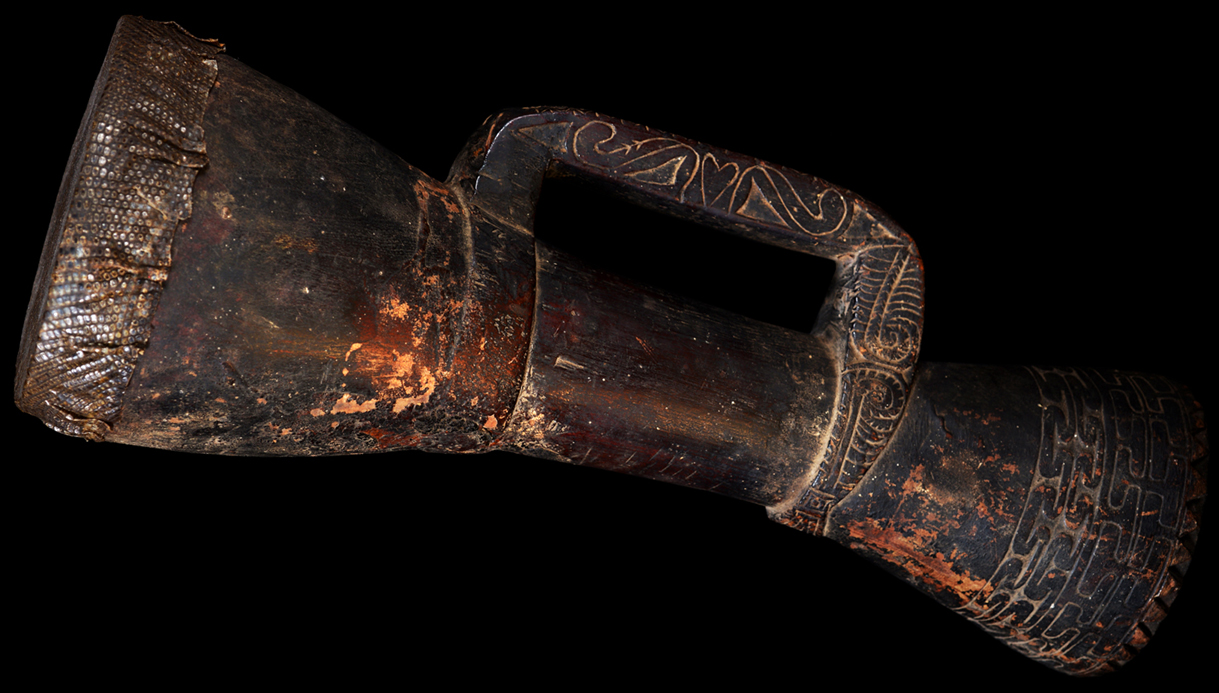
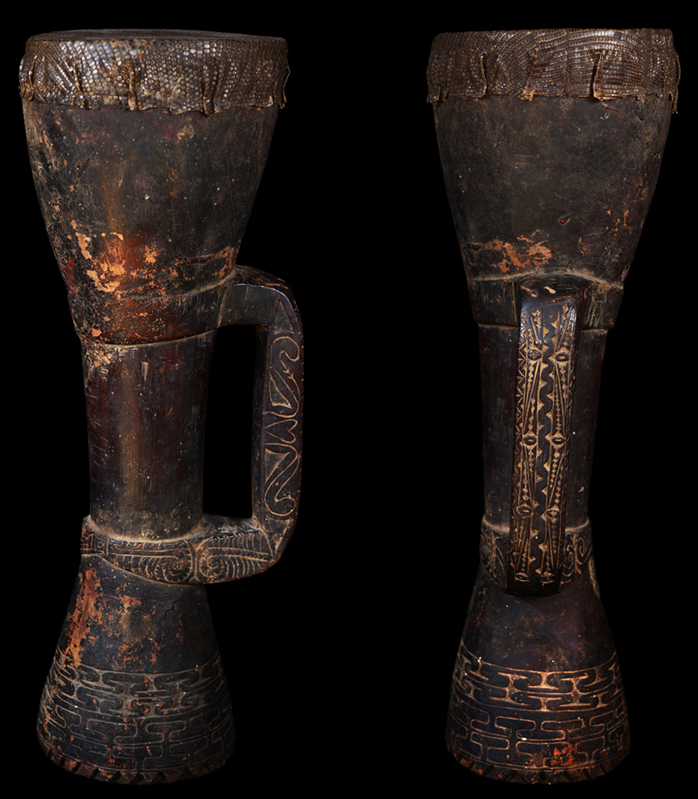
The kundu is one of the most widespread hand drums of Papua New Guinea and occurs in a remarkable variety of regional forms. Although the hourglass-shaped body is the most characteristic type, cylindrical, conical and transitional forms are also documented. The design of the body, the form of the handle and the treatment of the surface vary considerably between different regions and communities.
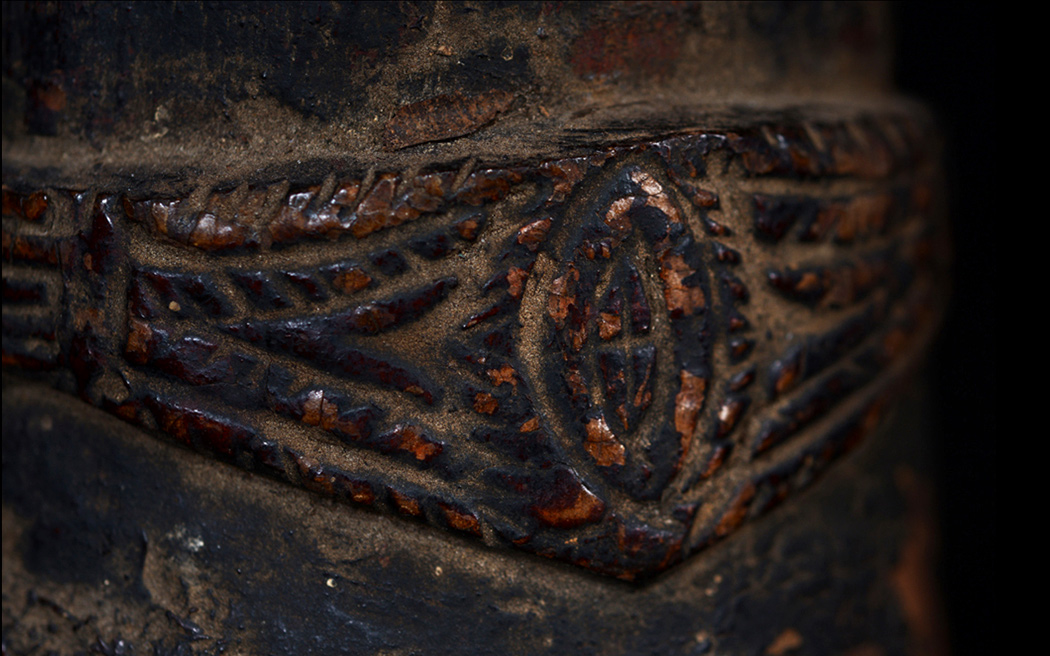
The present drum is an unusually compact example, measuring approximately 50 cm in height. Its carefully carved surface is particularly remarkable. Geometric patterns cover the central and lower sections of the body, combining raised and incised elements into a dense ornamental composition. The dark, highly developed patina indicates prolonged use and gives the carving a particularly distinctive appearance.
The drum is single-headed and has a carved central handle, allowing it to be held in one hand while the membrane is struck with the fingers of the other. The membrane of the present instrument is identified as monitor-lizard skin (Varanus). Reptile skins are well documented as drumheads in the lowland regions of Papua New Guinea, while other types of animal skin were traditionally used in areas where large lizards were less readily available.
The production of kundu drums involves hollowing a wooden body by cutting, scraping and, traditionally, controlled burning. The membrane is attached to one end of the resonator, and its tension can be adjusted to regulate the pitch. Beeswax applied to the membrane is also documented as a means of modifying and fine-tuning the sound.
Kundu drums are used throughout Papua New Guinea in musical performances accompanying singing, dancing, ceremonies and communal celebrations. Their musical functions and associated meanings differ between regions, and the instrument may occur in both ceremonial and secular contexts.
The precise regional or ethnic provenance of the present drum is not documented. Its distinctive proportions and unusually elaborate carved decoration nevertheless place it within the broad and highly varied tradition of Papua New Guinean kundu drums. Comparable museum examples demonstrate that considerable variation in form, decoration, materials and dimensions exists within this widespread instrument type.
Bibliography:Love, W., Fletcher, Neville H. & others: Kundus of Papua New Guinea. Ethnomusicology / musical-instrument research.
Haddon, Alfred Cort: The Decorative Art of British New Guinea: A Study in Papuan Ethnography. Cambridge, 1894.
Friede, John (ed.): New Guinea Art: Masterpieces from the Jolika Collection of Marcia and John Friede. San Francisco: Fine Arts Museums of San Francisco, 2005.
Libin, Laurence (ed.): The Grove Dictionary of Musical Instruments. Oxford University Press.