New Guinea
Geelvink Bay drum New Guinea
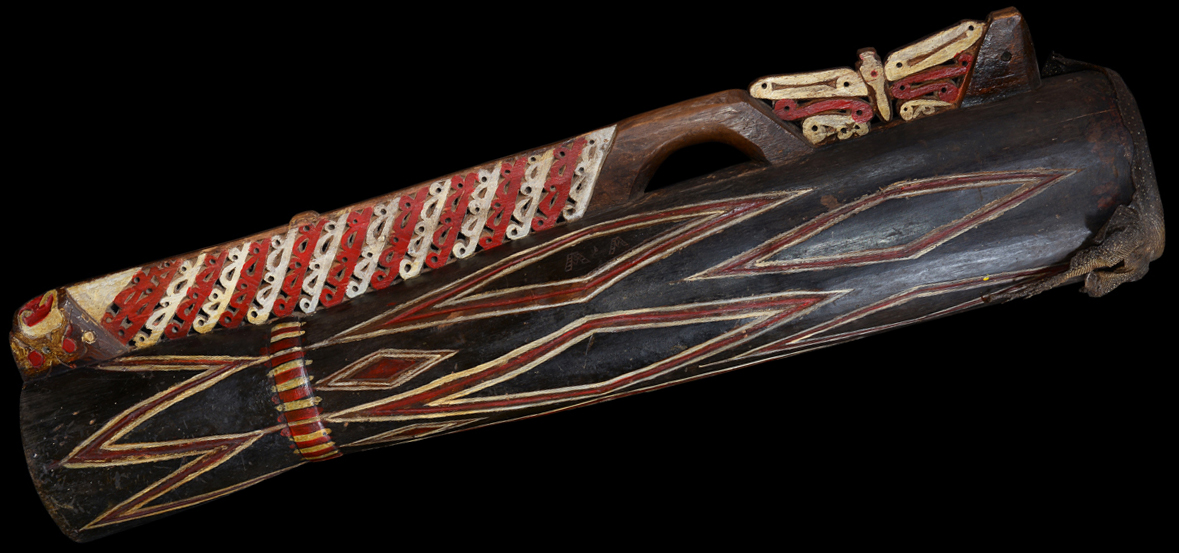
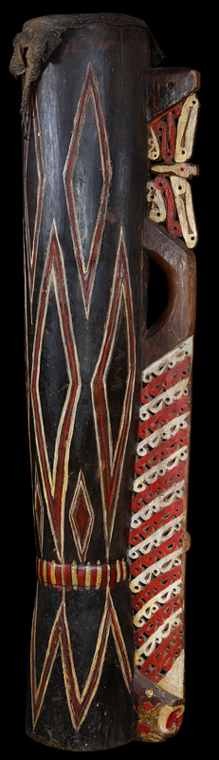
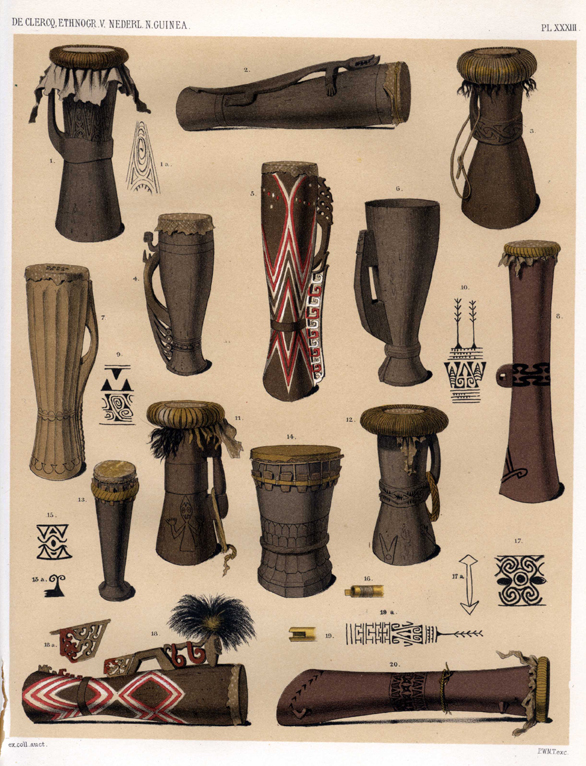
Geelvink Bay Drum (Korwar Area, West Papua, New Guinea)
The present drum comes from the Geelvink Bay region of northwestern New Guinea, an area whose traditional art is particularly associated with the so-called Korwar style. The term refers to a distinctive artistic and religious tradition in which carved representations of human beings and ancestors played an important role in the relationship between the living and the supernatural world.
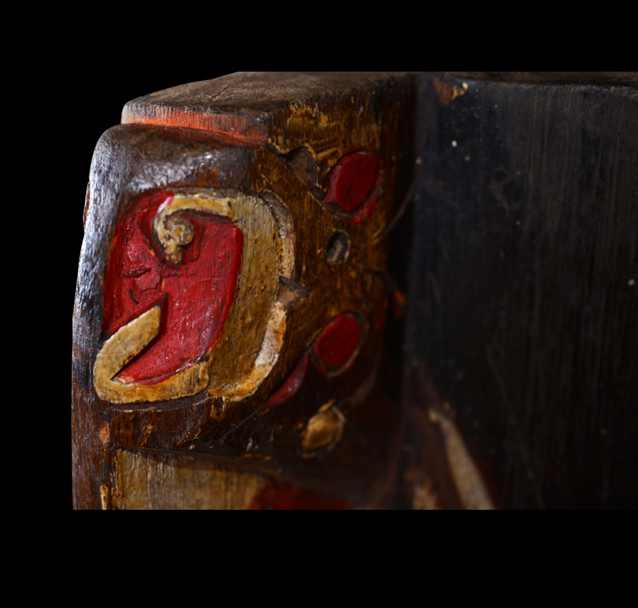
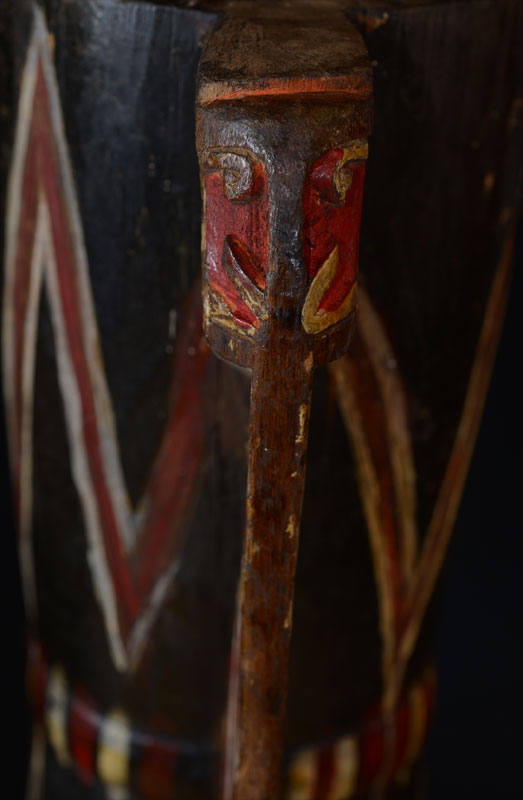
The drum is a single-headed hourglass-shaped membranophone with a carved wooden handle. Its elongated body is extensively decorated with finely incised and painted geometric patterns, while the handle and its adjoining elements are also richly ornamented. The combination of a carefully shaped resonator, an elaborately decorated handle and a dark, polished surface is characteristic of the highly developed woodcarving traditions of the Geelvink Bay and neighbouring regions.
The production and maintenance of the drumhead required considerable practical knowledge. Jaap Kunst recorded in detail how the skin of the iguana, known locally as moiwa, was cleaned while fresh, stretched over a frame and dried in the sun. When a new skin was fitted to a drum, the rim was treated with the sticky residue of mangrove fruit before the moistened skin was stretched tightly over it and secured with cane. The final drying process fixed the membrane firmly to the drum.
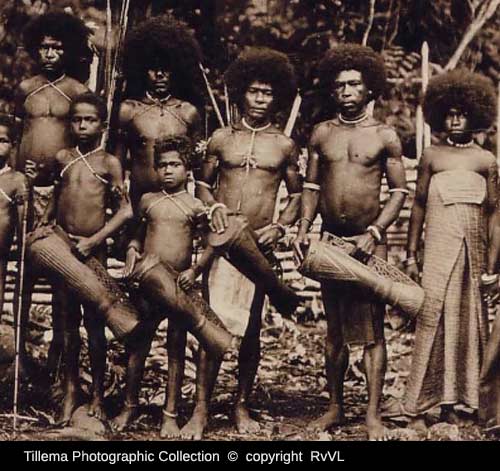
Music in the Geelvink Bay region was closely connected with ceremonial life and with ideas concerning communication between human beings and the supernatural world. Drums were played at important celebrations and ritual occasions and commonly accompanied dancing. Historical descriptions record festivities lasting for several days and nights, including celebrations associated with important life events and successful hunting or fishing.
The relationship between the drum and the ancestral sphere is particularly significant within the cultural environment of the Korwar area. Korwar figures traditionally represented deceased persons whose spirits were believed to remain connected with the living and to provide protection or assistance. The carved imagery found on musical instruments from the region should therefore be understood within this broader artistic and religious context, although the precise meaning of the individual motifs on the present drum cannot be established without specific provenance or field documentation.
"The skin of the iguana, moiwa, which abounds here, is used for the drumheads. The skin is scraped clean while it is still fresh, stretched over a frame made of laths and dried in the sun. When a man wants to renew the skin on his drum, he first smears the rim with the sticky parings of the fruit of the mangrove. The skin is then made pliable by wetting it, pulled taut over the rim and bound tightly with a piece of cane. After that, the skin is thoroughly dried in the sun to fix it firmly to the drumhead and the strip of cane is then removed."
Excerpt from: Jaap Kunst, Music in New Guinea – Three Studies. The Hague: Martinus Nijhoff, 1967, pp. 106–107.
"Muziek heeft vaak te maken met het contact tussen de mens en de bovennatuurlijke wereld. Het geluid van bepaalde instrumenten, zoals van deze trom, kan ervaren worden als de stemmen van de voorouders. Dergelijke instrumenten worden dan ook bij belangrijke ceremoniële gelegenheden bespeeld. Vaak wordt er ook bij gedanst. De bevolking van het Geelvinkbaaigebied houdt veel van feestvieren, of het nu ter ere van een eerstgeborene is of ter gelegenheid van een geslaagde haaien- of schildpaddenvangst. De feestelijkheden kunnen dagen en vooral nachten achtereen duren. In sommige streken maken mannen en vrouwen samen rondedansen, in andere, met name de oostelijker gebieden, danst men afzonderlijk. Als het kan wordt op het strand gedanst."
Copyright: HI en DS, 1999, collectie@wereldculturen.nl.
Bibliography:
de Clercq, F. S. A.: Ethnographische Beschrijving van de West- en Noordkust van Nederlandsch Nieuw-Guinea. Met medewerking van J. D. E. Schmeltz. Leiden, 1893.
Greub, Suzanne: Art of Northwest New Guinea – From Geelvink Bay, Humboldt Bay and Lake Sentani. 1992.
Kunst, Jaap: Music in New Guinea – Three Studies. The Hague: Martinus Nijhoff, 1967.
van Baaren, T. P.: Korwars and Korwar Style. The Hague: Mouton, 1968.
Webb, Virginia-Lee: Ancestors of the Lake: Art of Lake Sentani and Humboldt Bay, New Guinea. The Menil Collection, 2011.
Corbey, Raymond: Korwar: Northwest New Guinea Ritual Art According to Missionary Sources. Leiden: C. Zwartenkot Art Books, 2019.