New Guinea
Highlands Drum New Guinea
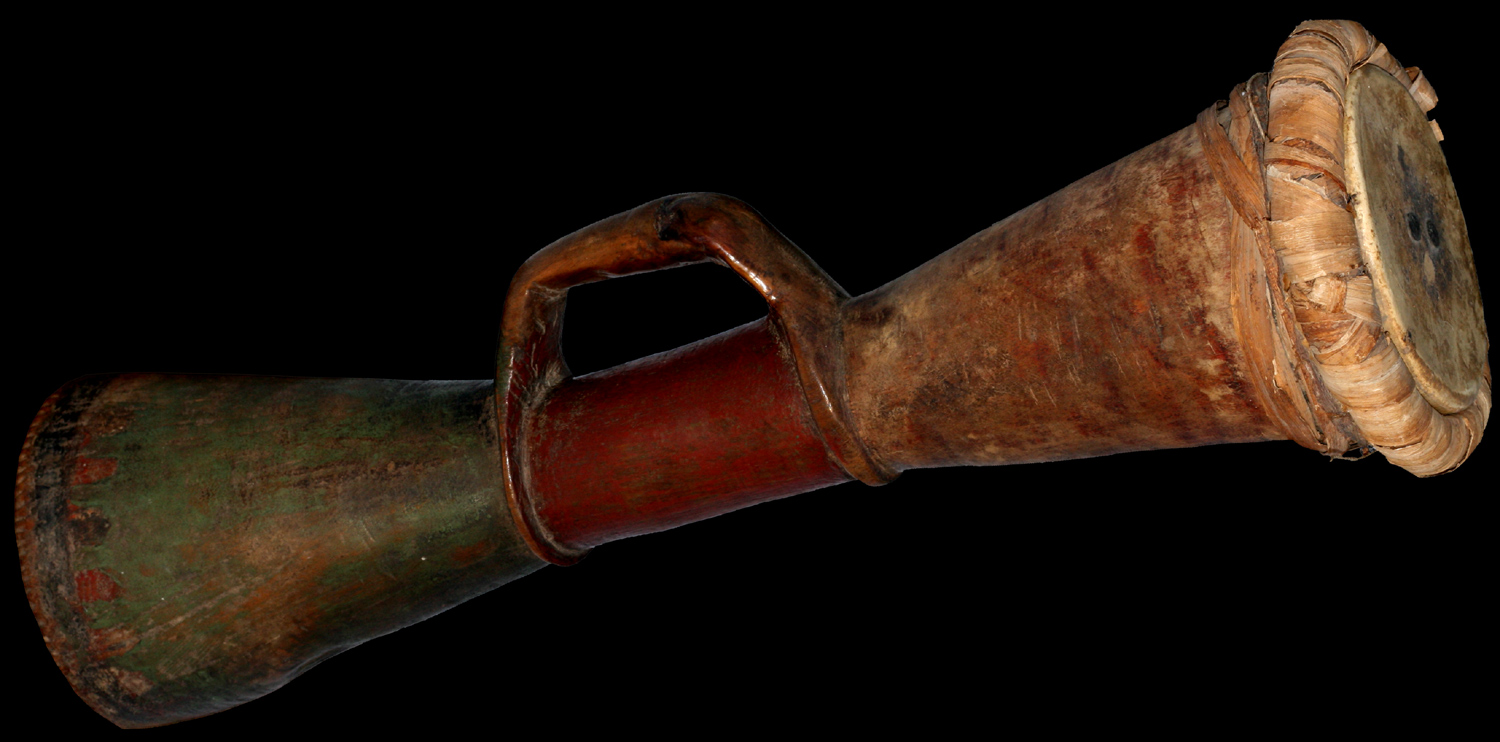
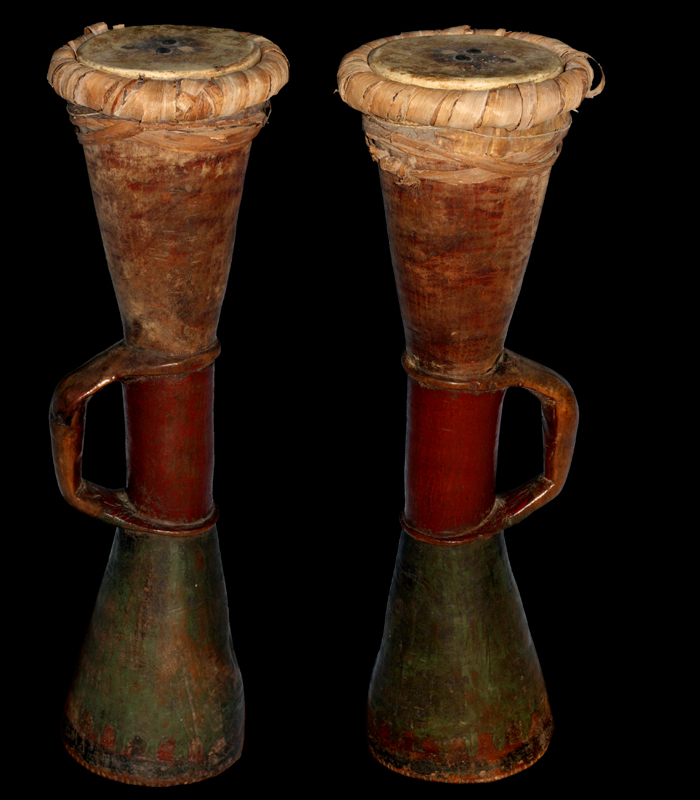
Highlands Drum (New Guinea, Papua New Guinea)
The kundu is one of the most widespread musical instruments of the New Guinea Highlands and accompanies dancing, singing and ceremonial performances throughout the region. Although the general hourglass form is widely shared, Highland drums display considerable variation in their proportions, surface treatment, decoration and construction.
The present example is particularly notable for its unusually prominent carved handle. While central handles occur on kundu drums in several regions of Papua New Guinea, many Highland examples are traditionally held directly around the narrow waist of the instrument or are provided only with a cord for carrying. The substantial wooden handle of the present drum therefore represents a distinctive feature of the individual instrument.
The surface of the drum has acquired a particularly rich and deeply developed patina. Traces of red, green and darker pigments remain visible on the wooden body, giving the instrument a subdued but exceptionally attractive appearance. The surviving surface treatment and signs of use emphasize the age and history of the object rather than functioning merely as decoration.
Highland kundu drums are traditionally made from a single piece of wood. The resonator is hollowed by a combination of cutting, scraping and controlled burning. The membrane is attached to the wider upper end, while the lower end remains open. In the Highlands, where large lizards are not naturally available, the skins of possums and related marsupials are commonly used for drumheads. The present instrument is consistent with this regional material tradition.
Kundu drums provide the rhythmic foundation for songs and dances and are particularly important during communal and ceremonial occasions. The instrument is normally held in one hand while the membrane is struck with the other. Its relatively light construction allows the drummer to move together with the dancers, making the drum an integral part of the performance rather than a stationary percussion instrument.
Bibliography:Niles, Don: Kundus of New Guinea. In: Adrienne L. Kaeppler & J. W. Love (eds.), The Garland Encyclopedia of World Music, Volume 9: Australia and the Pacific Islands. New York: Garland Publishing, 1998, pp. 383–384.
Love, J. W. & Fletcher, Neville H.: Kundus of Papua New Guinea. Ethnomusicological study of the construction, distribution and regional variation of the kundu.
McLean, Mervyn, Niles, Don, Wolfram, Paul, Gillespie, Kirsty & Kartomi, Margaret: Kundu. In: Laurence Libin (ed.), The Grove Dictionary of Musical Instruments. Oxford University Press, 2014.
Schieffelin, Edward L. & Feld, Steven: Kaluli Dance. In: The International Encyclopedia of Dance. Oxford University Press, 1998.