Yé-anim Drum (Yéi-nan, South New Guinea)
Yé-anim Drum (Yéi-nan, South New Guinea)
The Yé-anim, also known as Yéi-nan, Je-nan, Jee-anim or Yei, are an indigenous population of the upper Maro River region of southern New Guinea, in the area north of Merauke. Although they are geographically and historically closely associated with the Marind-anim, the Yé-anim constitute a distinct cultural and linguistic community. Early ethnographic literature therefore distinguishes their musical instruments from those of the neighbouring Marind-anim.
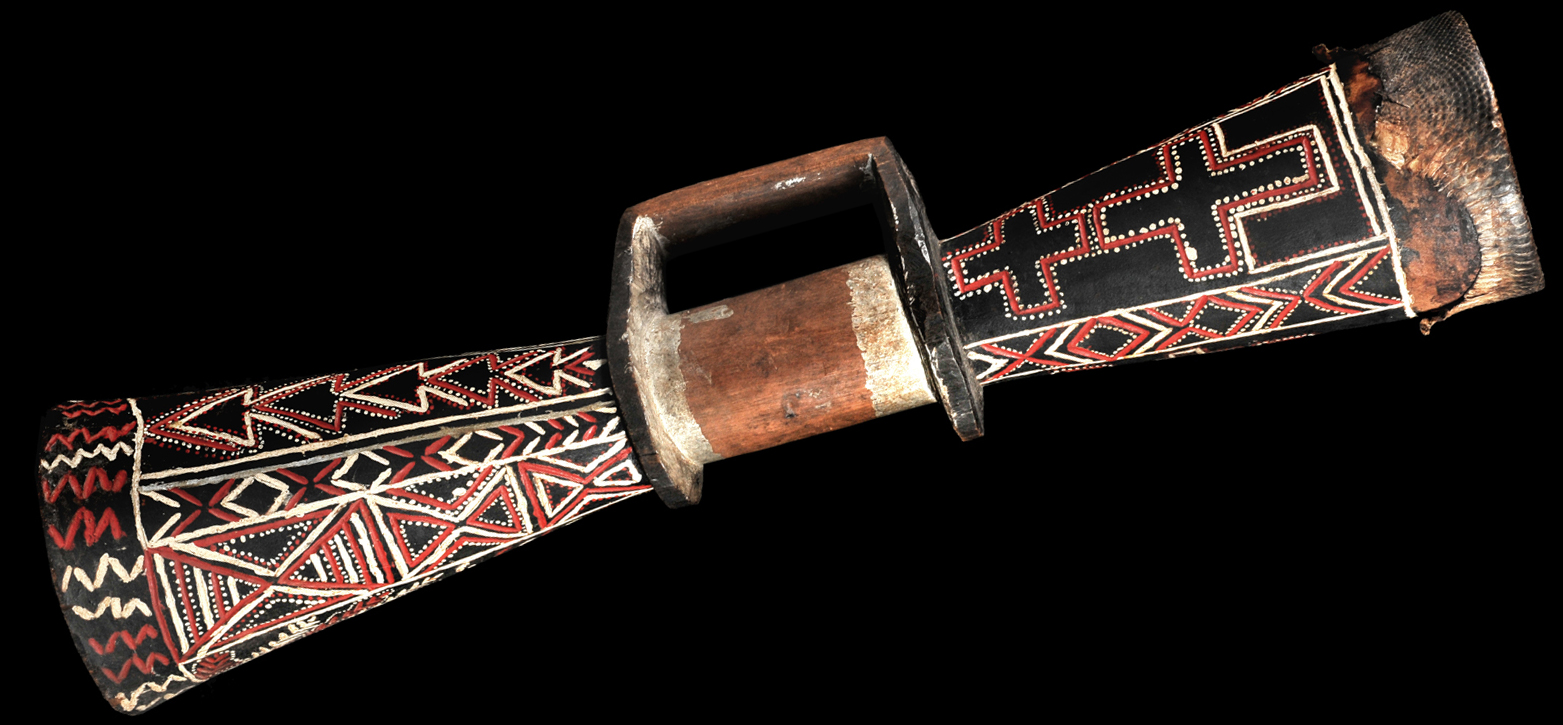
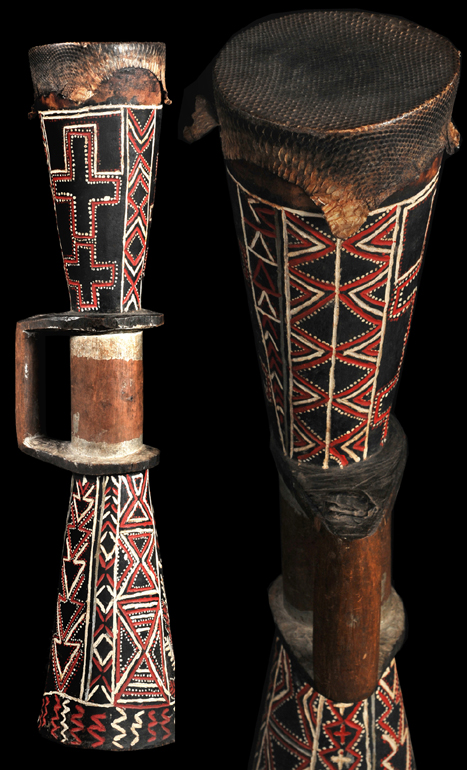
Jaap Kunst specifically differentiates the Yé-anim drum from the better-known Marind-anim kandara. He records the Yé-anim drums under the names tempai and teruar and describes their body as narrowing toward the centre before gradually expanding toward both ends. In contrast to the Marind-anim drum, whose waist is more cylindrical, the Yé-anim form has a continuously curving hourglass profile. Kunst also notes that its handle is considerably smaller than that of the Marind-anim drum.
The present instrument corresponds closely to this general description. It is a single-headed hourglass-shaped membranophone with a relatively compact central handle. The wooden body has been carefully carved and hollowed, while the surface is covered by an exceptionally elaborate painted decoration in red, white and black. Geometric bands, stepped forms, zigzag patterns and linear motifs cover almost the entire visible surface of the resonator.
Particularly striking are the large cross-shaped motifs on the upper section of the drum. These Christian symbols are clearly distinguishable from the geometric vocabulary of the surrounding decoration. They should not automatically be interpreted as traditional Yé-anim imagery. Rather, they appear to document a later phase in the history of the instrument, when Christian visual symbols had become incorporated into the decoration of locally made objects. The drum therefore provides an unusual material record of the encounter between an established indigenous artistic tradition and Christian missionary influence.
The introduction of Christianity brought profound cultural changes to communities in the Merauke region during the twentieth century. Among the Yé-anim, Catholic and Protestant missions became established in different settlements, and Christian religious practice was gradually incorporated into local social life. The survival of traditional musical forms alongside newly introduced Christian imagery illustrates the complex process through which indigenous artistic traditions were transformed rather than simply replaced.
As with other drums of southern New Guinea, the instrument was associated with singing, dancing and ceremonial performance. Drums provided rhythmic accompaniment for dances and songs connected with initiation and other important communal occasions. The sound of the drum could also be understood within a wider cosmological framework in which musical performance connected the human community with the supernatural world.
The construction of southern New Guinean hourglass drums required considerable technical skill. Historical descriptions record that the resonator was carved from a single section of soft-hearted wood and hollowed progressively from both ends. Controlled burning, scraping and adze work were employed to obtain the long internal cavity and the characteristic external profile. The membrane was traditionally made from reptile skin, with the tension adjusted by heating the drumhead over a fire.
The present drum is particularly significant because its decoration preserves two different cultural layers. The geometric and linear ornament belongs to the visual tradition of southern New Guinea, while the conspicuous Christian crosses testify to a later period of cultural and religious transformation. Rather than being regarded simply as a traditional drum with foreign decoration, the instrument can therefore be understood as a historical document of cultural change among the Yé-anim.
The distinction between Yé-anim and Marind-anim is especially important in the study of southern New Guinean drums. Jaap Kunst observed that the Marind-anim kandara had already largely superseded the older Yé-anim type in the wider region. The present instrument is therefore of particular interest as an example of a less frequently documented drum tradition that survived within the cultural sphere of the Yé-anim.
Bibliography:Baal, Jan van (1982): Jan Verschueren's Description of Yéi-Nan Culture. Verhandelingen van het Koninklijk Instituut voor Taal-, Land- en Volkenkunde, Vol. 99. The Hague: Martinus Nijhoff.
Baal, J. van (1966): Dema. Description and Analysis of Marind-Anim Culture (South New Guinea). Translation Series No. 9. The Hague: Koninklijk Instituut voor Taal-, Land- en Volkenkunde.
Collaer, Paul (1965): Musikgeschichte in Bildern – Ozeanien. Musikethnologie 1. Leipzig.
Fischer, Hans (1958): Schallgeräte in Ozeanien. Sound-producing Instruments in Oceania.
Graf, Walter (1950): Die musikwissenschaftlichen Phonogramme Rudolf Pöchs von der Nordküste Neuguineas.
Kunst, Jaap (1967): Music in New Guinea – Three Studies. 's-Gravenhage: Martinus Nijhoff.
Nevermann, Hans (1941): Die Je-nan. Baessler-Archiv 24.
Wirz, Paul (1922–1925): Die Marind-anim von Holländisch Süd-Neu-Guinea. 2 vols. Hamburg: Friederichsen & Co.