New Guinea
Kwanga Area drum New Guinea
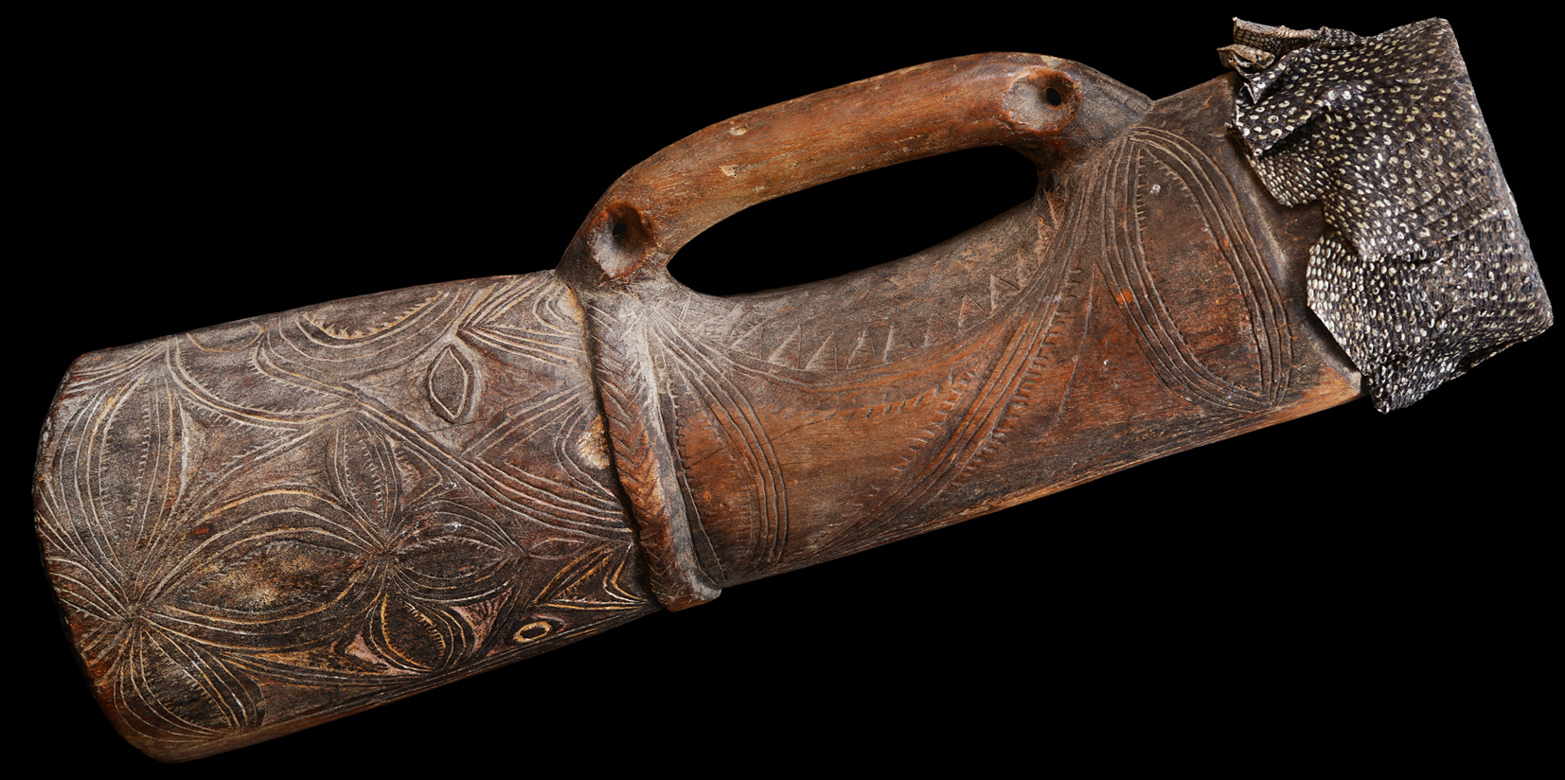
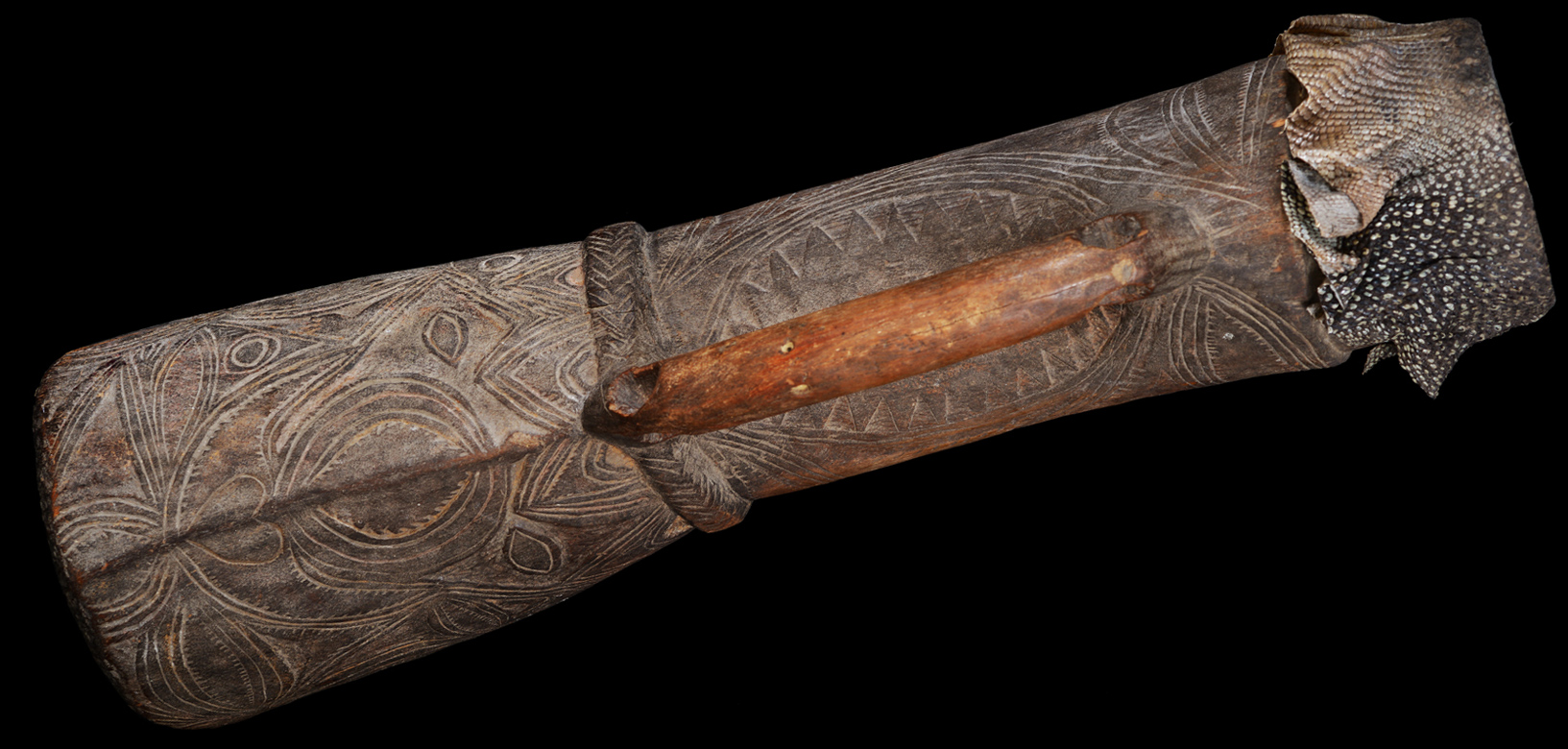
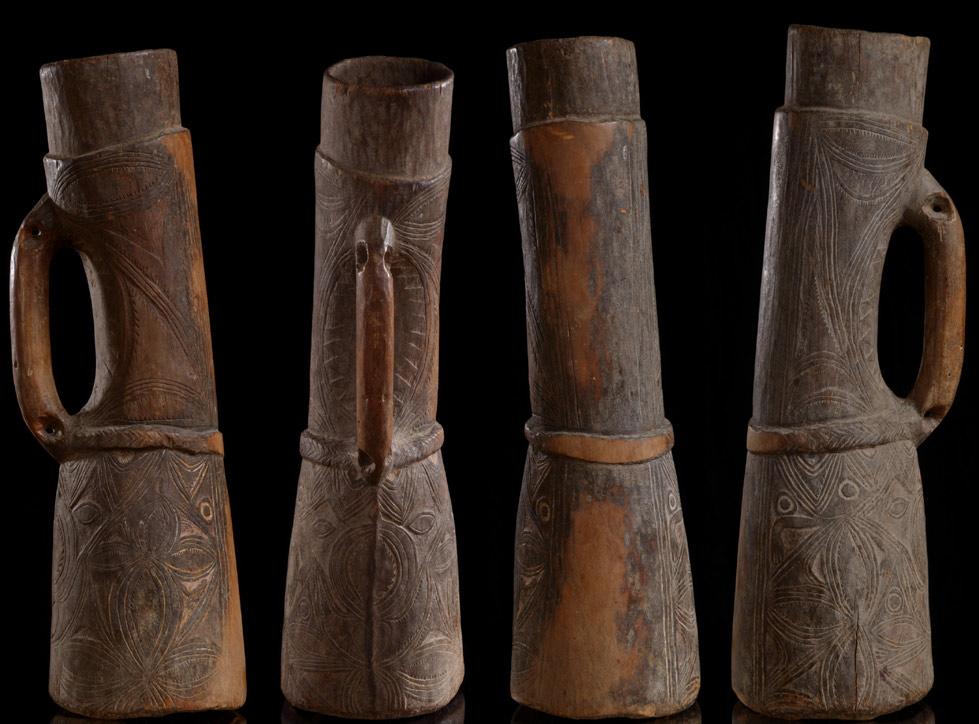
Kwanga Hand Drum (Kwanga, East Sepik Province, New Guinea)
The Kwanga hand drum represents a distinctive regional tradition of wooden membranophones from the Prince Alexander Mountains of the East Sepik Province. The Kwanga-speaking communities live in the region to the southwest of the Abelam and north of the Sepik River, where their artistic traditions show certain affinities with those of their better-known Abelam neighbours while retaining a distinctive visual vocabulary of their own.
The present drum is particularly remarkable because of its pre-contact construction and its traditional stone-carved surface. Before the introduction of metal tools, drums of this type were laboriously shaped with stone implements and hollowed by controlled burning and subsequent scraping. Such construction required considerable time and technical knowledge. The survival of a drum retaining evidence of this earlier technology makes the present example especially significant for the study of the history of woodworking and musical instrument production in the Sepik region.
The surface is decorated with an extensive system of curvilinear incised and low-relief designs. Rather than being applied as superficial decoration, the ornament is integrated into the carved wooden surface and follows the contours of the resonator. The repeated arcs, concentric forms and flowing linear motifs create a continuous visual rhythm that corresponds remarkably well with the highly developed graphic traditions of the Kwanga and neighbouring Wosera region.
The relationship between Kwanga and Abelam artistic traditions is particularly important in this context. Kwanga communities occupy a region immediately adjoining the southern and western areas of the Abelam cultural sphere, and their visual culture shares certain formal characteristics with Abelam art. At the same time, Kwanga carving can be distinguished by specific treatments of ancestral imagery, geometric structures and curvilinear ornament. The present drum demonstrates this regional artistic dialogue without simply belonging to the Abelam tradition.
Hand drums throughout the Sepik and neighbouring regions are associated with singing, dancing and ceremonial activity. Their rhythmic patterns provide an important musical framework for communal performances, while the drum itself may carry associations with ancestors, spirits and the transmission of traditional knowledge. In this wider cultural context, a hand drum is not merely an acoustic device but also an object in which technical skill, visual art and ceremonial practice converge.
Comparable Kwanga drums are exceptionally rare in museum and private collections. A particularly important example is preserved in the Jolika Collection and has been attributed to Nungwaia, a Kwanga village in the Wosera region. Michael Hamson describes this pre-contact, stone-carved hand drum as one of the finest examples known to him, emphasizing its age, patina and the quality of its carved ancestral imagery. He also notes that figurative sculpture from Nungwaia shares certain characteristics with Abelam art while retaining distinctive features, including characteristic treatment of ancestral faces and bodies.
The present example is therefore of particular importance not only as a musical instrument but also as a document of regional sculpture and woodworking. Its combination of traditional stone-carved construction, mature surface patina, pierced handle and extensive incised ornament places it within an early phase of Kwanga material culture, before the widespread adoption of European metal tools. It provides an important link between the technological history of New Guinean drums and the highly sophisticated artistic traditions of the East Sepik region.
"Well to the south of the southern Abelam area known as the Wosera is a large village called Nungwaia. Figurative sculpture from this village is similar to Abelam in style but with subtle differences. The face of the ancestral spirits often have arched eyebrows and the figures have torsos with well-defined ribs. It is possible to see some of these traits in the pre-contact, stone-carved hand drum—one of the finest I have ever seen."
Michael Hamson, Aesthetics of Integrity in New Guinea Art, section "Kwanga Drum", describing a Kwanga drum from Nungwaia Village, Jolika Collection.
Craig, Barry; Busse, Mark; Eoe, Soroi (2010): Living Spirits with Fixed Abodes – The Masterpieces Exhibition. Papua New Guinea National Museum and Art Gallery. Honolulu: University of Hawai‘i Press.
Fischer, Hans (1958): Schallgeräte in Ozeanien. Sound-producing Instruments in Oceania.
Hamson, Michael (ed.): Art of the Abelam. With contributions by Siobhan Campbell, Laurent Granier, Virginia-Lee Webb and Diane Sheehan.
Hamson, Michael: Aesthetics of Integrity in New Guinea Art. Section: "Kwanga Drum", Jolika Collection.
Koch, Gerd: Kultur der Abelam. Die Berliner Maprik-Sammlung.
Martínez-Jacquet, Elena: Invocando a los espíritus: instrumentos musicales de Indonesia y Oceanía en la colección Helena Folch.
Maaz, Klaus: Abelam: Die magische Welt der Abelam. Kunst und Kult in Papua-Neuguinea.
Obrist van Eeuwijk, Annelies (1992): Studies of the Kwanga villages and agricultural system of the Wosera region.