New Guinea
Lake Sentani drum New Guinea
Lake Sentani Drum (Sentani, West Papua, New Guinea)
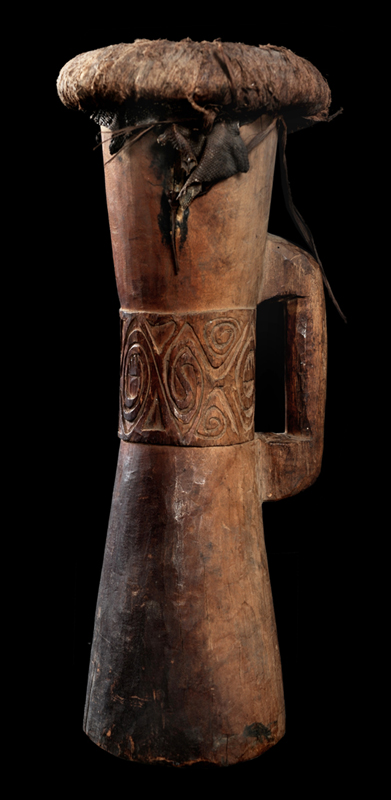
The present drum belongs to the broad and relatively massive type of wooden hand drum documented in the Lake Sentani region of western New Guinea. Simon Kooijman distinguished two principal forms of drum used around Lake Sentani: a broad and substantial type, which could be cylindrical, conical or hourglass-shaped, and a second type that was considerably longer and narrower, with only a slight central constriction. The present example clearly belongs to the first category.
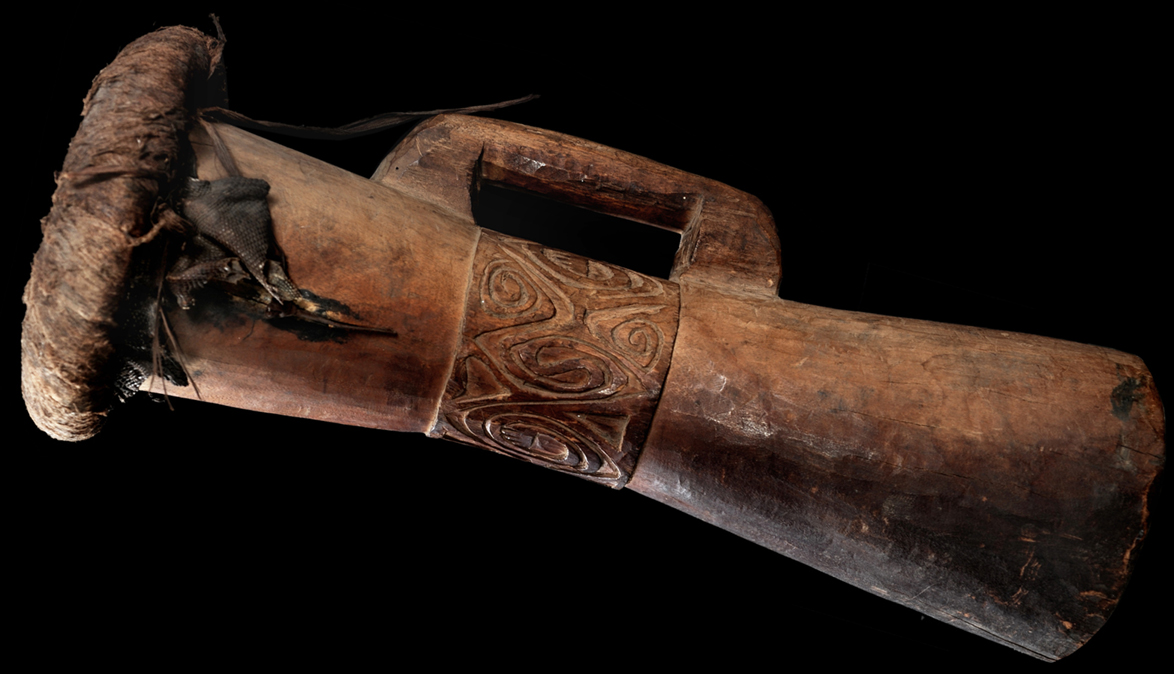
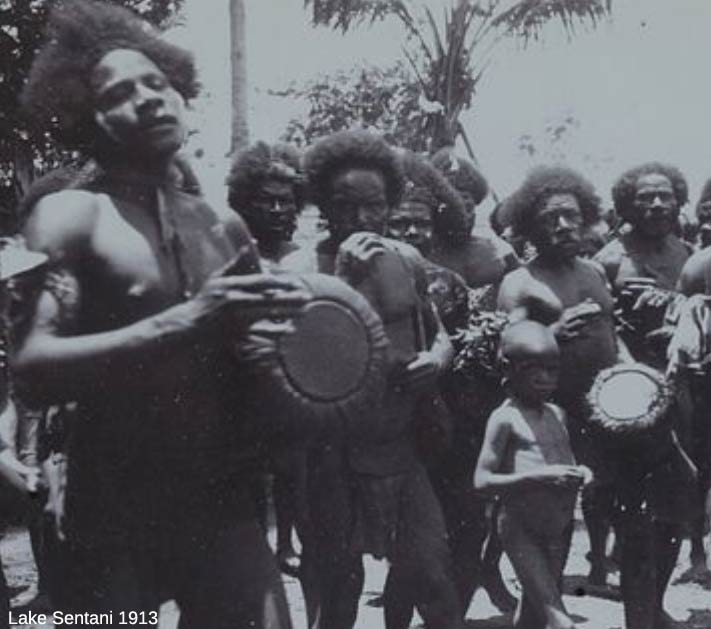
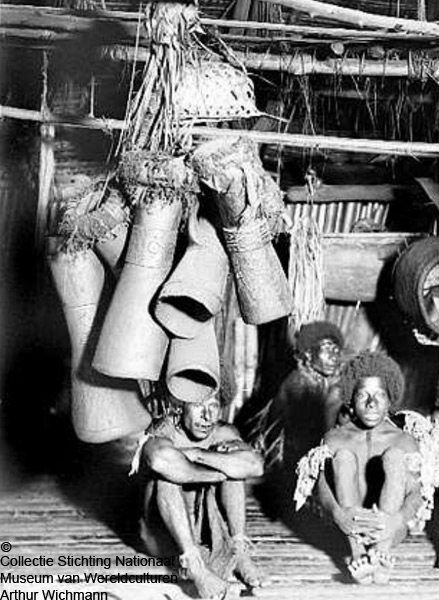
The drum is characterized by a strongly articulated hourglass profile, with broad upper and lower sections separated by a pronounced central waist. A large, solid wooden handle is carved directly from the body. This form is particularly characteristic of the larger Sentani drums and can also be seen in early historical photographs of the region. A photograph dated 1913 showing inhabitants of Lake Sentani includes a similar drum, providing valuable visual evidence for the form and use of these instruments in the early twentieth century.
The drumhead is secured by a substantial circular tension band. Kooijman notes that the tympanum of Sentani drums was traditionally kept taut by means of a thick ring made of rattan or bark. The construction allowed the membrane to maintain the tension necessary for producing a strong and resonant sound, while the wooden body served as the resonating chamber.
The surface of the present drum is especially notable for its restrained but finely incised decoration. The carved motifs include flowing spiral and curvilinear forms which are closely related to the characteristic ornamental vocabulary of Lake Sentani art. These motifs are not merely decorative additions but form part of a regional artistic tradition in which spiral, concentric and flowing linear patterns occur on a wide variety of objects.
Kooijman observed that the broader type of Sentani drum closely resembles drums from neighbouring Humboldt Bay. He considered it reasonable to assume that this form had been adopted from the coastal region, while emphasizing that the Sentani examples could be distinguished by their distinctive decoration. In particular, he identified the series of spiral motifs as one of the characteristic features of Lake Sentani artistic expression.
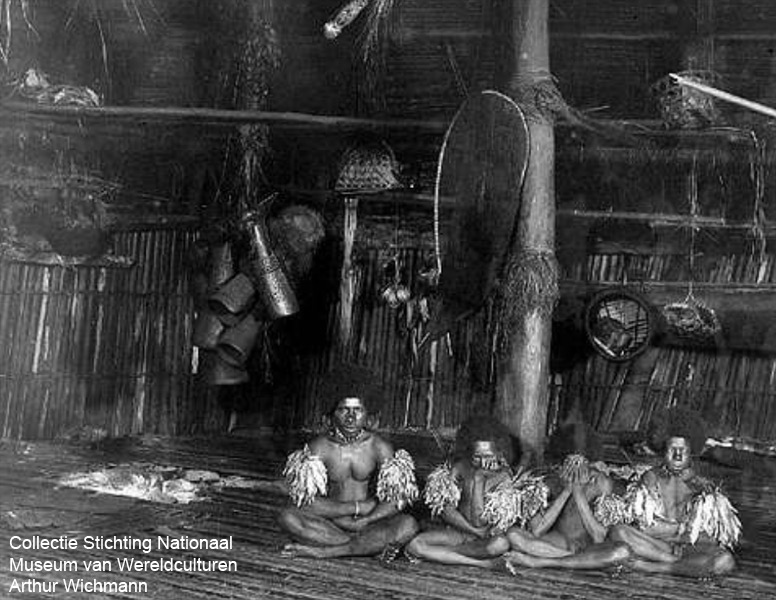
Wooden hand drums were associated with the mau and ondoforo houses and formed part of the important ceremonial equipment of the Sentani communities. Unlike the bamboo flutes, which belonged to a more restricted sacred sphere, drums could also be owned by ordinary villagers and kept in their houses. Their use therefore occupied a somewhat different position within Sentani ceremonial and social life.
The historical evidence suggests that the drum was used in connection with singing, dancing and ceremonial gatherings. Within the wider musical culture of Lake Sentani, sound could also carry associations with the supernatural and ancestral world. The drum consequently functioned not only as a rhythmic instrument but also as part of a complex system of social, ceremonial and artistic expression.
"Among the indispensable paraphernalia of the mau and the ondoforo house were the wooden hand-drums; but these were not such "sacred objects" as the bamboo flutes, and might be in the possession of ordinary villagers who kept them in their houses. As far as we know two types of drum were in use in the Lake Sentani region : one broad and massive, in the shape of a cylinder, cone or hour-glass ; the other long and narrow, with a slight central constriction. The tympanum is always kept taut by means of a thick, circular band made of rattan or bark. The first type greatly resembles the drums used by villagers of Humboldt Bay, and it seems reasonable to assume they were adopted from that part of the coast. They differ from the Humboldt Bay drums, however, in their decoration. This includes the series of spiral motifs which are so characteristic of Lake Sentani art."
Kooijman, Simon (1959): The Art of Lake Sentani. The Museum of Primitive Art, New York, p. 22.
Bibliography:
de Clercq, F. S. A.: Ethnographische Beschrijving van de West- en Noordkust van Nederlandsch Nieuw-Guinea. Leiden, 1893.
Greub, Suzanne (1992): Art of Northwest New Guinea – From Geelvink Bay, Humboldt Bay and Lake Sentani.
Kooijman, Simon (1959): The Art of Lake Sentani. The Museum of Primitive Art, New York.
Webb, Virginia-Lee (2011): Ancestors of the Lake: Art of Lake Sentani and Humboldt Bay, New Guinea. The Menil Collection.