New Guinea
Lake Sentani Drum New Guinea
Lake Sentani Drum (Sentani, West Papua, New Guinea)
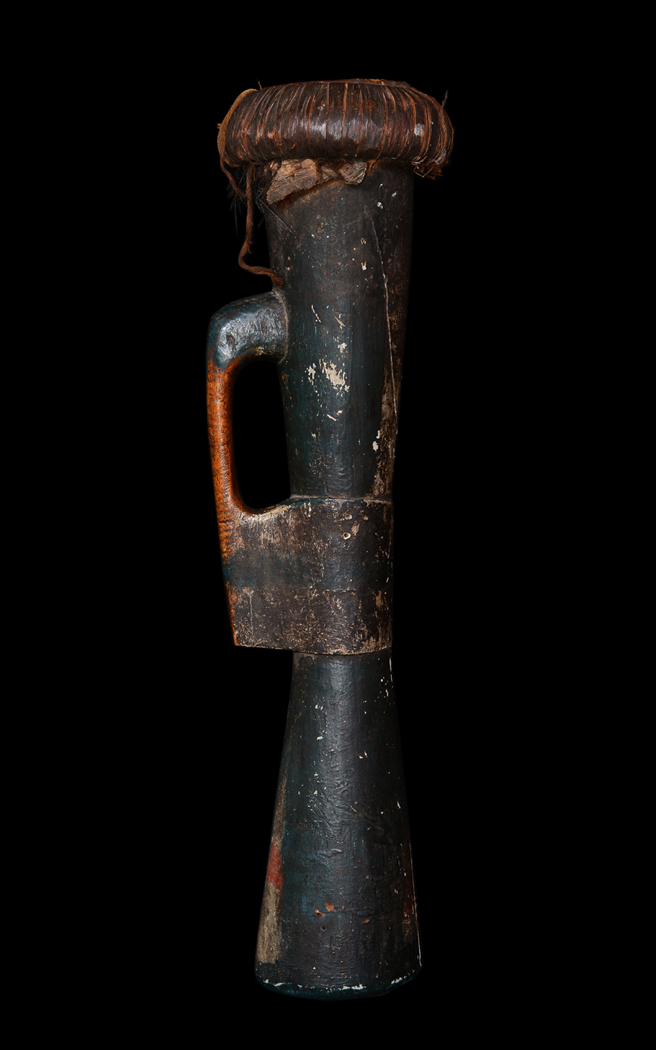
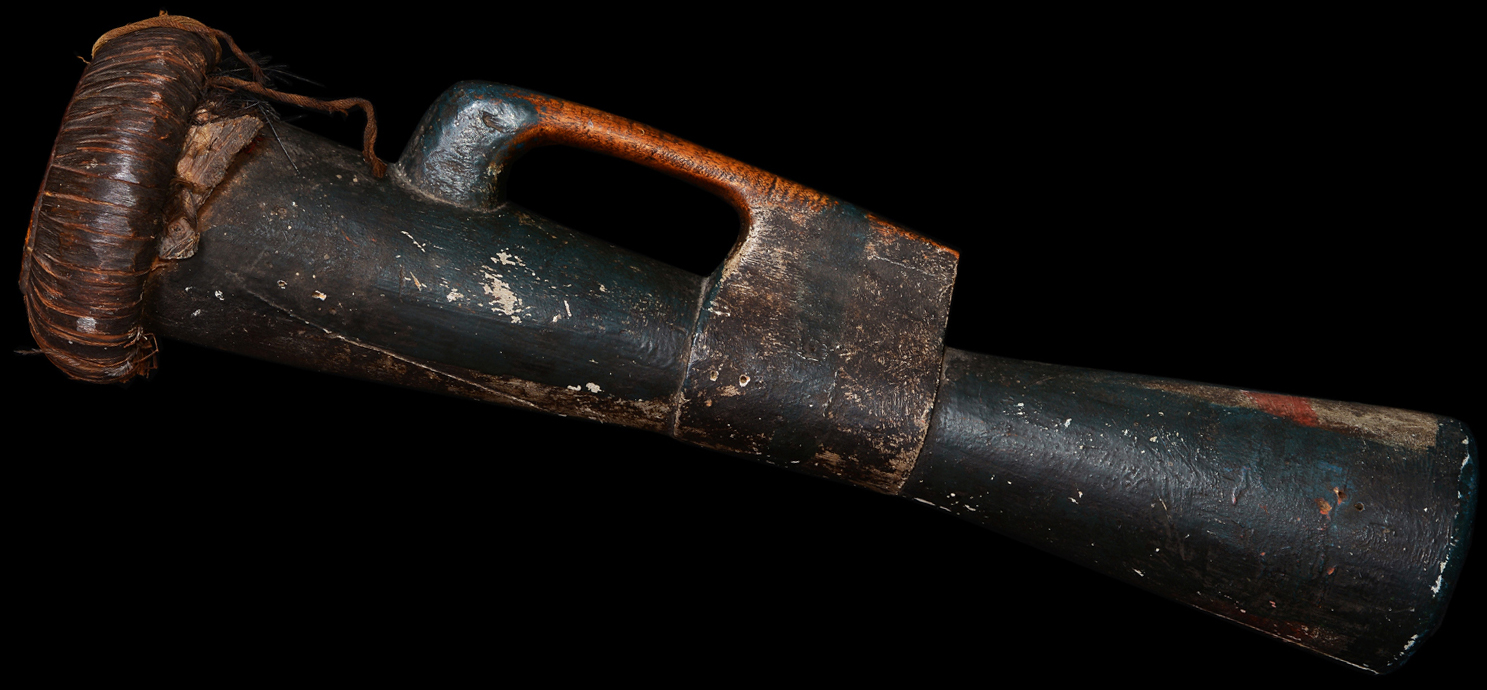
Among the traditional musical instruments of the Lake Sentani region, the wooden hand drum occupies an important position in ceremonial and communal life. Historical accounts distinguish two principal forms: a broad and relatively massive type, which may be cylindrical, conical or hourglass-shaped, and a second, much longer and narrower type with only a slight constriction at the centre. The present instrument belongs clearly to the latter form.
The drum is remarkable for its unusually elongated proportions. Its long cylindrical body narrows slightly toward the centre and expands again toward the ends, while a substantial wooden handle is carved directly from the body. The drumhead is secured by a thick circular tension ring, a construction characteristic of drums from the Lake Sentani region. The dark, highly polished surface and extensive patina indicate prolonged handling and use.
Historical documentation indicates that wooden hand drums were among the important objects associated with the mau and ondoforo houses. Unlike the sacred bamboo flutes, however, drums were not necessarily restricted objects and could also be kept by ordinary villagers in their houses. This distinction illustrates the different degrees of ritual significance attached to musical instruments within Sentani society.
Particularly important were drums belonging to village leaders and ritual specialists. Ethnographic descriptions record that certain ceremonial drums possessed individual names and were regarded as connected with ancestral beings. Their sound could be understood as the voice of an ancestor communicating through the drumhead. In this context, the instrument was not merely a means of producing rhythm but formed part of a wider relationship between the living community and the ancestral world.
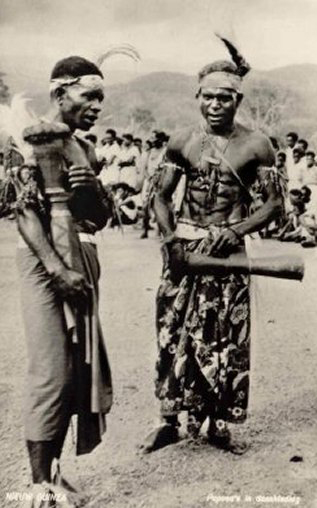
The present drum is especially interesting when compared with an historical photograph showing a Sentani man holding a remarkably similar long, narrow drum. The proportions, elongated body, central handle and general construction correspond closely to the present example. The photograph cannot, however, be regarded as proof that the illustrated instrument is the same object. It nevertheless provides valuable historical evidence for the form and manner in which this type of Sentani drum was used.
The close visual correspondence between the historical photograph and the present instrument is particularly noteworthy because early photographic documentation of New Guinea instruments provides rare evidence of objects in active cultural contexts. Such photographs complement museum specimens by showing not only their physical appearance but also how they were held, carried and incorporated into ceremonial life.
"Among the indispensable paraphernalia of the mau and the ondoforo house were the wooden hand-drums; but these were not such "sacred objects" as the bamboo flutes, and might be in the possession of ordinary villagers who kept them in their houses. As far as we know two types of drum were in use in the Lake Sentani region : one broad and massive, in the shape of a cylinder, cone or hour-glass ; the other long and narrow, with a slight central constriction. The tympanum is always kept taut by means of a thick, circular band made of rattan or bark. The first type greatly resembles the drums used by villagers of Humboldt Bay, and it seems reasonable to assume they were adopted from that part of the coast. They differ from the Humboldt Bay drums, however, in their decoration. This includes the series of spiral motifs which are so characteristic of Lake Sentani art."
Kooijman, Simon (1959): The Art of Lake Sentani. The Museum of Primitive Art, New York, p. 22.
Bibliography:
de Clercq, F. S. A.: Ethnographische Beschrijving van de West- en Noordkust van Nederlandsch Nieuw-Guinea. Leiden, 1893.
Greub, Suzanne (ed.) (1992): Art of Northwest New Guinea: From Geelvink Bay, Humboldt Bay and Lake Sentani. New York.
Hoogerbrugge, Jac. (1967): Sentani-meer mythe en ornament. Kultuurpatronen 9.
Kooijman, Simon (1959): The Art of Lake Sentani. The Museum of Primitive Art, New York.
Webb, Virginia-Lee (2011): Ancestors of the Lake: Art of Lake Sentani and Humboldt Bay, New Guinea. The Menil Collection.