New Guinea
Marind Anim Drum New Guinea
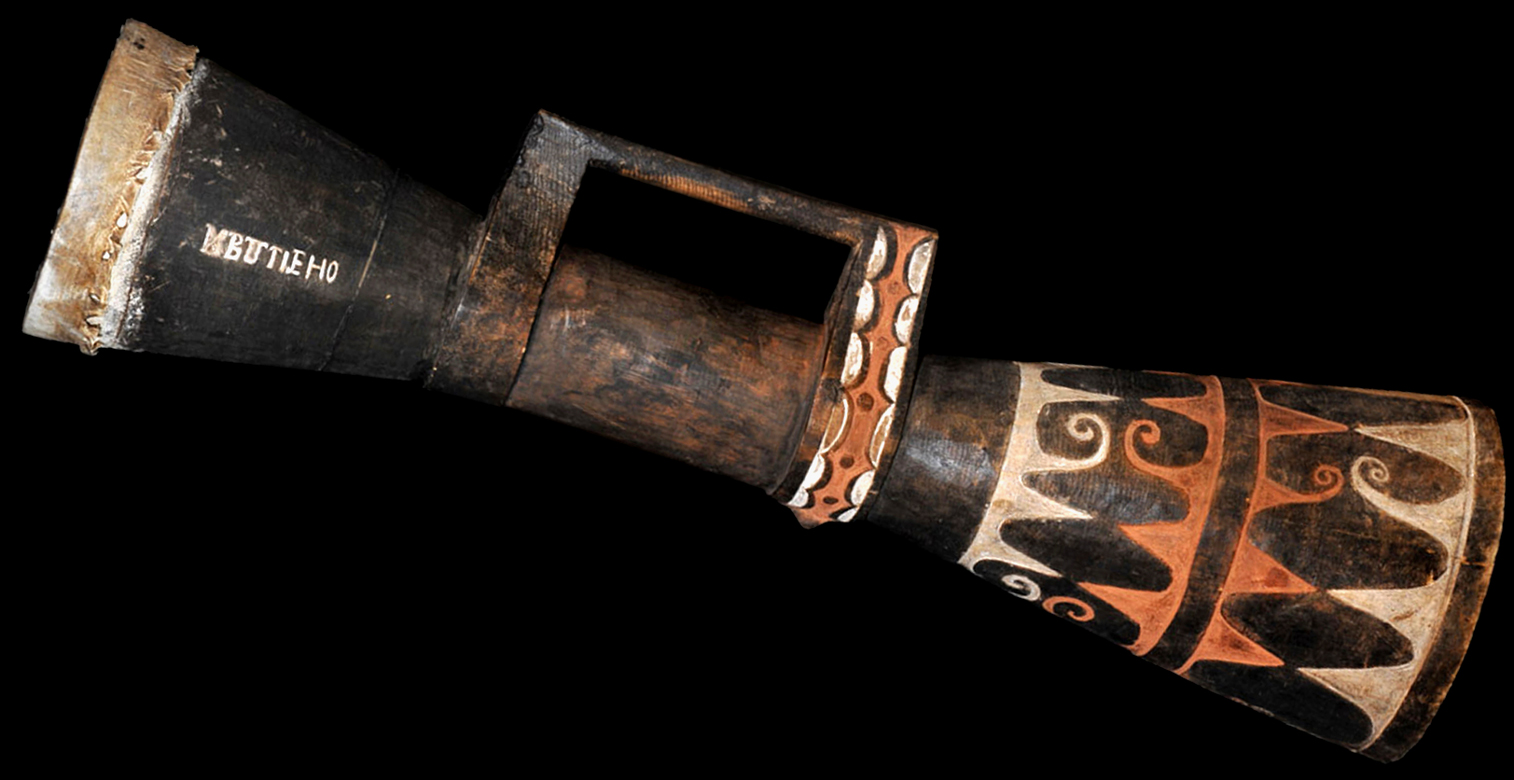
Marind-Anim Drum (South New Guinea, Indonesia)
The Marind-Anim are one of the major indigenous peoples of southern New Guinea, traditionally inhabiting the region around the Maro, Kumbe and Bian rivers and the adjacent coastal areas of the Arafura Sea. Their cultural traditions were characterized by an elaborate system of mythology, initiation, clan organization, ritual performance and ancestral beliefs. Among the most important ethnographic sources are the extensive studies of Paul Wirz and Jan van Baal, which document the religious and social life of the Marind-Anim during a period of profound cultural change.
Central to Marind-Anim religious thought is the concept of dema, referring to primordial beings and ancestors whose actions established the order of the world and the cultural institutions of human society. Dema beings were associated with clans, animals, plants, places and the forces governing fertility and reproduction. Through ceremonial performances, these ancestral powers were ritually recalled and brought into the present. Music, singing, dancing, costume and bodily performance therefore formed an integrated part of the religious and social system.
Drums played an important role within these ceremonial performances. They accompanied dances and songs during initiations, communal celebrations and other important ritual occasions. The drum was not merely a rhythmic instrument but formed part of a larger system of ritual communication in which sound and movement helped to establish a connection between the human community, ancestral beings and supernatural powers. The large kandara drums are particularly associated with the ceremonial traditions of the Marind-Anim and could reach considerable dimensions.
The importance of the drum is also reflected in the elaborate beliefs surrounding its construction and sound. Jaap Kunst recorded that the Marind-Anim used special substances in attaching the drumskin and attributed particular acoustic and social qualities to the resulting instrument. The preparation of the drum was therefore not simply a technical process but was embedded in a wider system of ritual knowledge and belief.
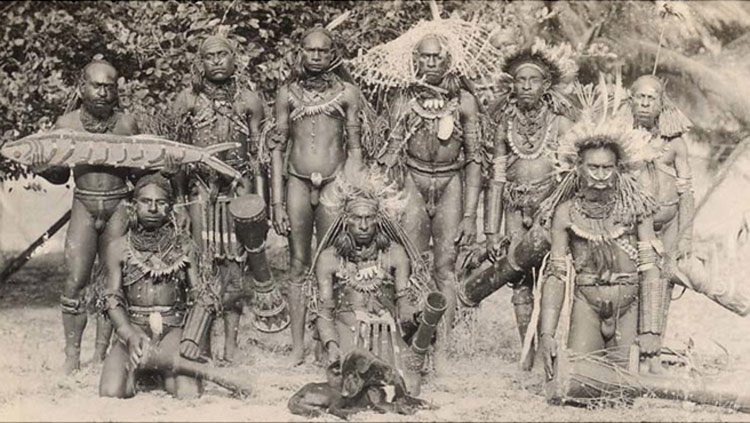
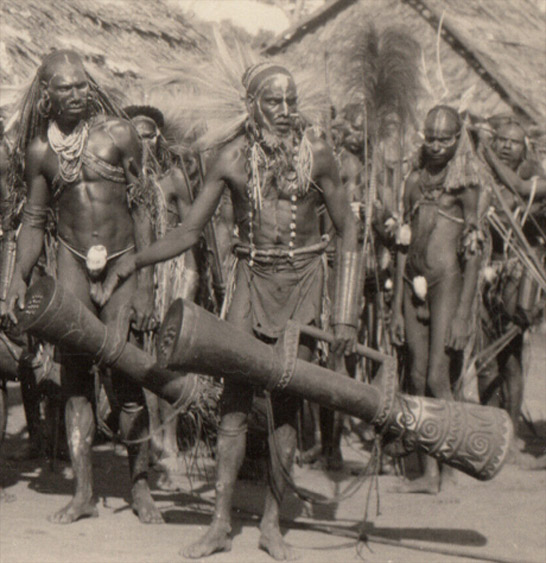
Music and dance were especially important during initiation ceremonies, in which young members of the community were introduced to the knowledge, traditions and obligations of Marind-Anim society. Ceremonial performances could involve groups of dancers, singers and drummers, with the rhythmic and visual elements combining to create a highly structured ritual environment. Historical photographs demonstrate the prominent position of large drums within these performances.
The present drum belongs to this distinctive Marind-Anim tradition. Its form, decoration and surviving traces of use place it within a musical culture in which the drum was closely associated with ceremonial performance, ancestral traditions and the transmission of cultural knowledge.
Historical comparison
The present drum may be compared with historical Marind-Anim drums documented in the photographic collections of the former Tropisch Instituut. Jaap Kunst published photographs of Marind-Anim drums as Illustration 26, Marind-anim drums, and Illustration 28, Marind-anim with drum, in Music in New Guinea – Three Studies. The photographs are credited to the Tropisch Instituut and provide important historical visual documentation of the use of drums among the Marind-Anim.
Historical photographs
The accompanying historical photographs show Marind-Anim men with large ceremonial drums. They provide valuable visual evidence for the scale, handling and ceremonial context of these instruments.
"The drums are made from the wood of a tree with a soft heartwood. A piece of the trunk is trimmed into the rough shape of a drum. One end is hollowed out a little and the piece of wood is then stood upright, the hollowed-out end uppermost. The lower end is stuck in the ground sufficiently to prevent its falling over. The hollowed-out end is then filled with water which is constantly and carefully replenished. Under the action of the water, the soft heartwood quickly begins to rot. The softened parts are then removed. When half of the cavity has been rotted away in this manner, the piece of wood is then reversed and the same thing is repeated at the other end. This process enables the innermost part to be pushed through with a piece of hard wood or a piece of bamboo. The result is a channel running through the length of the piece of wood. This channel is then widened by firing, the heat being regulated by bellows and the inside is scraped with shells and pigs' tusks. Internodes of bamboo are also made to explode in the cavity - if sound internodes of bamboo are held in a fire they burst open with a mighty bang. This is intended as sympathetic magie, the object being that the drum will produce a loud sound. When the required internal cavity has been obtained, the outside of the drum is then worked with an adze and finished off: carving is then done with pigs' tusks.“
Excerpt from the book: Jaap Kunst, Music in New Guinea – Three Studies. 's-Gravenhage: Martinus Nijhoff, 1967.
The Marind-Anim use a mixture of lime, blood and urine to make the glue to fix the skin to the drumhead. The blood was generally obtained from the owner of the drum. The Marind-Anim believed that a drum whose skin was attached in this manner would produce a particularly clear sound and arouse a strong reaction in women.
Baal, J. van (1966): Dema. Description and Analysis of Marind-Anim Culture (South New Guinea). Translation Series No. 9. The Hague: Koninklijk Instituut voor Taal-, Land- en Volkenkunde.
Wirz, Paul (1922–1925): Die Marind-anim von Holländisch-Süd-Neu-Guinea. 2 vols. Hamburg: Friederichsen & Co.
Kunst, Jaap (1967): Music in New Guinea – Three Studies. 's-Gravenhage: Martinus Nijhoff.
Collaer, Paul (1965): Musikgeschichte in Bildern – Ozeanien. Musikethnologie 1. Leipzig.
Fischer, Hans (1958): Schallgeräte in Ozeanien. Sound-producing Instruments in Oceania.
Graf, Walter (1950): Die musikwissenschaftlichen Phonogramme Rudolf Pöchs von der Nordküste Neuguineas.