DRUMS OF THE WORLD
New Guinea
Motu Drum New Guinea
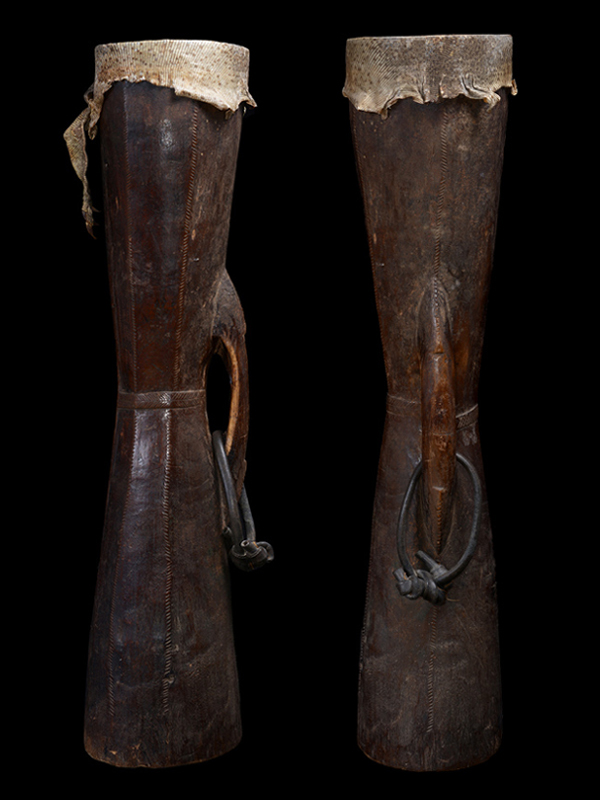
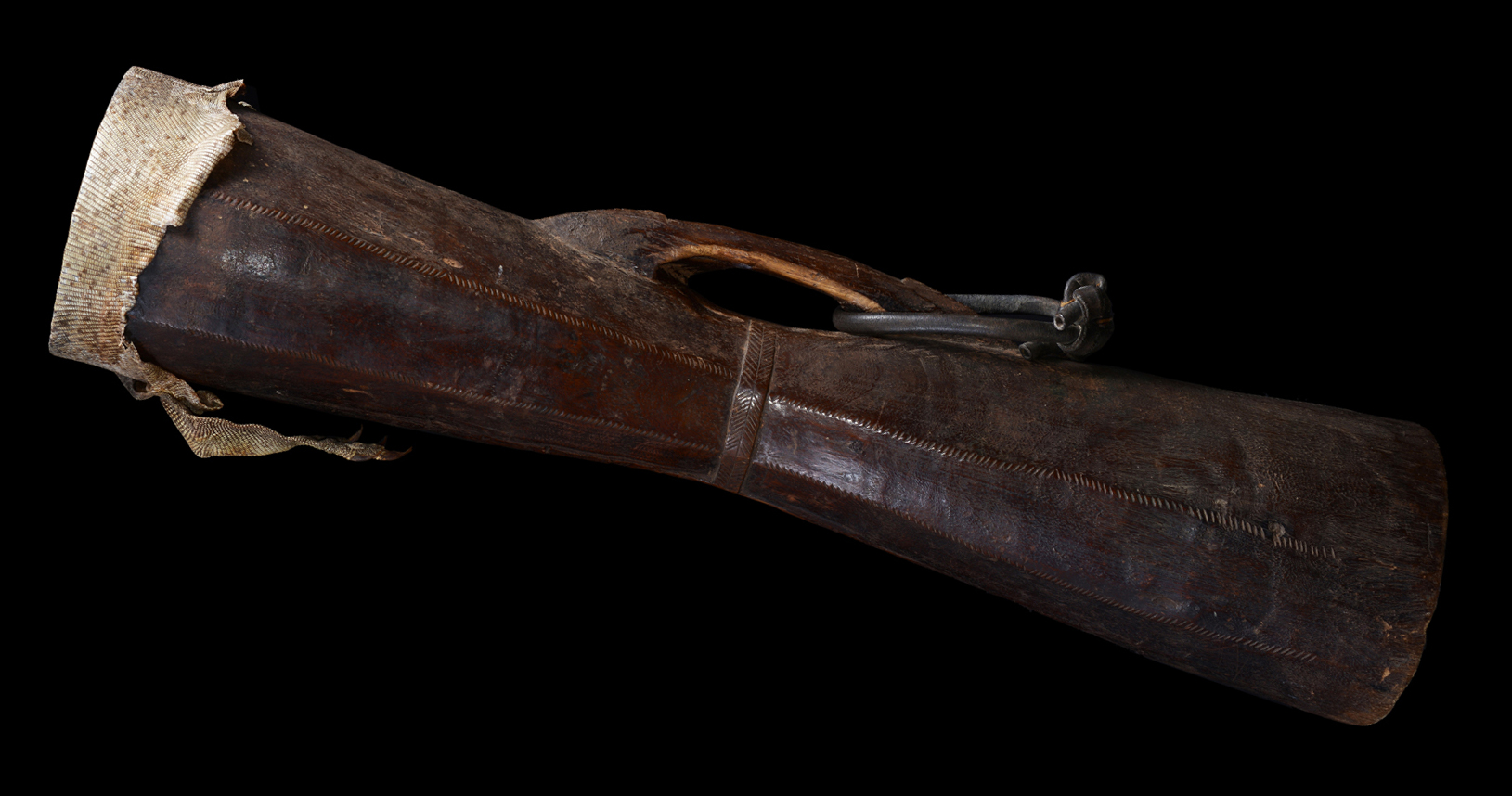
Motu Area Drum (Port Moresby, Papua New Guinea)
The Motu are an Austronesian-speaking people of the southern coast of New Guinea, traditionally inhabiting the coastal region around Port Moresby and extending eastward and westward along the adjacent coast. Port Moresby lies at the centre of the traditional Motu area. The Motu developed extensive maritime and trading networks, most famously associated with the hiri, the large-scale trading voyages in which their sailing canoes travelled westward along the Gulf of Papua.
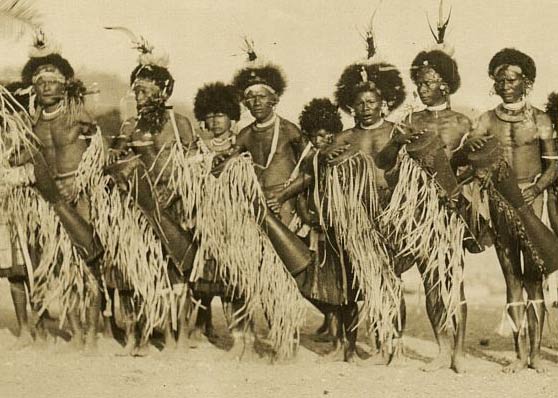
Music, dance and ceremonial performance formed an important part of Motu social life. The hourglass-shaped hand drum, known locally as gaba, is one of the characteristic musical instruments of the region. The same general type is widely known today in Papua New Guinea by the Tok Pisin term kundu, although local names, forms and decorative traditions vary considerably from one region to another.
The drum also has a particular significance in the context of Motu initiation. Ernest Crawley, writing in the early twentieth century, recorded that among the people of the Port Moresby area the making of a drum formed an important duty of boys undergoing initiation. According to his account, the drums were subject to taboo and the initiates remained in the forest while their instruments were being completed. The period required for making an individual drum could extend from approximately one week to a month. This account is particularly significant because it connects the manufacture of the instrument directly with male initiation, rather than treating drum making simply as a technical or musical activity.
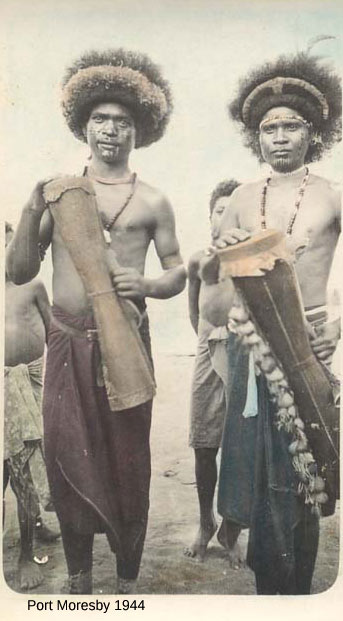
A particularly valuable historical comparison is provided by an early photograph preserved by the Pacific Manuscripts Bureau of the Australian National University. The photograph, attributed to Henry Dexter and dated approximately 1910–1915, shows a Motu man wearing ceremonial dress and holding a drum identified in the archival catalogue as a gaba. The catalogue specifically records the instrument as a drum or gaba in Motu. The image provides rare early photographic evidence of the characteristic drum form in ceremonial context.
The traditional name gaba remains in use among Motu communities today. Contemporary Motu cultural practitioners describe the drum as an instrument connected with communication, ceremony, ancestry and community identity. In this respect, the historical role of the instrument in dance and initiation forms part of a living musical tradition rather than merely a feature of the ethnographic past.
Ethnographic Source:
Among the Port Moresby natives the boys at initiation have only one serious duty, which is for each to make his drum. They are taboo, and live in the forest until the drums are completed ; this may be a week or a month.
See: Crawley, A. E. – Dress, Drinks, and Drums; Further Studies of Savages and Sex. London: Methuen, 1931. The work includes a substantial study of drums, including their social functions and sacredness.
Historical photographic comparison:
Henry Dexter, c. 1910–1915. Motu man in ceremonial headdress (Tubuka) holding a drum or gaba. Pacific Manuscripts Bureau, Australian National University, reference AU PMB PHOTO 2-033.
Bibliography:
Ammann, Raymond (1997): Le rythme Kanak. Cahiers de musiques traditionnelles.
Bateson, Gregory (1936): “Music in New Guinea.” The Eagle 48.
Bogner, Piet (1984): Traditionelle Musikinstrumente aus Neuguinea. München: Gesellschaft zur Erforschung der Naturvölker.
Chauvet, Stephen (1930): Les arts indigènes en Nouvelle-Guinée.
Collaer, Paul (1965): Musikgeschichte in Bildern – Ozeanien. Musikethnologie 1. Leipzig.
Craig, Barry (ed.) (2011): Living Spirits with Fixed Abodes. Honolulu: University of Hawai'i Press.
Crawley, A. E. (1931): Dress, Drinks, and Drums: Further Studies of Savages and Sex. London: Methuen.
Fischer, Hans (1958): Schallgeräte in Ozeanien. Sound-producing Instruments in Oceania.
Friede, John (2005): New Guinea Art – Masterpieces of the Jolika Collection from Marcia and John Friede.
Gourlay, Kenneth (1975): Sound-Producing Instruments in Traditional Society.
Graf, Walter (1950): Die musikwissenschaftlichen Phonogramme Rudolf Pöchs von der Nordküste Neuguineas.
Kelm, Heinz (1966): Kunst vom Sepik.
Kunst, Jaap (1931): A Study on Papua Music.
Martinez-Jacquet, Elena: Invocando a los espíritus: instrumentos musicales de Indonesia y Oceanía en la colección Helena Folch.
Neuhauss, Richard (1911): Deutsch-Neu-Guinea. Vols. I–III. Berlin: Reimer.
Niles, Don (2006): “Drums.” In P. Peltier and F. Morin (eds.), Shadows of New Guinea: Art from the Great Island of Oceania in the Barbier-Mueller Collections.
Peltier, Philippe; Schindlbeck, Markus; Kaufmann, Christian (eds.) (2015): Sepik. Arts de Papouasie Nouvelle-Guinée. Paris: Skira / Musée du quai Branly.
Reche, Otto (1913): “Der Kaiserin-Augusta-Fluss.” In Georg Thilenius (ed.), Ergebnisse der Südsee-Expedition 1908–1910.
Spearritt, Gordon (1982): “The Pairing of Musicians and Instruments in Iatmul Society.” Yearbook for Traditional Music 14.
Wirz, Paul (1959): Kunst und Kult des Sepik-Gebietes (Neu-Guinea). Amsterdam: Koninklijk Instituut voor de Tropen.