New Guinea
New Britain Kundu Drum (Bismarck Archipelago, Papua New Guinea)
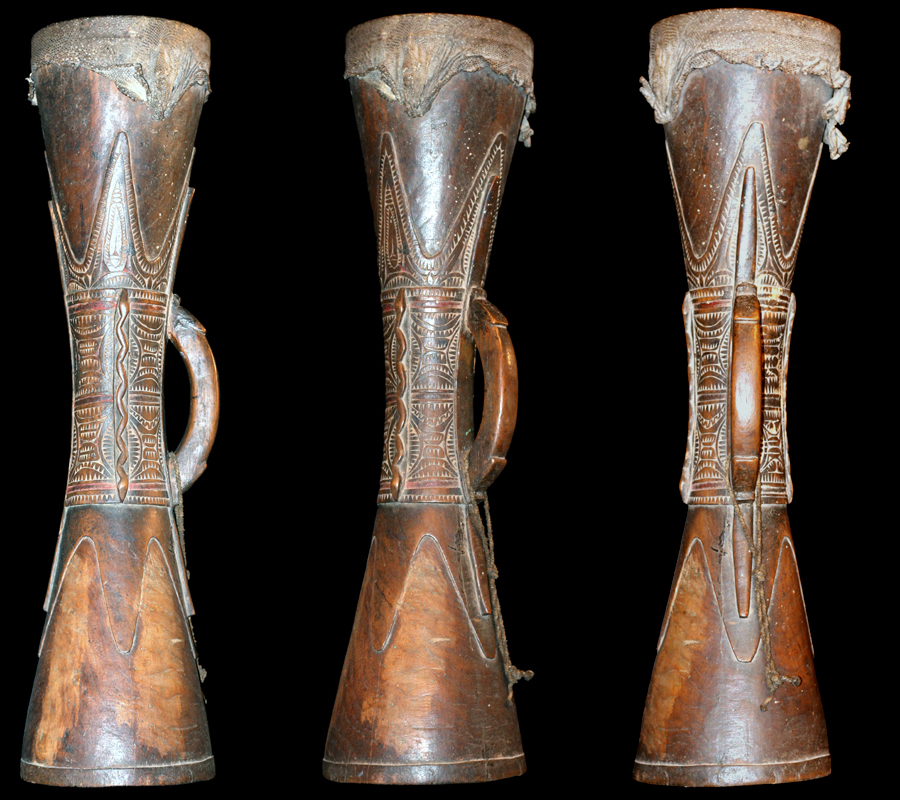
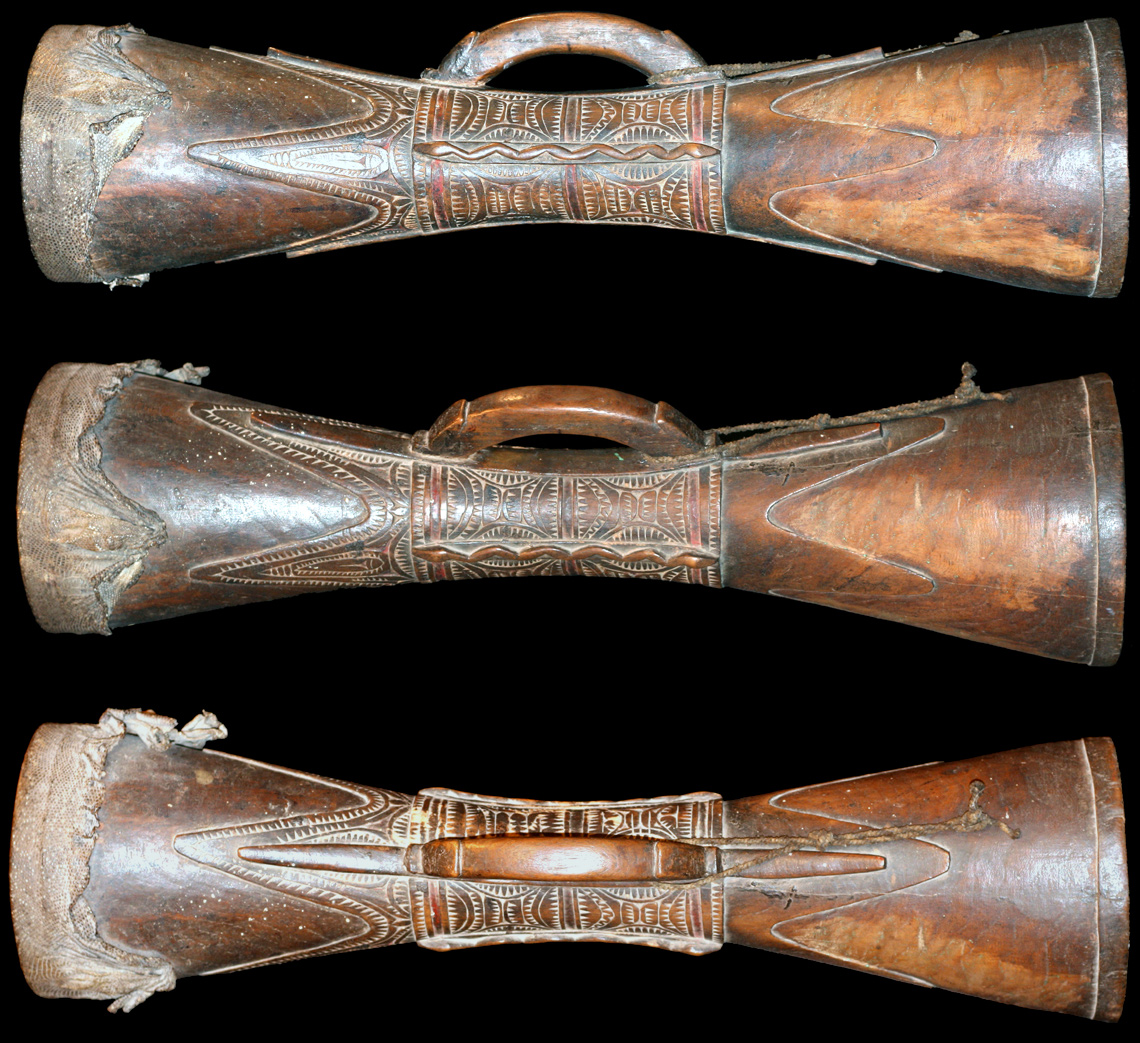
New Britain Kundu Drum (Bismarck Archipelago, Papua New Guinea)
This Kundu drum represents another distinctive form of the hourglass-shaped hand drum tradition of New Britain in the Bismarck Archipelago. Kundu drums are traditionally played by holding the instrument in one hand and striking the lizard-skin membrane with the other. They accompany dancing, singing and ceremonial gatherings and form an important part of the musical traditions of New Guinea.
The present example is particularly notable for its carefully carved and incised decoration. The central waist and the adjoining sections of the body are covered with finely executed geometric and curvilinear motifs, demonstrating the close relationship between drum making and the woodcarving traditions of New Britain. The ornament is not merely applied decoration but forms an integral part of the sculptural conception of the instrument.
As both a musical instrument and a carved object, the New Britain Kundu demonstrates the close connection between sound, performance and visual art in the indigenous cultures of the Bismarck Archipelago. Its elaborate surface treatment distinguishes it from more simply finished examples and emphasizes the importance of the drum as an object of both musical and artistic expression.
"The skins of the lizards were simply dried and, without any further preparation, rolled up in a bamboo tube. Before use, the skins were softened in water, stretched tightly over the opening of the drum and firmly bound at the rim; the edge hanging out under the binding was pulled from all sides until the drumhead became evenly taut. First, however, the rim of the drum was smeared with the juice of a tree which glued the skin securely to the wood on drying. Another important material was the wax supplied by the stingless Trigona bees, pea-sized pieces of which were rolled and stuck to the drumhead. If these wax pieces were hit, the drum gave a pleasanter sound. During the dance every man had a nut-sized piece of wax stuck to the handle of the drum, to replace pieces which came off. If the skin began to sag during the dance, it was warmed at the fire to make it taut again, and it was occasionally beaten to tune it."
Bodrogi, Tibor (1961), Art in North-East New Guinea, pp. 79–81. Budapest: Hungarian Academy of Science.
Lender: The Wagner Family
Bibliography:
Bodrogi, Tibor (1961): Art in North-East New Guinea. Budapest: Hungarian Academy of Science.
Dark, Philip J. C. (1974): Kilenge Art and Life. London: Academy.
Finsch, Otto (1888): Reisen in Kaiser Wilhelms-Land und Neu-Guinea an Bord des Dampfers Samoa.
Finsch, Otto (1888): Ethnologische Erfahrungen und Belegstücke aus der Südsee: beschreibender Katalog einer Sammlung im K.K. Naturhistorischen Hofmuseum in Wien.
Heermann, Ingrid (2001): Form Colour Inspiration: Oceanic Art from New Britain. Arnoldsche Verlagsanstalt.
Neuhauss, Richard (1911): Deutsch-Neu-Guinea. Vol. 1–3. Dietrich Reimer / Ernst Vohsen, Berlin.
Newton, Douglas (1999): Arts of the South Seas.
Parkinson, Richard (1999): Thirty Years in the South Seas. Translation by John Dennison of Dreissig Jahre in der Südsee (1887).