New Britain Drum (Bismarck Archipelago, Papua New Guinea)

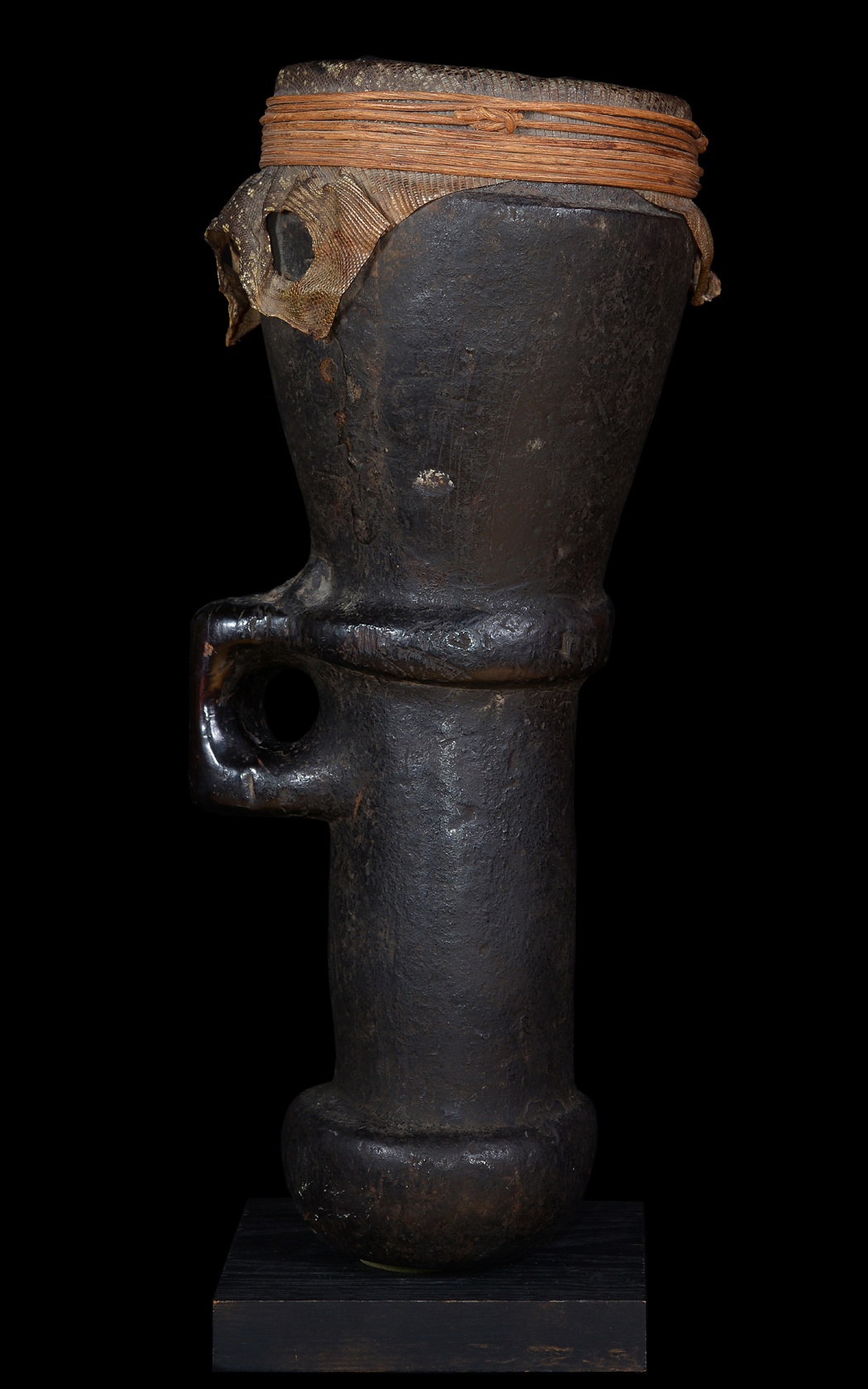
New Britain Drum ( Pre-Contact )(Bismarck Archipelago, Papua New Guinea)
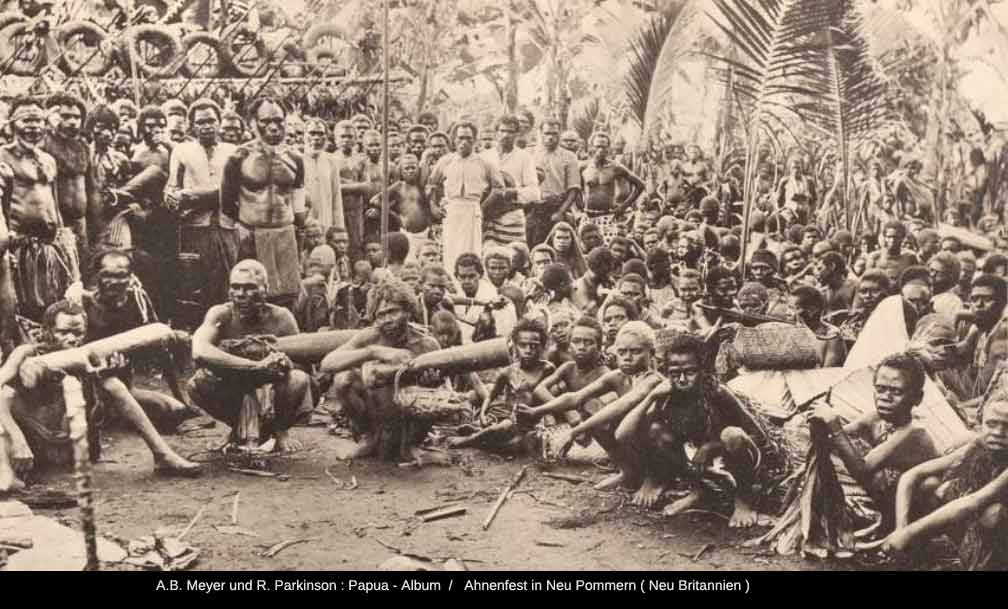
The drum traditions of New Britain form part of the rich ceremonial and musical culture of the Bismarck Archipelago. Drums accompany dances, songs and other important communal occasions, where musical performance is closely connected with ceremonial life, social identity and traditional knowledge. Historical collections from New Britain already document the use of these characteristic hand-held drums at the beginning of the twentieth century.
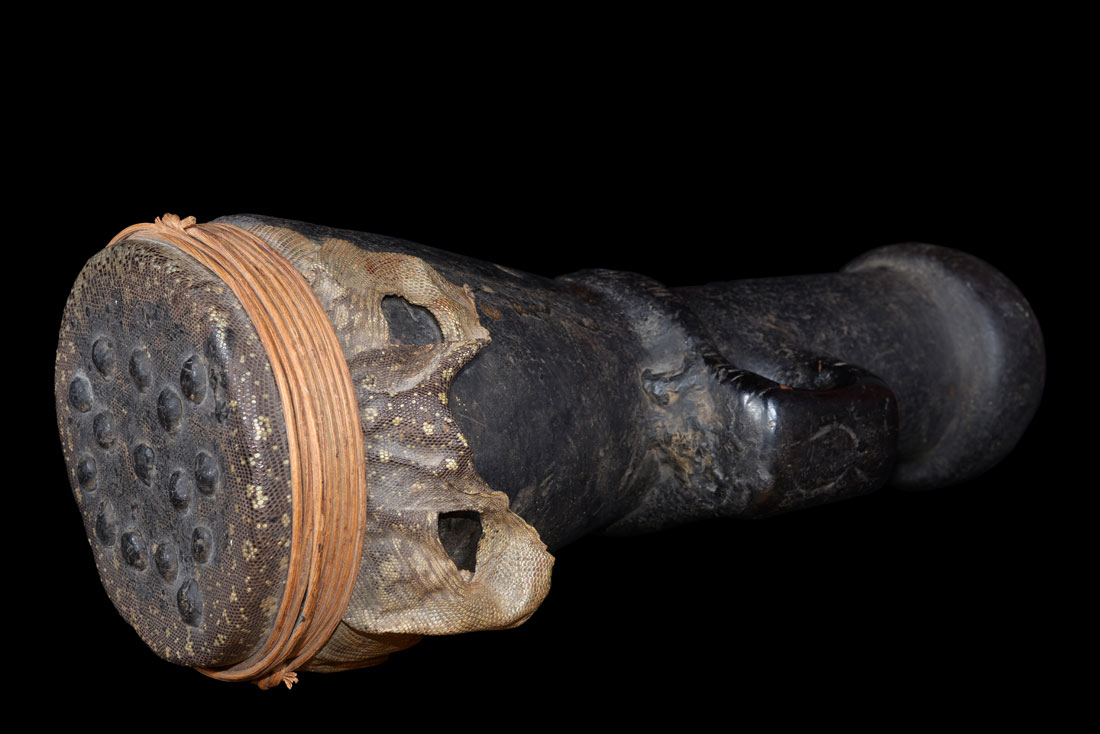
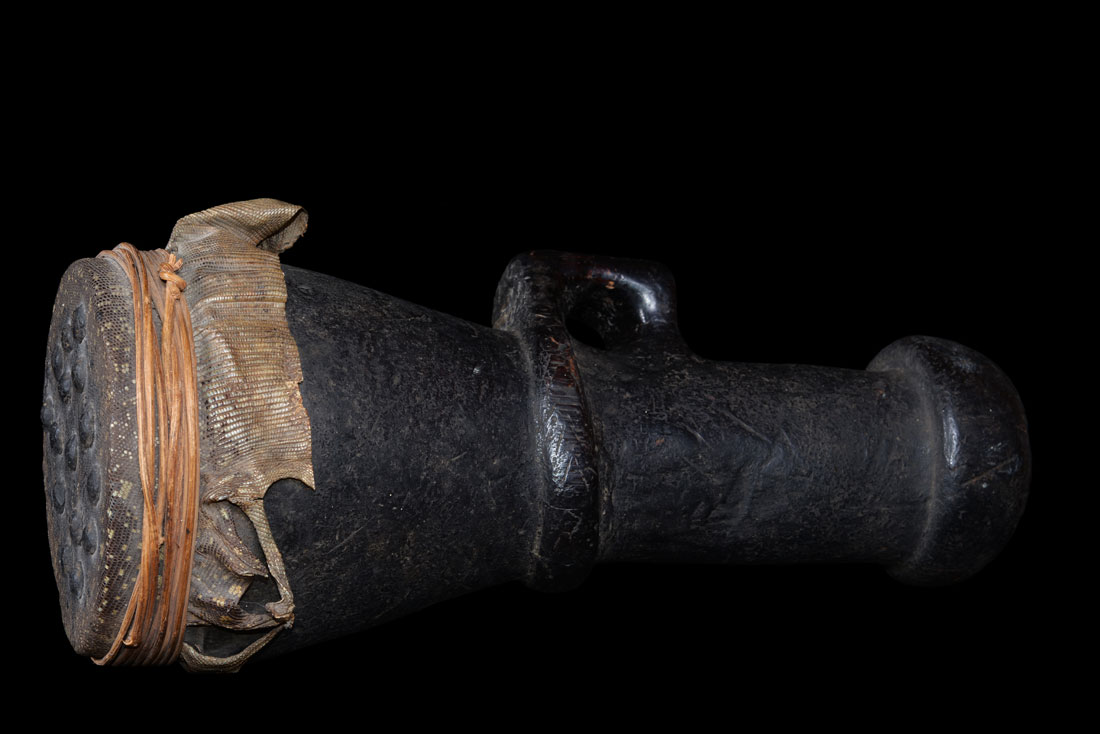
The drum is played while held in one hand, with the other hand striking the lizard-skin membrane. The tension of the drumhead is an important part of its sound production. Historical descriptions record the use of beeswax applied to the membrane to modify the sound, while heating the skin over a fire was used to restore its tension when it became slack during performance.
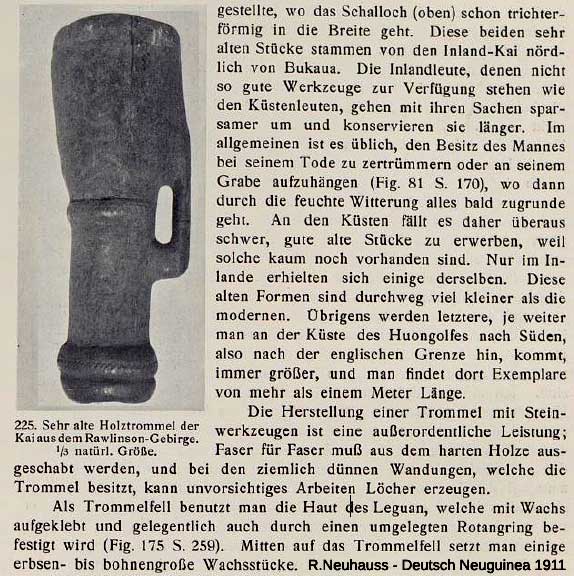
The manufacture of such drums required considerable woodworking skill. Historical evidence from neighbouring regions of northeastern New Guinea demonstrates that particularly old examples could be produced with stone tools. Neuhauss describes the manufacture of a drum from hard wood as an exceptionally demanding task, in which the interior had to be hollowed out fiber by fiber. The relatively thin walls of the finished instrument made the work especially difficult, since careless working could easily perforate the wood. His description provides an important historical insight into the technical knowledge required to produce these instruments before the widespread introduction of metal tools.
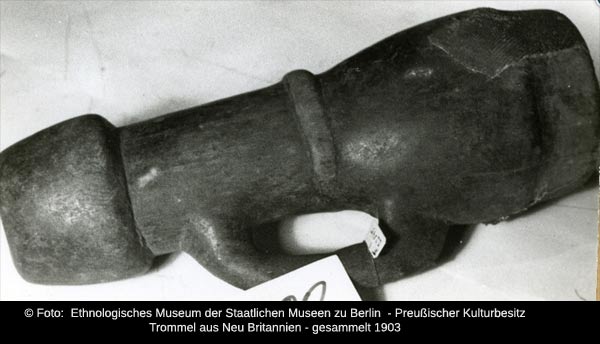
Neuhauss also recorded that older drum forms were generally smaller than later examples and that larger forms became increasingly common farther south along the Huon Gulf coast. Although his illustrated example was attributed to the Rawlinson Mountains rather than New Britain, its form provides an important comparative document for the development of the wider New Guinea hand-drum tradition. A separate historical specimen in the Ethnologisches Museum Berlin, collected in New Britain in 1903, demonstrates the presence of closely related drums on the island at this early date.
The drumhead was traditionally made from lizard skin. Historical descriptions record that the skin could be fixed with wax and additionally secured by a rattan binding. Small pieces of wax were placed on the membrane and served to influence the acoustic qualities of the drum. These details illustrate the sophisticated practical knowledge involved in preparing and maintaining the instrument, in which the materials themselves were carefully selected and manipulated to achieve the desired sound.
The present drum is particularly notable for its strongly developed dark patina and the carefully worked wooden body. The combination of the characteristic hand-held form, the pierced handle and the preserved lizard-skin membrane places the instrument within a long-established New Guinea tradition of carved drums. As both a musical instrument and a work of indigenous woodcarving, it represents the close relationship between sound production, craftsmanship and ceremonial practice in the region.
"The skins of the lizards were simply dried and, without any further preparation, rolled up in a bamboo tube. Before use, the skins were softened in water, stretched tightly over the opening of the drum and firmly bound at the rim; the edge hanging out under the binding was pulled from all sides until the drumhead became evenly taut. First, however, the rim of the drum was smeared with the juice of a tree which glued the skin securely to the wood on drying. Another important material was the wax supplied by the stingless Trigona bees, pea-sized pieces of which were rolled and stuck to the drumhead. If these wax pieces were hit, the drum gave a pleasanter sound. During the dance every man had a nut-sized piece of wax stuck to the handle of the drum, to replace pieces which came off. If the skin began to sag during the dance, it was warmed at the fire to make it taut again, and it was occasionally beaten to tune it."
Bodrogi, Tibor (1961), Art in North-East New Guinea, pp. 79–81. Budapest: Hungarian Academy of Science.
"...gestellt, wo das Schalloch (oben) schon trichterförmig in die Breite geht. Diese beiden sehr alten Stücke stammen von den Inland-Kai-Nördlich von Bukaua. Die Inlandleute, denen nicht so gute Werkzeuge zur Verfügung stehen wie den Küstenleuten, gehen mit ihren Sachen sparsam um und konservieren sie länger. Im allgemeinen ist es üblich, den Besitz des Mannes bei seinem Tode zu zertrümmern oder an seinem Grabe aufzuhängen (Fig. 81 S. 170), wo dann durch die feuchte Witterung alles bald zugrunde geht. An den Küsten fällt es daher überaus schwer, gute alte Stücke zu erwerben, weil solche kaum noch vorhanden sind. Nur im Inland erhielten sich einige derselben. Diese alten Formen sind durchweg viel kleiner als die modernen. Übrigens werden letztere, je weiter man an der Küste des Huongolfes nach Süden, also nach der englischen Grenze hin, kommt, immer größer, und man findet dort Exemplare von mehr als einem Meter Länge. Die Herstellung einer Trommel mit Steinwerkzeugen ist eine außerordentliche Leistung; Faser für Faser muß aus dem harten Holze ausgeschabt werden, und bei den ziemlich dünnen Wandungen, welche die Trommel besitzt, kann unvorsichtiges Arbeiten Löcher erzeugen. Als Trommelfell benutzt man die Haut des Leguan, welche mit Wachs aufgeklebt und gelegentlich auch durch einen umgelegten Rotangring befestigt wird (Fig. 175 S. 259). Mitten auf das Trommelfell setzt man einige erbsen- bis bohnengroße Wachsstücke."
Neuhauss, Richard (1911), Deutsch-Neu-Guinea, Vol. II. The illustrated passage refers to a very old wooden drum from the Rawlinson Mountains.
Historical comparison: The photograph of the drum collected in New Britain in 1903 is preserved in the Ethnologisches Museum, Staatliche Museen zu Berlin – Preußischer Kulturbesitz. A related historical form is illustrated by Richard Neuhauss in Deutsch-Neu-Guinea as a very old drum from the Rawlinson Mountains.
Lender: The Wagner Family
Bibliography:
Bodrogi, Tibor (1961): Art in North-East New Guinea. Budapest: Hungarian Academy of Science.
Dark, Philip J. C. (1974): Kilenge Art and Life. London: Academy.
Finsch, Otto (1888): Reisen in Kaiser Wilhelms-Land und Neu-Guinea an Bord des Dampfers Samoa.
Finsch, Otto (1888): Ethnologische Erfahrungen und Belegstücke aus der Südsee: beschreibender Katalog einer Sammlung im K.K. Naturhistorischen Hofmuseum in Wien.
Heermann, Ingrid (2001): Form Colour Inspiration: Oceanic Art from New Britain. Arnoldsche Verlagsanstalt.
Neuhauss, Richard (1911): Deutsch-Neu-Guinea. Vol. 1–3. Dietrich Reimer / Ernst Vohsen, Berlin.
Newton, Douglas (1999): Arts of the South Seas.
Parkinson, Richard (1999): Thirty Years in the South Seas. Translation by John Dennison of Dreissig Jahre in der Südsee (1887).