New Guinea
Abelam Tumbuna Drum New Guinea
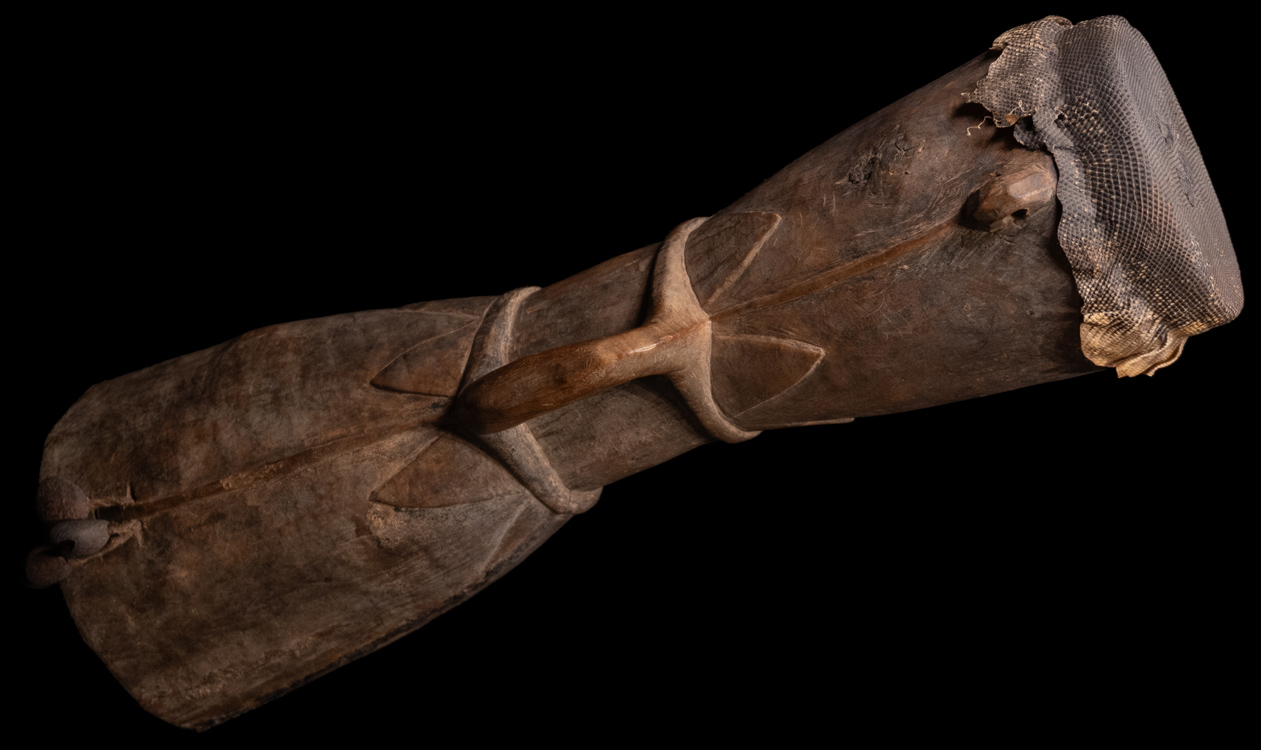
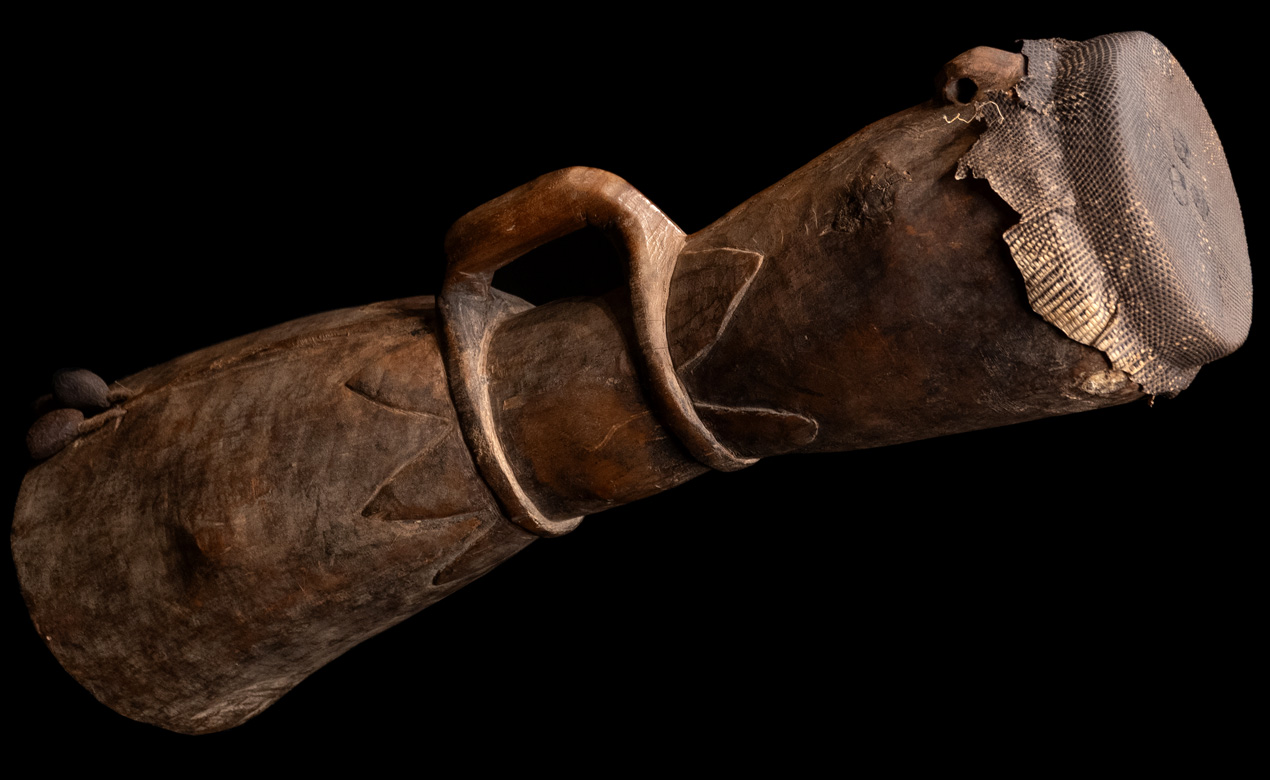
Abelam Tumbuna Drum (Abelam, New Guinea, Papua New Guinea)
The Tumbuna drum belongs to the traditional musical culture of the Abelam of the East Sepik region of New Guinea. Drums occupy an important position in Abelam ceremonial life and are used particularly during initiation ceremonies, yam festivals and other communal events. In these contexts, drumming and singing form part of performances through which ancestral traditions, social relationships and cultural knowledge are expressed.
The present drum measures approximately 80 cm in height and is carved from a single piece of wood. Like other traditional Abelam drums, it was shaped and hollowed by hand. The instrument is designed to be held by its central handle while the other hand strikes the drumhead. The membrane is traditionally made from lizard skin. When necessary, the tension of the skin can be restored by warming it over a fire, thereby raising the pitch.
Unlike many Abelam drums whose surfaces are covered with elaborate painted or carved ornament, this example is comparatively restrained in its decoration. Its artistic character derives instead from the carefully shaped wooden body and, above all, from the unusual central handle. The handle projects prominently from the narrow waist and forms a strong sculptural element within the otherwise relatively simple construction.
The unusual form of the handle creates an almost organic impression. Its curved, swelling shape can evoke the appearance of a stylized limb or animal form, although no specific representation or symbolic meaning can be established with certainty from the available documentation. This ambiguity is part of the artistic interest of the object: the functional handle has been transformed into a distinctive sculptural feature.
The drum illustrates an important characteristic of Abelam material culture, in which practical objects may simultaneously possess a strong visual and sculptural presence. Its restrained ornamentation, carefully worked wooden surface and striking handle demonstrate that artistic expression does not necessarily depend on dense decoration, but can also emerge from proportion, carving and the transformation of functional elements into expressive forms.
In ceremonial use, the Tumbuna drum belongs to the wider tradition of Abelam music in which rhythmic performance accompanies dancing, singing and important communal events. The instrument therefore connects the practical function of a membranophone with the social and ceremonial life of the community.
Bibliography:
Koch, Gerd: Kultur der Abelam – Die Berliner Maprik-Sammlung.
Maaz, Klaus: Abelam – Die magische Welt der Abelam. Kunst und Kult in Papua-Neuguinea.
Hamson, Michael (ed.): Art of the Abelam. Contributions by Siobhan Campbell, Laurent Granier, Virginia-Lee Webb and Diane Sheehan.
Craig, Barry; Busse, Mark; Eoe, Soroi (2010): Living Spirits with Fixed Abodes – The Masterpieces Exhibition. Papua New Guinea National Museum and Art Gallery.
Fischer, Hans (1958): Schallgeräte in Ozeanien. Sound-producing Instruments in Oceania.